EKIP– Expert Club for Economics and Politics A Different Opinion

Author: William Griggs, the article is translated from the author's blog
In August 1914, in an episode of unprecedented recklessness, the Great Powers of Europe launched a full-scale war against each other. Germany, a rising military power with great ambitions, swept through Belgium in search of a quick checkmate against France before Russia could mobilize on the Eastern Front, thus eliminating the risk of a two-front war. Thousands of young Germans filled trains bound for the front and, anticipating a six-month conflict, sang an optimistic refrain: " Ausflug nach Paris. Auf Widersehen auf dem Boulevard.", translated as "Excursion to Paris. See you again on the Boulevard."
The French, meanwhile, were eager to avenge the loss of Alsace and Lorraine, which had been taken from them by Germany in 1870. The British government, which had until then been suspicious of Germany's growing power, mobilized hundreds of thousands of young men to "teach the Huns a lesson." British historian Simon Rees wrote that "millions of active servicemen, reservists, and volunteers... rushed enthusiastically to the war banners... the atmosphere was more like a celebration than a military conflict."
Each side expects the conflict to be over by Christmas. But as December approaches, the warring parties find themselves stuck in the trenches of the Western Front – a static trench line hundreds of kilometres long, cutting across parts of France and Belgium. At some points along the front, the warring parties are separated by less than 100 paces. Their primitive redoubts are little more than large pits dug in the muddy, white-grey soil. Ill-equipped for the winter, the soldiers quench their thirst with slightly salty water.
The intervening territory, called "No Man's Land" by the belligerents, is awash in the hideous remains of war - spent ammunition buried in the lifeless bodies of those on whom it was spent. The dead remains of many of the slain soldiers are grotesquely entwined in the webs of barbed wire. Villages and homes are reduced to ruins. Abandoned churches have been converted for use as military bases.
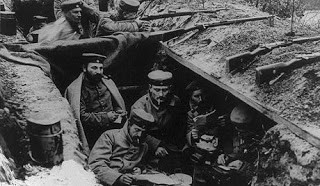
As casualties mounted and a stalemate established, the war mania began to recede from the consciousness of both sides. Many of those pressured to join the Western Front did not succumb to their initial bloodlust. Hindus and Sikhs from India, as well as Gurkhas from the Himalayan kingdom of Nepal, fought alongside French, Belgian, and British troops.
Colonial conscripts were transported from their homelands thousands of miles away and sent to the trenches set in Belgian winter gardens. There were also Scots at the Front, proudly dressed in their traditional kilts despite the bitter December cold.
The German troops were led by elite Prussian officers, representatives of the warlike Junker aristocracy. The German rank and file included Bavarian, Saxon, Westphalian, and Hessian reservists, many of whom had lived—or even been born—in England and spoke perfect English. Despite Bismarck's attempts to unite the fragmented German principalities, many German soldiers remained far more attached to their local communities than to the abstract German nation.
Brothers in arms
Cold-blooded in muddy ditches, drenched in freezing rain, and surrounded by the smoldering remains of their comrades, soldiers on both sides maintained grim military discipline. On December 7, Pope Benedict XV requested a temporary cessation of hostilities for Christmas. This proposal met with little enthusiasm from political and military leaders on both sides of the Front. But the exhausted troops had a different opinion.
On 4 December the commander of the British Second Corps sent a message in which he noted with disappointment the "live-and-let-live" mood that was beginning to pervade the Front. Although there was no explicit fraternisation between the belligerents, the lack of initiative in initiating attacks on the enemy was evident. Neither side fired on the other during meals, and friendly remarks were often exchanged by shouting across No Man's Land. A letter published by Andrew Todd, a Scot from Edinburgh and part of the Royal Engineers, stated that "the soldiers on this part of the front, separated by only 60 yards in one place... (have become) very 'friendly' with each other".
Instead of throwing lead at their opponents, troops sometimes threw newspapers (tied to stones) and tins of provisions across the front line. Barrages of insults and curses were also sometimes exchanged, but usually in a tone "that contained less vitriol than between London taxi drivers after a minor street fight," says Leslie Walkinton of the Royal Westminster Infantry.
As December progressed, the fighting spirit of the front-line troops faded more and more. As Christmas approached, scattered and rare expressions of goodwill between enemies became more frequent. About a week before Christmas, German troops near Armentier managed to smuggle a chocolate cake across the front line to their British enemies. Along with it, they sent a remarkable invitation that read:
"We propose to hold a concert this evening, in view of the fact that it is our Captain's birthday, and we respectfully invite you to attend - provided you give us your word of honor that as guests you agree to cease hostilities between 7:30 and 8:30... When you see us lighting candles and lanterns on the edge of our trenches at 7:30, you may safely peek your heads over the trench, we will do the same and the concert will begin."
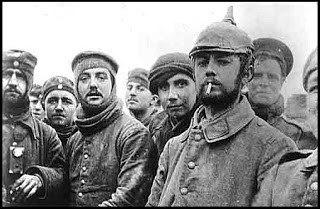
The concert takes place on time, and the intoxicated German soldiers sing "like carolers," according to one witness. Each song they sing is greeted with enthusiastic applause from the British troops, prompting the Germans to invite the English to sing along. One British soldier brazenly shouts, "We'd rather die than sing in German." This biting comment is met with a benevolent response in the same tone from the other side, "We'd die if we heard you." The concert ends with an enthusiastic rendition of "Die Wacht am Rhein" and is marked by several warning shots fired into the sky, signaling that the brief pre-Christmas truce is over.
Elsewhere on the front, soldiers negotiate about the collection of their fallen comrades and the provision of burials for them.
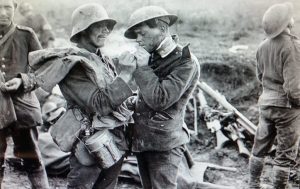
In a letter to his mother, Lieutenant Geoffrey Heineke of the Royal Westminster Infantry described how this happened on December 19. "Some Germans came forward with their hands in the air and began to collect some of their wounded, and then we immediately came out of the trenches and began to collect ours," he recalled. "The Germans then asked us for help and many of us went to them and then they helped us to bury our dead. This went on all morning and I talked to some of them and I must say they seemed like perfectly pleasant men... It seems very ironic. We had had a terrible fight the night before and the next morning they were smoking our cigarettes and we were smoking theirs."
Football in No Man's Land
Soon, rumors began to circulate on the front lines about a formal cessation of hostilities in honor of Christmas. The idea again met with resistance from above. Historian Stanley Weintraub commented in his book, Silent Night: The Story of the Christmas Truce in World War I:
"Most of the officers turned a blind eye to the fragmented episodes of cohesion that had occurred earlier. A Christmas truce, however, was another matter. Any delay in action during Christmas week could undermine the fighting spirit and willingness to sacrifice among troops who were already lacking ideological motivation. Despite the efforts of propagandists, German reservists showed little hatred for their enemies. Convinced that they should hate the Germans, British soldiers were not convinced that the French and Belgian lands were worth sacrificing for. Rather, both sides fought as soldiers fight in most wars anyway - for survival and to protect the men they had come to feel were part of their family.
In a sense, the war itself was fought within the same family, for both Kaiser Wilhelm II of Germany and King George V of England were grandsons of Queen Victoria. More importantly, the warring nations were all part of Christendom. The irony of this was particularly evident to those who were forced to spend Christmas at the Front.
By Christmas Eve, the German side of the Front was already illuminated by the glow of "Tannenbeume" - small Christmas trees, sometimes set up under fire by soldiers determined to pay their respects to the holy day. "To most British soldiers, the German obstinacy in celebrating Christmas was a shocking sight in view of the propaganda about Teutonic bestiality, and for their part the Germans had long considered the British, as well as the French, to be soulless materialists, incapable of appreciating the spirit of the Christmas festival," writes Weintraub. "Considered by the French and British as heathens - even savages - no one expected the pragmatic Germans to risk their lives for every "Tannenbaum". Yet when some of them were felled by enemy fire, the Saxons on the opposing (British) line doggedly climbed the trench parapets to erect the trees."
The glow of Christmas trees reminds some Indian soldiers of the lanterns used in the celebration of the Hindu "Festival of Lights." Some of them must be puzzled by the fact that they must freeze, malnourished, face a lonely death thousands of miles from their homes as soldiers in a war between Christian nations. "Don't think this is war," one Indian soldier wrote to a relative. "This is not war. This is the end of the world."
But on both sides of the fratricidal conflict there are souls who are determined to preserve at least the good morals of Christianity even in times of war. As Christmas approaches, German Saxon troops begin to shout to British soldiers across the front: "Merry Christmas, English!"
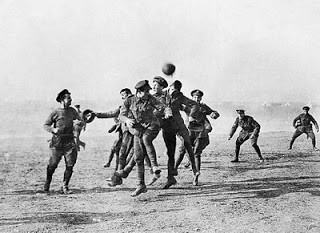
A sudden frost freezes the entire battlefield during the holiday, which is actually a welcome relief for the troops, who have been constantly trudging through mud. All along the Front, soldiers emerge from their trenches and head towards each other across No Man’s Land, at first with slight trepidation, but then with excitement. Greetings and handshakes are exchanged, and gifts from families back home are opened. German souvenirs that could otherwise only be acquired after bloodshed – such as the standard German pickelhaube spiked helmets, or buckles with the inscription Gott mit uns – are traded by the English for British trinkets. Christmas carols are sung in German, English and French. Unarmed British and German officers line up side by side and take group photos in No Man’s Land.
On the front near Ypres, Germans and Scots were hunting rabbits to cook for the festive Christmas dinner. Perhaps it was the excitement of chasing rabbits that inspired some of the soldiers to organize a football match. In any case, it took young, ambitious men – many of them English youths recruited from the football fields – little to inspire them to organize a match. In a number of letters sent from the Front, we find evidence that on Christmas Day 1914, German and English troops were playing football on the frozen ground of No Man’s Land.
British artillery lieutenant John Wedderburn-Maxwell described what happened as "probably the most extraordinary event of the whole war - a military truce without any orders from officers or generals..."
Sainsbury's advertisement dramatizing events on the Western Front during Christmas, 1914.
This is not to say that what has happened is met with unanimous approval. Here and there, occasional skirmishes across the Front remind the celebrants that the war is still going on. From his outpost behind the front line, "a pale soldier with a haggard face covered by a thick, dark moustache and sunken eyes" watches with disdain the spontaneous outburst of Christmas camaraderie. The German field courier of Austrian descent showers his comrades, who are exchanging Christmas greetings with the British, with scathing comments. "Such things should not happen in wartime," snarls Corporal Adolf Hitler. "Have you no German honour left?"
"Hitler's reaction was not provoked by patriotic scruples alone," Weintraub writes. "Although baptized Catholic, he rejected all expressions of religious tradition while his detachment celebrated Christmas in the cellar of the Messenian monastery."
What if...?
In its report on the Christmas Truce, published on January 2, 1915, the London newspaper Daily Mirror said that the "gospel of hate" had lost its persuasiveness for soldiers who had met at the Front.
"The soldier's heart rarely harbors any hatred," the newspaper commented. "The soldier goes to fight because that is his job. What precedes it - the reasons for the war, questions like how and why it came to this - does not particularly concern him. He fights for his country and against its enemies. Collectively, they must be branded and torn to pieces. Individually, he knows that they are not bad people."
"Many British and German soldiers, as well as front-line officers, looked upon each other as gentlemen and men of honor," Weintraub writes. The rank and file began to understand that the man on the other side of the rifle was not the soulless monster depicted in ideological propaganda, but rather a frightened and desperate man who wanted more than anything to see his family again. For many of the soldiers on the Front, this reality was illuminated by the glow of German Christmas trees.
In the shared symbol of the Christmas tree—an ornament of pagan origin borrowed by Christians centuries ago—British and German soldiers found “a sudden and remarkable connection between themselves,” noted British author Arthur Conan Doyle after the war (in which his son died). “It was such a remarkable sight,” Doyle said, “that it must stir bitter thoughts against the high-ranking conspirators against world peace, who in their mad ambition forced such men to seize each other by the neck instead of by the hand.”
In a remarkable letter published by The Times of London on January 4, a German soldier said that "as the wonderful scenes in the trenches (at Christmas time) show, there is little malice on our part, and none on the part of many of those sent against us." But this certainly did not apply to those who orchestrated the war, "the high-ranking conspirators against the peace of the world." As British historian Neil Ferguson points out, the global plans of the rulers responsible for the war called for "the greatest possible bloodshed at the lowest possible cost."
An informal truce was maintained over Christmas and in some parts of the front line during the following day (known as "Boxing Day" to British units). But before New Year's the war was renewed in full vicious fury and the suicide of Christendom continued in full force.
Most wars are mindless exercises in mass murder and unnecessary destruction. World War I, however, is notable not only for being an unjustified war that could easily have been avoided, but also for its role in opening the gates of hell. The mass starvation and economic misery inflicted on Germany during and immediately after the war gave birth to the National Socialist (Nazi) movement. A nearly identical catastrophe befell Russia and led to the rise of Lenin and the Bolsheviks to power. Benito Mussolini, a socialist agitator who was at one point considered Lenin's successor, rose to power in Italy. Radicals of intolerant totalitarian nationalism swept across Europe. The seeds of future wars and terrorism were sown deep in the Middle East.
What would have happened if the Christmas Truce of 1914 had held? Perhaps negotiations for a full armistice would have been initiated, saving Christendom from ruin for a little while longer? We cannot know. It is doubtful whether the "high-ranking conspirators against world peace" would have been long thwarted in the pursuit of their mad schemes. But the truce—a welcome expression of fellowship amid the symphony of destruction—illustrates an age-old truth about the nature of the human soul as sculpted by the Creator.
Reflecting on the Christmas Truce, Scottish historian Roland Watson wrote: "The state shouts the orders 'Kill! Carve! Conquer!' but a deeper instinct in the individual's mind does not allow him so frivolously to put a bullet through someone who has done him no harm, and rather makes him ask himself with him, 'What am I doing here?'"
For a tragically short time, the Spirit of the Prince of Peace silences the murderous whims of the State.