EKIP– Expert Club for Economics and Politics A Different Opinion
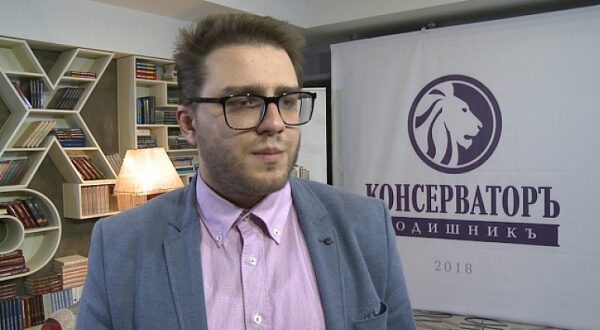
The website of the “Conservator” is empty. At the time of writing this text, the most recent articles on the main page were uploaded at most three days ago. None of the five were written for the site – they are all reprints.
To the extent that there are still people who are making efforts for “Conservator”, they are mainly focused on making the platform seem alive, even though it is not. Four years after its creation, “Conservator” is trying to preserve its existence above all. The lack of any authorial content is only a symptom – of the hundreds of people who participated at the beginning in 2017, only a few remain. And not one of them can be called a representative of a “supra-party platform”.
The detailed history of “Conservatori”, originally “Misul”, is worth examining, but this task requires real journalistic resources. The short version goes like this: in 2017, immediately after the parliamentary elections, the huge disappointment with the lack of a “true right-wing party” in the then new National Assembly gave rise to a desire to create a “right-wing platform” - words that still stand next to the name of “Conservatori” today.
Between ideology...
If we conditionally divide politics into two – party politics and ideological politics, then “Conservator” was and to some extent still is a place where only the second part is discussed. And because in Bulgarian politics ideological disputes are more or less limited to communism and anti-communism (the remaining ideological disputes are now rather historical), “Conservator” tried from the very beginning to talk mainly about international ideological disputes, to present them in a Bulgarian context, and to warn that sooner or later everything that happens in the West will also happen in the country.
This is understandable. In 2016, 2017 and 2018, practically everyone was talking about ideology. Words like “populism”, “conservatives”, “liberals”, “left”, “right”, “far-right”, “ultra-left”, etc. rained down in every text, without anyone understanding the problem that none of these words had a specific meaning and definition, respectively, funny and not so funny situations arose in which some people insulted others as “liberals”, but at the same time explained to them that they were not real liberals, because the real liberals were them, but they were not really liberals either, because they were conservatives.
The fatigue from writing and talking about ideology came mainly from repeating the same thing. At every event in Bulgaria, Europe or the USA, the same authors wrote the same theses and warned about the same things. Whether the readers decreased first or the number of authors decreased first is an open question, but today “Conservator” practically does not have a single author – it only has those who have given it permission to reprint their materials for other publications.
...and the party
Meanwhile, “Conservator” moved into the other field – the party field. It did so in two ways. First, it took money from party activists, or more specifically, Alexander Toshev-Johnny, a close friend of Tsvetan Tsvetanov and organizer of GERB’s physical campaigns, who paid about 15 thousand leva for the publication and advertising of the first collection “Anniversary”. If you have wondered how a site that does not generate profit can get such money for a boutique edition and several dozen billboards in the center of Sofia – the answer is not from money for snacks, which is the explanation that the creator of “Conservator” Nikolay Oblakov generally gave at the time.
In addition to funding, “Conservator” also entered party politics in a very literal way. First, Kristiyan Shkvarek, perhaps the best-known face of the platform, became a candidate for MEP from VMRO in 2019, and then others followed him – Nikolay Oblakov became an assistant to GERB MEPs, Kuzman Iliev ran for MP from VMRO (after previously being expected to be part of GERB, along with his partner Vladimir Sirkarov). Both Iliev, Oblakov, and other names from “Conservator”, such as Mihail Krastev and Nikola Filipov, met directly with Prime Minister Boyko Borisov and then Finance Minister Vladislav Goranov.
In all likelihood, at least some of them will be candidates for deputies in the elections on July 11 – Nikola Filipov, for example, hinted that he would be part of the GERB civil quota after his attendance at the party meeting in August 2020, but in the end Borisov decided not to include a single representative from “Conservator” in his lists. According to rumors, which can only be partially confirmed, the reason is Georgi Harizanov’s inability to ensure the participation of Ivaylo Tsvetkov-Noizi in the list. Again, according to rumors, Noizi will probably still be a candidate in the elections in July, and with him the chances of representatives from “Conservator” are also increasing.
What was it all about?
“Conservator” was born out of the disappointment of the lack of a “true right-wing party” in the National Assembly, after which all active members and individuals on the platform became part of parties from the government created by the same parliament. The ideology remained only in the texts, while the party politics turned out to be far more interesting. If they had stayed in the field of ideology, the people from “Conservator” would probably have supported Petar Moskov’s KOD – the ideologically closest to the description of a “true right-wing party” in the authors’ texts.
The collapse of “Conservator” as an interesting media project will most likely be reflected in the electoral weight of the platform’s members. Kristiyan Shkvarek managed to collect over a thousand preferences in 2019, but in a national vote (and with a rather questionable high turnout for him in the village of Bahovitsa, Lovech). Kuzman Iliev collected only 646 preferences in the two largest MIRs in the country. No matter how small this weight is, it will actually turn out to be even smaller if they, Oblakov, Krastev, Sirkarov, Noizi, Stoyan Radev and all the other “ideological” candidates are on the ballots at the same time – the audience for them is simply too small.
Last but not least, the “Conservative” is no longer the cool kid on the block, i.e. on the internet. The people on the platform are no longer the ones making fun of, but the ones being made fun of. And for good reason – the transition from ideological moral stalwart to third-rate party activist rarely wins applause.
The final confrontation with reality will come with the election campaign, when the same people who still occasionally complain that the parties do not speak in a language that people understand and are not interested in their real problems will have to explain to ordinary voters exactly how they intend to fight cultural Marxism, crypto-communism, ecumenism and schism. In other words – the hot topics in the everyday life of every Bulgarian.