EKIP– Expert Club for Economics and Politics A Different Opinion
The short answer is because, despite all the banditry spreading throughout the country, for the past nearly 12 years the government has been unwaveringly implementing the agenda of the Berlin-Brussels-Paris axis. This so-called agenda generally consists of centralization and transfer of sovereignty (the so-called European integration), granting artificial competitive advantages to industries/countries with strong lobbies in Brussels, and importing certain ideological models popular in the West. In short – expanding the power of the Union and the political-bureaucratic caste that governs it.
In fact, the EU not only ignored the transgressions of the Borisov regime, but also actively supported and subsidized them from its very conception in the offices of the Hans Seidel and Konrad Adenauer Foundations. It is no coincidence that the billions in cohesion EU funds were called “life-saving blood in the veins of the mafia” by none other than an otherwise openly pro-EU politician like Hristo Ivanov. EU funds in our country play the same role for the GERB regime as the significant deposits of natural resources in Russia do for the Putin regime – who controls the fat, controls the country (to paraphrase Frank Herbert). And where the fat comes from was told to us by Borisov himself, after he was offered an additional one in exchange for turning the euro around 180 degrees and forcibly pushing the leva into YAREM 2 and the country into the Banking Union. [1]
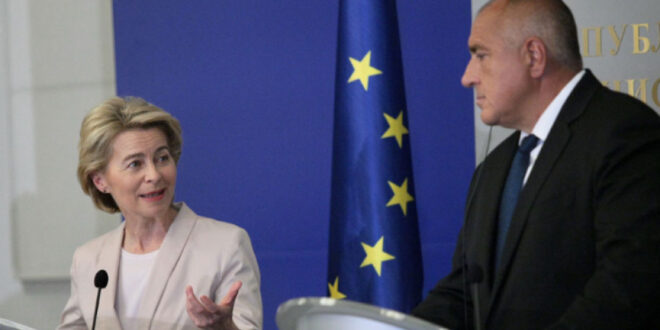
A familiar deal – you give sovereignty, you get money. The scheme works almost always, with minor exceptions. The situation with Macedonia was indicative of how exceptions happen. We have great internal resistance, we have coalition partners who will completely stop looking like nationalists if they screw up here too, we have Russian interest. The solution is postponement and more external pressure until the colonial province lowers its flags. As with the Istanbul Convention, Borisov probably had the best intention to please, but he still has to maintain power, sometimes succumbing to other interests. Despite everything we know and what is known, European commissioners continue to visit the deposed leader, and the largest party in the European Parliament directly incriminates itself, asking for a “partner like GERB”. Partner in what exactly, Mr. Weber?
Unlike the US with its control over the world’s banking systems, the EU has another channel of action, namely through the euro. As with Oresharski, it would have been easy to temporarily suspend the tranches “until the rule of law issues are resolved,” leading to an immediate change in the structure of incentives guiding the regime. This was not done, firstly, because of Borisov’s obedience, and secondly, because it would have exposed the country’s pathological political and economic dependence on the euro.
Like a backward African country, our elite and a significant part of the economy have become addicted to international aid. For Brussels, exposing these dependencies is a serious obstacle to the project of eliminating nation-states within the EU. The cession of independence must happen quietly so as not to arouse protective patriotic sentiments. In fact, stopping payments to regimes antagonistic to Brussels is significantly more difficult than to obedient ones like the Bulgarian one. The reason is that such a scenario could be played out by Orban (for example), in the direction of a new exit, setting off centrifugal processes dangerous for the Eurocrats throughout the continent. While our “Euro-Atlantics” will have to obey. Therefore – more gifts for the former rulers.
Thus we arrive at the increasingly paradoxical nature of the EU, which grows and takes over more and more of the independence of its member states, and at the same time becomes increasingly fragile and prone to unexpected collapse. Like the late Borisov regime, power in the Union is held through monetary dependencies that become harder to finance with each crisis (see the growth in the ECB balance sheet and debt levels in the eurozone) and through a fabricated reality of belonging to the center that becomes harder to watch without laughing (see the billions for media, Erasmus, Eurovision, etc. propaganda). Unaccountable power without responsibilities inevitably becomes the kernel of future problems.
The conflicts arising from the structure described above will define the main political debates in the next decade, including in Bulgaria. Until then, without taking into account the role of the EU in what has happened over the past 12 years, we will not be able to answer the question of how
Let's not get to this point again. The rose-colored glasses should have been taken off during the summer protests.
[1] Banking Union, which has been ignoring the Bulgarian National Bank for the ninth month, for example