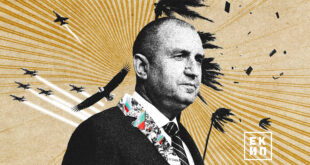
EKIP– Expert Club for Economics and Politics A Different Opinion

"I was a young lieutenant in the fire department back then. They mobilized us and sent us to Dulovo. Hundreds of thousands of Bulgarian citizens and Bulgarian Muslims were expelled by this same communist party, now called socialist. And I don't know how our opponents from the MRF agree to form a coalition with the former communists who haven't given up... They're celebrating their fortieth congress? Here, people were lined up for passports. They were given one square meter to load up on for household goods. Thousands of people! There's nothing worse than what the communists did to us."
The author of the joke is Boyko Borisov, the date is June 30, 2021. In less than two weeks, elections are coming up. The leader of GERB, which ruled the country for 12 years (with one interruption and several not-quite-interruptions), can hardly cope with the agenda imposed by everyone else and which includes all his transgressions over the years, so he decided to make his own. And he spoke again about the Revival Process.
It's not his first time. He has done it many times in the past, far from with today's pathos and theses. "It's not the goals, but the methods of the Revival process that are vicious and deserve criticism. It should have been very consistent, as in the USA, that the first name of the newborns should be Bulgarian, a list is given, as it is there, the surnames of the fathers and grandfathers, respectively," Borisov said in a 2008 interview on bTV.
In fact, the great irony is in another statement he made a few days later. After being severely criticized, including by Georgi Parvanov and Sergey Stanishev, Borisov stated that “the topic of the Revival Process diverts attention from corruption.” It took 13 years for the wheel to turn completely and for Boyko Borisov to talk about the Revival Process to divert attention from corruption.
Borisov's endless attempts to present himself as an opposition to the "communists", however, raise a bigger question: if Boyko Borisov is not a communist, then who is? And what determines whether you are a communist? Party affiliation, ideology or actions? In all three, by the way, Borisov meets the requirements.
Borisov correctly remembers that he was a junior lieutenant at that time, which is strange, because his memory usually fails him so much that he does not remember whether his grandfather was a communist or a tsarist officer. It is good to remember another thing – whose party he was a member of at that time. As expected, this is a rhetorical question – he was a member of the Bulgarian Communist Party. In 1991, when the Ministry of Internal Affairs was undergoing depoliticization, he left the ministry. Not the party, but the ministry, because the party is more important. This is also an important moment, because a quarter of a century later Borisov will say that the UDF was “our party when we were little”.
We leave aside his career as a bodyguard for Todor Zhivkov, whom he defines as one of his two universities, along with Simeon Saxe-Coburg-Gotha. It is a separate scenario, because Borisov somehow manages to distinguish in front of his electorate the “communists” on the one hand and Zhivkov on the other – the man who ruled the regime for 35 years. The communists are bad, but “one hundredth of what he built for Bulgaria and what has been done in these years to achieve the economic growth of the country at that time would be a huge success for any government.”
Of course, the question of what it means to be a communist could be explored in at least several thousand pages, and yet there would be no unambiguous answer, because all countries would give a different definition.
Absolutely the same applies not only to communists, but also to fascists, democrats, liberals, conservatives, etc., simply because there is no central unit that says what it means or does not mean to be a communist, a fascist and a democrat, nor is there a specific definition that everyone agrees with down to the last detail. Along with “left”, “right” and so on, these are empty terms, where everyone has different conditions for their implementation and when a hundred people hear them, they imagine a hundred different things. Moreover – if 100 years ago the people who called themselves or were called “liberals”, for example, had radically different views than those 50 years ago or today, perhaps it is time to expand the vocabulary.
But specifically in the Bulgarian context, we can clearly say that if being a former member of the Bulgarian Communist Party, a former bodyguard of a communist dictator, and a supporter of achieving the basic postulates of communism does not make you a communist, then this word has no specific meaning. In other words: if Boyko Borisov is not a communist, then no one is.