EKIP– Expert Club for Economics and Politics A Different Opinion
Different views on the (re)structuring of society are promoted with different labels. Probably the most widely used are left and right. They should briefly explain the essence of proposed reforms and policies, and help identify the political opponent.
In this text, we will read the views of a Bulgarian “right-wing” from the 1930s and early 1940s through “left” glasses. For the left, the root of social evils lies in capitalism and private property. The questions to which an answer is sought are: do left-wing ideas differ from right-wing ideas and is the extreme right diametrically opposed to the left? Since ideas do not exist in a sterile environment, we will first outline the general situation in the country.
The overall picture in Bulgaria
In the early 1930s, the market-oriented sectors of the Bulgarian economy were devastated by the Great Depression. Export opportunities shrank dramatically. Before the depression, easy loans were given out, which became uncollectible in times of crisis. Gradually, Germany emerged as the most important buyer of Bulgarian products. Attempts to break out of its orbit ended in failure. State regulation intensified in the Bulgarian economy. Currency controls were imposed, the state bought up an increasing part of agricultural production, the banking sector was dominated by state banks. Fewer and fewer prices were market-based and increasingly determined by state authorities, a minimum wage was introduced, and free trade union association was abolished.
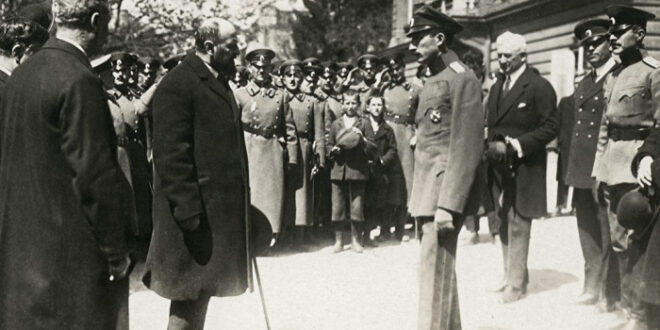
The country's political system is democratic, but democracy is unstable. In 1931, the People's Bloc coalition came to power. Disagreements between its partners were constant, which created the impression of a complete crisis of parliamentarism. On May 19, 1934, a military coup was carried out. The new rulers dissolved the National Assembly, banned parties, and limited local self-government. Hundreds of officials were dismissed from the state apparatus with the explanation that competent government was being introduced. In fact, any potential opponents of the new regime were purged. Governance smoothly passed from the coup plotters to the hands of Tsar Boris III. He did not restore the parties, but the parliament was restored. With the beginning of World War II, authoritarian tendencies deepened.
One of the motives for the coup of May 19, 1934, was the elimination of corruption. However, anti-corruption successes were minimal. Bulgarian tobacco exports were strictly controlled by the state and large trading companies provided significant amounts in their budgets for bribes to officials so that they would not hinder their trade. The administrative regulation to which bread production in Sofia was subjected gave weapons to the officials who applied it and they blackmailed the producers for bribes. The deputy from the government majority, Petar Koseivanov, benefited from the supply of wagons for the Tsar, etc.
Ideas of the ruling "right wing"
In the early 1930s, the principles of forces that were later involved in the governance of the country crystallized. In 1930, the “Declaration on the Difficult Situation of the Country and the Way Out of It” was published. Behind the banal title lies a program document of the Political Circle “Zveno”, which, together with the Military Union, carried out the coup of May 19, 1934. “Zveno” is an elitist structure of a fascist, i.e. extreme right, type. In the Declaration, the national economy is characterized as “unorganized, devoid of experienced and enlightened leadership”, it is “left to move by blind chance”, and through foreign credit institutions the fruits of national labor are exported outside the country. It is proposed to develop a “program for coordinated and expedient economic activity”, state organization of credit, and expanded social legislation.
The ideologists of the "right" coup of May 19, from the moment they appeared, subjected the market economy to left-wing criticism and envisaged the introduction of planning. The difference from the classical Marxist left is that the aspiration for social justice is not universal, but is focused on the Bulgarian nation, whose labor is being robbed by international capital.
The "right" ideological evolution can be traced in the magazine "Nation and Politics", which began to be published in 1936. One of its creators was the lawyer Dr. Nikola Minkov. On the pages of the periodical, he formulated his ideological beliefs. In 1936, Dr. Minkov wrote that the aspiration of his like-minded people was to achieve social justice and popular government. To this end, labor must be protected "before capital", "capital, voluntarily or forcibly" must be harnessed and serve the general welfare, those who cause unemployment must be persecuted, those who hide profits must be expelled from the country, etc. The anti-capitalist essence of the ideas presented consists in the aspiration for purposeful limitation of private property and in the preferential protection of the poor and the disadvantaged.
N. Minkov became a deputy from the government majority in the XXV Ordinary National Assembly (1940-1944), i.e. he was part of the ruling "right wing". In December 1940, in a parliamentary speech, he declared that the old capitalist world was irrevocably dying. It would be replaced by "a new socialism", which would be "national in the broadest sense of the word". Elements of socialism were state ownership of the Bulgarian National Bank, post offices, the Pernik mines, etc. The state monopoly was to encompass export trade, insurance, etc. In a synthesized form, the future Bulgarian socialism was presented as follows: "statization and monopolies of large economic entities, and cooperation in the lowlands". In August 1944, Dr. Minkov again declared in parliament that the world was moving towards socialism.
From the review, it becomes clear that during the decade from 1934 to 1944, socialist concepts were well accepted by representatives of the ruling "right".
Ideas of the opposition "right"
There is also an opposition "right wing" in Bulgaria. Sometimes it gets very close to the government, but it does not become part of it.
The most prominent representative of the opposition "right" is Professor Alexander Tsankov. A former Prime Minister and Chairman of the National Assembly, before the coup of May 19, 1934, he was the leader of the mass People's Social Movement (NSD). In the second half of the 1930s, former members of the NSD were attracted to the government, but expectations of the organization becoming a ruling party were not justified. Alexander Tsankov was an opposition deputy in the XXIV (1938-1939) and XXV (1940-1941) ONS.
In the early 1930s, Tsankov expressed the opinion that capitalism was dying out. In 1936, he visited Hitler's Germany and was impressed by its system, i.e., he was undoubtedly extremely "right-wing".
Alexander Tsankov's ideas from the second half of the 1930s and the beginning of the 1940s were expressed in public speeches, articles and parliamentary speeches. They were presented in a synthesized and thoughtful manner in his book "The Three Economic Systems. Capitalism, Communism and National Socialism", published in 1942. He predicted that capitalist Europe would have to give way to a socialist one. He took German National Socialism as the prototype of socialism. According to him, the economic crises under capitalism were the result of free market relations, and the raging Second World War would put an end to capitalism. In the new socialist system, distribution would be "based on participation and merit", private interest must be "limited and coordinated with the public". In Tsankov's words, under National Socialism, on the one hand, "the right to property is a sacred principle", but on the other, "property is in the service of the public interest and the public welfare". Without reaching the Marxist thesis of de jure nationalization of property, Tsankov supports de facto nationalization.
A prominent figure of the opposition “right” is the former Minister of War and later leader of the Bulgarian National Legions, Gen. Hristo Lukov. His interest in socio-economic problems is limited. However, in public statements from the early 1940s he praised the “German national leader for the New Europe”, for the new political and social order “freed from the greedy creeps of international capitalism”. According to Gen. Lukov, the German victory in World War II meant a new era in the structure of the world “without exploitation and with the equal right of peoples to work and live”.
Anti-capitalist sentiments and the bright socialist future are obviously close to the hearts of the opposition Bulgarian "right".
Closing remarks
It has long been known in specialized literature that there is no unity in leftist movements and organizations on issues such as religion or atheism, revolution or evolution, nationalism or internationalism, the role of the state, etc. The unifying link of all is the criticism of the capitalist system and calls for the abolition of private ownership of the means of production. It is motivated by the desire to achieve social justice. The ideological characteristics of the Bulgarian “right” of the 1930s and early 1940s show that there is an easily detectable leftist bias in them. Apparently, regardless of the labels, significant groups of society are obsessed with the fight against injustices, which they identify with underdeveloped Bulgarian capitalism. From this perspective, it seems that in September 1944 the tanks of the Red Army were executing the already issued death sentence of capitalism.
What is the significance of the historical episode discussed for today and tomorrow? The answer is banal, but it bears repeating – the road to hell is paved with (left-right) good intentions.
P. Penchev