 EKIP– Expert Club for Economics and Politics A Different Opinion
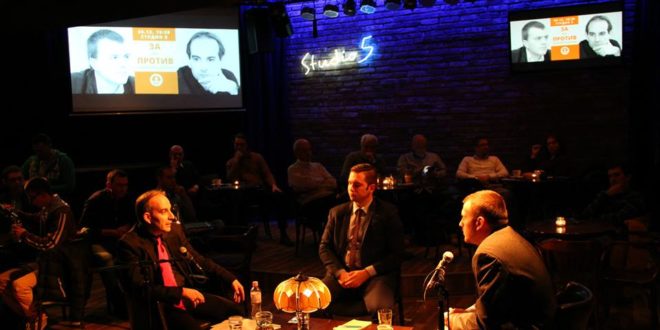
The following text is a continuation of the debate between Petar Volgin and Petar Ganev "FOR and AGAINST the social state", organized by the Bulgarian Libertarian Society. The audience at the Studio 5 club, where the clash of ideas took place, had many more questions than time allowed, so both participants agreed to present answers to the remaining unasked questions.
Unfortunately, more than a month after the event, Mr. Volgin has still not sent his positions on the topics involved. If and when he does, we will add his text.
Update: You can see the answers added by Mr. Volgin
You can see a video of the debate HERE.
For both of you
Why, in an existing market economy, can't pensioners get a haircut? There are enough barbershops! Out-of-work barbers, too! Prices are high (7-8 leva) and they're not going down. Should the state intervene? The situation is similar with other services.
Ganev: Strange question. At least I know of a salon in the center of Sofia where it is explicitly written that there is a haircut for pensioners for 3 leva. The most interesting thing is that it is on one of the most expensive streets in the capital (Oborishte Street). The state has not yet started cutting hair, but the market has offered a solution to your case - more than half the price of the one you quoted. In any case, it is not correct to automatically conclude a cause-and-effect relationship between two observations - uncut elderly people and unemployed hairdressers, as a mismatch between demand and supply, and a market failure. Receiving such a service is not anyone's inherent right, nor is providing it an obligation for someone else.
How would you comment on Thomas Piketty's arguments in his book "Capital in the 21st Century"? He puts forward a critical condition for a global wealth tax rate of 70%. Do you think this is possible in the future?
Ganev: I disagree with Piketty. His thesis is that the increase in capital leads to inequalities. This is not so. The increase in capital leads to development and a better standard of living in society. We (meaning the world) are much richer than our parents - this happened thanks to capitalism, not the welfare state. A global tax on the rich would be among the last steps before the collapse of the imposed "welfare" state.
Do you think globalization increases inequality between people?
Ganev: No, I think that's a stupid statement. Globalization means open borders and the possibility of free movement (of goods, capital, people, etc.). Free access makes us equal. In fact, if you take the trouble to see which countries are lagging behind in their development, then these are exactly those that do not participate in free trade and globalization processes. Statistics on global income distribution show a decline in income inequality worldwide over the last 3-4 decades, precisely thanks to the opening of borders and globalization.
Since the minimum wage is such a well-working tool, why not make it 2,000 leva and solve the problems with poverty?
Ganev: The minimum wage is not a working tool. Artificial intervention in the wages of the labor market has always led to only one thing - unemployment and lost competitiveness. If we increase it to 2,000 leva, then the number of officially employed people in the country will fall from 3 million to about 100,000 people. Everything else will be hidden employment and in practice we will have a completely illegal economy.
How would you explain the total economic, social, and cultural bankruptcy of the welfare state in the 20th century?
Ganev: In short - the welfare state does not create, but redistributes and relies on empty promises from politicians. Collapse is inevitable.
If you had the chance, in which year would you have lived in Bulgaria after 1878 and why?
Ganev: I would live in the years immediately after the liberation until the beginning of the 20th century. This is a purely romantic answer, which suggests that in fact the choice is deceptive and impossible. If I really have to choose, I will choose the present.
The welfare state, coercion, and violence, are they related? Does this concept generate conflicts in society or prevent them?
Ganev: The welfare state is by definition coercive. All positive rights (benefits) are in practice reciprocal obligations. Just as the right to a pension is an obligation to make pension contributions. Obviously, it creates conflicts. Not just conflicts, but the moral bankruptcy of a fictional society of donated prosperity.
About Peter Volgin
Currently, the state redistributes 38% of GDP, how much percent should it redistribute to be social? Why?
I don't think the point is in the specific percentage. Much more important is the philosophical concept of how and from whom the money is collected and what is done with it. Generally speaking, there are two concepts. According to one, the super-rich should be given all the conditions to get even richer. Accordingly, they will start making sure that the not-so-rich live better - have better living conditions and better incomes. In theory, this sounds great, but it is nowhere implemented in practice. In practice, it turns out that the more benefits you provide to the super-rich, the more they care about their own well-being and completely forget about the others, whom they are supposed to help. According to the second concept, not the super-rich, but the state should take care of ensuring that EVERYONE has equal chances for prosperity. This inevitably means that the super-rich will be forced to part with part of their wealth. Among other things, this would also be fair, because as we know very well, most of their wealth was not accumulated in the most honest way.
Why do you think that prosperity is owed to someone, rather than created by someone?
Wealth is created by all of us. But some people appropriate the vast majority of it, while others live in misery. The mantra that those with a lot of money deserve every cent because they are incredibly talented and creative is just that. In the vast majority of cases, wealth is achieved not because of incredible talent, but because of the right connections with the right people. Senior managers who collect million-dollar bonuses are perhaps 5-6 times more talented than ordinary employees. They are by no means 100 or 200 times more talented, which is the difference in pay.
Do you have any examples of free market countries with a few billionaires and a majority of poor people?
Like everything else in this world, wealth is limited. Accordingly, the more the number of billionaires increases, the more the poor increase. This is extremely harmful to democracy. First, some people can buy whatever institution they want, who they want as deputies, who they want as prime minister. And second, when people see that inequalities are increasing in a society that is called democratic and their lives are constantly getting worse, they hate democracy itself. A revolution is coming. So, it turns out, the super-rich are really becoming the gravediggers of their own future.
Don't you think that the welfare state "caress" some groups and "scourges" others?
The state should neither "caress" nor "scourge". It should take care that inequalities do not increase and that more and more people do not fall into poverty. In fact, it is precisely the state that functions according to neoliberal principles that makes it so that some people enjoy enormous benefits, while others constantly drown. It is precisely the neoliberal principles applied in practice that led to the world falling into the most severe crisis since the late 1920s.
Do you like the experience of Venezuela - in terms of nationalization and the welfare state?
I like every attempt by the state, be it in Europe, Asia, South or North America, to fulfill its obligations. And this means taking care not only of the interests of multinational corporations and the super-rich elite, but also of the fate of its ordinary citizens. If the state does not do this, if it leaves everything to the "invisible hand of the market", it will lead to a monstrous state of society, in which the 1 percent of the super-rich elite will live super-happily at the expense of the remaining 99 percent. I have already written what this anomaly will ultimately lead to.
About Petar Ganev
To compare the healthcare system in the USA and England. Private vs. public. How much they spend respectively and how many people are excluded from the system.
Comparing these two systems is a whole new topic. Have a health debate and let them discuss it in detail. Moreover, after Obama's reform, the debate will become quite colorful. The debate about costs versus coverage is quite misleading. I would put it this way - which system develops health services? Which system innovates? Yes, as you might expect, where there is more market, there is also the engine of modern medicine.
You said that the welfare state was the intellectual failure of the 20th century. And also that the banks were part of it, as were the super-rich. What did the great right-wing economists do to stop this?
Defenders of freedom use arguments, not coercion. Throughout human history there have been people who have defended the principles of freedom. They are the last people we can blame for one injustice or another.
80% of employers have secondary and lower education – BIA survey. How do you expect them to create sustainability and jobs?
This percentage is highly debatable, but even if it is - forget the word employer and replace it with entrepreneur. Providing a service or good is not necessarily tied to any education. Replace the word sustainability with wealth. Creating wealth does not require employers to be academics. It does not say that they should not be. Entrepreneurs do not hire people because they themselves are highly educated and know that this is how society develops. They hire them because they are pursuing an idea or a profitable opportunity.
Isn't the collapse of the welfare state a result of insufficient taxation of the rich (business)?
No, the collapse of the welfare state is fundamentally embedded in the idea of the welfare state - welfare through redistribution, coercion and dependency. It has nothing to do with any particular tax rate.
What percentage of GDP can be allocated to social needs before the state goes bankrupt?
There is no such percentage. The state can go bankrupt with 10 percent solidarity social spending, or with 50% and above. When state spending is half of the economy, and debts are more than the economy itself, the crisis of the welfare state is already obvious.






Both are complete idiots. What does the American Ganev understand by a welfare state? America has never been a “welfare state”, only a “liberal” one. And in the last 30 years it has been neoliberal. There is a difference between a “liberal” and a “social” state as big as the distance between the two poles of the earth. And neoliberalism has deepened this difference even further, the distance has become as far as the moon.
What does the Puninite Volgin understand by a welfare state? Is the state of his employer Putin "social"? Or is his homeland a welfare state, where the Russian-Bulgarian oligarchy rules under Putin's baton.
Do both of them know the social states of the most developed European countries from northern and central Europe - Sweden, Finland, Norway, Denmark, the Netherlands, Germany, Austria and Switzerland and why don't they give them as an example? Because both of them have no other view on the social state of Europe from Croatia to the west and are spouting nonsense. Their goal in this ridiculous conversation is only one - to kill the Bulgarian's dream of a social state and to get paid for spouting nonsense in the national media supported by Bulgarian taxpayers. Dora Apostolova
When will we, the citizens, stop playing with our money to support the national media, which is paid without asking us to do such journalistic sloppiness by meaningless journalists diligently serving the dirty oligarchic status quo, fighting among themselves to win the "award for servile journalism"?!
Ganev went to America straight from communist Bulgaria, which was at a crossroads. At that time, communism had lost the competition with Western Europe in building socialism (a welfare state) and was replacing it with a "neoliberal" one on the American model. He does not know at all the welfare state of Western Europe, which was built in the most developed countries of northern and central Europe and has remained there unshakable until now. And that is why he is not at all an interlocutor in such a conversation. This is the case with most Bulgarians in the USA, who left a communist state that did not profess democracy and the rule of law and went to a neoliberal state that professes representative democracy, which the Americans themselves call "fake". Thus, their consciousness remains at the same level as it was in Bulgaria and does not grow even by a year. American Bulgarians have no idea at all about the real/open democracy of Western Europe and its strongly functioning rule of law in the face of the most developed European countries from Northern and Central Europe, which stands 100 steps above American representative democracy. Dora Apostolova
The communist Volgin does not even understand what the difference is between "Chavez's socialism" and the socialism of Western Europe, known as the "welfare state". He does not understand that Chavez was building a welfare state according to Stalin's theories and with his political system without democracy and the rule of law, and that is why now, after his death, Venezuela has failed as a state.
Socialism is a socially just society, it cannot be built without democracy by a narrow political elite issuing its decrees from the Politburo of the only party in the state. Socialism was built only in Western Europe with a lot of, and real, democracy and its main lever - democracy, i.e. the people built their social state and govern their state from the bottom up.
The real democracy of the Westerners has one great achievement - it gave birth to a legal state, which protects the social state and keeps it from decay and destruction. The better the legal state works, the more it eliminates corruption at all levels, every cent of the public product goes to the state treasury and from there to develop the economy and the social sphere, increases material goods, fills people's pockets, and the standard of living grows rapidly.
Chavez failed to learn his lesson from the collapse of the USSR and the former communist system and the failure of the communists to build a social state. They lost the competition with the West in building a social state in the late 1970s and in order to stay in power after 1989 they changed their system from "socialism" to "neoliberal capitalism", and then, according to the rules of neoliberalism, the children plundered and destroyed the work of their fathers in building the social state. Thus, the communists from "fighters against capitalism" turned into large predatory capitalists-oligarchs and multimillionaires of the neoliberal type.
Apparently, the goal of both of them in this ridiculous conversation is only one - to kill the Bulgarian's dream of a welfare state and to get paid for spouting nonsense in the national media, supported by Bulgarian taxpayers.
"Socialism" is the construction of a "socially just society" and it has been proven that it cannot be built without democracy by a narrow political elite issuing its decrees from the Politburo of the only party in the state.
Social justice, equality and equality for every citizen is the most important feature of the European welfare state. In the neoliberal USA, this still remains a dream, where social inequality reigns and the pursuit of the mirage of money at all costs.