EKIP– Expert Club for Economics and Politics A Different Opinion
 A fuel surcharge will not prevent the creation of a cartel, but will make it easier and more profitable in the long term.
Referendums have clearly established themselves as a stepping stone for public figures to enter the political life of the country. Popular polls do not come with the same negative associations as founding a party, they test and demonstrate the organizational potential of the initiators, and position newly minted politicians as relevant commentators on a range of topics of public interest.
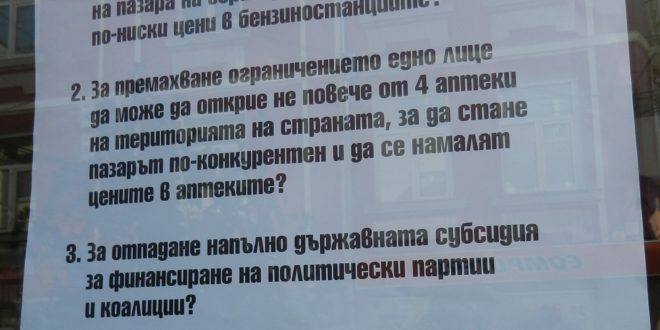
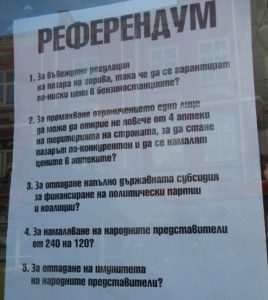
A favorite case study has emerged in the electoral legislation, recast as a "punishment" for the universally disliked figure of the Bulgarian MP - we will remove their subsidies, reduce their number, introduce a ceiling on mandates, take away their immunities, elect them in a different way, etc. Here, Veselin Mareshki, for whose referendum it is not yet finally clear whether 400,000 of the over 524,000 signatures collected are valid for it to be binding for the parliament, is following the fashion of "fighting for MPs". Three out of the five questions are about them: whether to abolish state subsidies for parties; whether to abolish immunity for MPs; whether to reduce their number from 240 to 120.
On political issues
Eliminating or drastically reducing state subsidies for parties is not a bad idea. Under the current system, we have at least two very negative effects from it - the reshaping of parties into organizations completely disconnected from their membership and from the need to finance their existence through communication with donors/voters, and the creation of parties as "small businesses" that collect 1-2-3% of the vote and provide four years of financial comfort to their creators at the expense of taxpayers. At the same time, we have not seen a significant decrease in corruption after the drastic increase in subsidies.
The number of MPs and their immunity are constitutional issues that will hardly be affected by holding a referendum. At the same time, the implicit proposals set out in Mr. Mareshki's two questions are counterproductive. Reducing the number of MPs would have the negative effect of concentrating power in a smaller number of people and closing the parliament to representatives of a large part of the population - we should go in the opposite direction, increasing the number of MPs who are directly accountable to smaller groups of voters. The case of immunity is even simpler - and there is currently a mechanism for its removal and there is no point in removing such protection from political repression. It is better to look at whether we elect hooligans as our representatives and then why and when they are tolerated by their colleagues (without using the existing method for removing immunity).
On economic issues
The remaining two questions are of an economic nature and directly related to the pharmacy and fuel business of the initiator of the consultation. It is proposed that we remove the requirement that one person cannot open more than 4 pharmacies, as currently written in Bulgarian legislation - a reasonable idea to eliminate an unnecessary and expensive regulation that is regularly circumvented, as Mareshki himself admits. Currently, pharmacy customers receive higher prices because large chains have to register dozens and sometimes hundreds of separate companies, for which they unnecessarily pay lawyers, accountants, employees, etc.
The other economic issue is related to fuels, as we are offered the introduction of new regulations, "so as to guarantee lower prices at gas stations". Certainly an extremely imprecise and irrelevant question in a referendum, given the nature of such price regimes, probably seriously damaging competition in favor of specific players on the market. Contrary to Mr. Mareshki's claims, the introduction of a maximum mark-up by the state will not prevent the creation of a cartel, but will make it easier and more profitable in the long term. Free trade, defended in the referendum materials, excludes price controls and administrative interventions.
Overall, Vesselin Mareshki's referendum is a curious mix of what have become almost mandatory questions to attack the political class and those related to the initiator's personal business. Mareshki seeks to kill two birds with one stone - to declare himself as a player on the political scene, but also to resolve in his favor some issues related to his business.
*You can see the original article in Trud newspaper from 10.05.2016 or at this link