EKIP– Expert Club for Economics and Politics A Different Opinion
For almost a year, with all my avowed hatred of the phenomenon of a “political party” in its modern Bulgarian form, I have been a member of the Supervisory Board of the Movement for European Unification and Solidarity (DEOS) party. I accepted the invitation as a representative of the Bulgarian Libertarian Society, not only because I was invited by our members and I want to protect their interest. Our members also participate in projects such as DSB, New Republic, the Greens, Yes, Bulgaria, DBG, etc. I did it because DEOS houses the same brand as ours. The two organizations are doomed to walk under the same umbrella– that of the liberal (in our case – the libertarian), regardless of whether we like each other or not. Precisely, in order for these mutual attempts to define “liberal” and “freedom” to go more smoothly, I agreed to supervise this political project. Here I have shared some of my observations on this party.
What has happened to DEOS so far?
In order to clarify everything else, I will make a brief overview of the development of the party so far. Since its inception, the organization has been led by one person - Emil Georgiev and publicly advertised by another - Viktor Lilov. The party recorded participation in two local elections, in the first registering about 3,000 votes for all its candidates throughout the country, and in the second - partial elections for the district mayor of Mladost, Momchil Yakimov achieved a result of 500 votes.
Needless to say, this is far from the real potential of the party and we should not measure it by these votes. In the party's reality, however, it is the counting of ballots that is the measure. That is why the unsatisfactory results led to the resignations of the board of directors and the chairman. At the last General Assembly, which was held on 28.01, Viktor Lilov took over as the head of the party and the board of directors changed its entire composition (with the exception of Justine Thoms, who must guarantee continuity between the previous and next leadership).
What DEOS should have done but hasn't done so far
The DEOS party branded itself as the authentic protest response to the events of 2013. It was supposed to unite those disappointed with the moral rock bottom that is the Reformist Bloc and to broadcast a combination of protest anti-corruption messages and a pink-liberal agenda (following the example of the Austrian liberal party NEOS ). When, at my first meeting with DEOS members, I asked them what they were fighting for and what they wanted to achieve, one of the party’s figures, Justine Thoms, answered me: “We want to have an MP who has openly declared that he is homosexual and a prime minister who is a woman in a few years.” In the following two years, the party successfully consolidated precisely this image – LGBT, pro-immigrant, pro-human rights, pro-“social justice” much more than any messages related to judicial reform, anti-corruption, economic vision, etc. However, this did not happen with any consensus, but simply the noisier activists managed, on behalf of DEOS, to shout these messages the loudest.
The party is made up of people from a wide political spectrum. When you have a team made up of social liberals, libertarians (classical liberals) and outspoken leftists, it is very difficult to gain enough trust and credit for actions on a certain policy. For example, on the topic of whether the state has a role in education, the leftist will say "Yes, always", the social liberal will say "Yes, sometimes", while the classicist will say "Of course not". How then to develop a unified DEOS policy on the topic that is in tune with everyone's moral compass at the same time?!
A simple experiment with the political compass ( thanks to Gligi for the idea ) showed the clear divergence in the political biases and vision of the members of DEOS
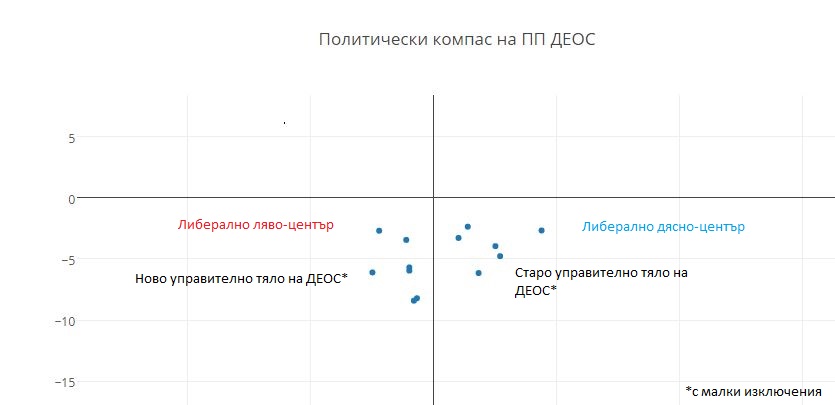
On the center-right side of the compass, for the most part, are the people who withdrew from active work in the party, and on the other - the center-left - are the new chairman and representatives of the new Board of Directors.
What this party needed in its first moments of existence was to develop the most comprehensive creed possible, which would answer as many questions as possible that could cause friction. In this way, the members of the party would know what it would do and what messages it would broadcast in the future, without having to worry that this could change with a change in leadership or membership. Certainly, such clarity would repel those who are far from that zone of the political compass that DEOS occupies as a vision, but the party would easily compensate with new ones who would be attracted by the ideological consistency. In the current situation, we can realistically expect everything as messages, and this is not good for a political organization.
Options for action and why things aren't so scary
Once the DEOS clearly understood what the party's already established image and the size of its electoral support were, it was expected that the things that happened would happen. The people who cared more about the so-called protest agenda ceded the leadership role of the party and harmonized the public image with the party's appearance. LGBT activist Viktor Lilov stood at the forefront.
Whether Viktor has real competition and an alternative at the top of DEOS is not the place to comment. With the reshuffle, the party gave a clear signal that talking about the rights of migrants and homosexuals will dominate its public communication. At first glance, this is absolute suicide in the market of electoral support, especially in Bulgaria. Both migrants and LGBT marriages are not topics that are well received in society, and the latter is discussed only once a year, when the traditional gay parade takes place.
This will remain as a situation, but not in the long term. With the maturing testosterone politics, as my colleague Kaloyan Pravov calls it, in which calls for a crackdown on migrants, deprivation of freedoms, construction of walls, control over people's lives and militarization, there will inevitably be a demand for anti-testosterone politics.
It may be 1% compared to 99% support for testosterone politics, but DEOS has the historic opportunity to be a conduit and a banner behind which to unite these 1%. And when testosterone politics begins to decline, the anti-testosterone will rebound. One percent will become two, two will become four… and so on. Then DEOS will have the opportunity to reap the political capital that it has accumulated, standing in the corner for so long. Therefore, the important thing now for this party is not to win elections and achieve constant growth, but to exist. And… to work.
The work
This is the biggest challenge facing such a small group. For a party of an urban (capital) type, such as DEOS, it is extremely important that visible activities take place that are its work. Even small, but visible offline achievements that can be communicated to the public. Alas, my personal observation is that people who stand up and say "I will do..." are in acute shortage in the ranks of self-proclaimed liberals in the organization.
Their discussion forums are full of talking heads who are capable of writing 1500 words every day about what "Should be done...", how "DEOS should be/be/achieve", but they are not willing to do it. One such person was even nominated to participate in the board of directors, after which, with the biggest smile in the world, he stood up and withdrew. There is a feeling that being a member of a party gives you more privileges than responsibilities. It is a privilege to not be satisfied with the state of affairs, the management, the lack of success. Who is responsible? Of course, the leadership. Who elects it? Of course, the members. And then what?!
The challenges facing DEOS are great. Another election is coming up, in which the party will not appear with its own brand, and the motivation to work is at its critical minimum. Whether something will change or the movement will remain in eternal stagnation is in the hands of the chairman Viktor Lilov, the Board of Directors... and those few members who are ready to devote their free time to achieving the desired results.
But... that's the difference between the right and the left, isn't it?! The left are static and demand that someone do something in their favor. The right get up and make what they want happen...
What DEOS will be like remains to be seen.