EKIP– Expert Club for Economics and Politics A Different Opinion

Healthcare is a cornerstone in the election promises of political parties in Bulgaria. It is one of the most speculated topics when it comes to reforms, development and improvement of the current situation. It is no coincidence that the post of Minister of Health can be compared to an electric chair. Recently, only Petar Moskov has lasted a little more than 2 years. Precisely because the topic is so important, it is worth taking the time to see what the different political forces are offering.
What are the problems of the healthcare system in Bulgaria?
- The NHIF monopoly continues to be a problem for both the efficiency of the system in terms of coverage and quality, and for the state budget - respectively for the taxpayer's pocket. As a result of the monopoly, vicious practices such as theft through referrals, prescribing expensive medications and weak control over public financial resources for health are taking shape.
- Outpatient care is underfunded at the expense of inpatient care. This creates the prerequisites for treating the disease when it is already in an advanced stage (the cost of treatment is high), instead of through prevention to stop it early (the cost of treatment is lower).
- The state's drug policy leads to a high co-payment for medication by the patient - between 50% and 55%, which creates a feeling that medicines in Bulgaria are expensive, while in fact they are the cheapest in all of Europe. At the same time, the state does not pursue a sufficiently adequate pro-generic and economically effective policy.
- Some of the state hospitals have gone bankrupt due to factors such as poor financial management, insufficient capacity, and also rigged public procurements. Here we can give an example of the budget of the Military Medical Academy (MMA), which is updated several times annually. The data shows that in 2010 it was updated 34 times and from 64 million leva swelled to 101 million leva by the end of 2010. MMA is just a clear example of what bankrupt mastodons there are among the hospitals. The other example with MMA is from 2016, when beds were purchased through public procurements at a price of 7,000 leva per unit, shelves costing 1,776 leva per meter and plastic chairs at a price of 700 leva per unit.
- The healthcare system is stuck in the 20th century in terms of digitalization, and the need for e-governance is urgent. E-health is a key factor for optimizing administrative capacity, better tracking of cash flow between different healthcare institutions, and control over the activities of medical specialists.
What do political parties propose in their election programs regarding the above-listed problems?
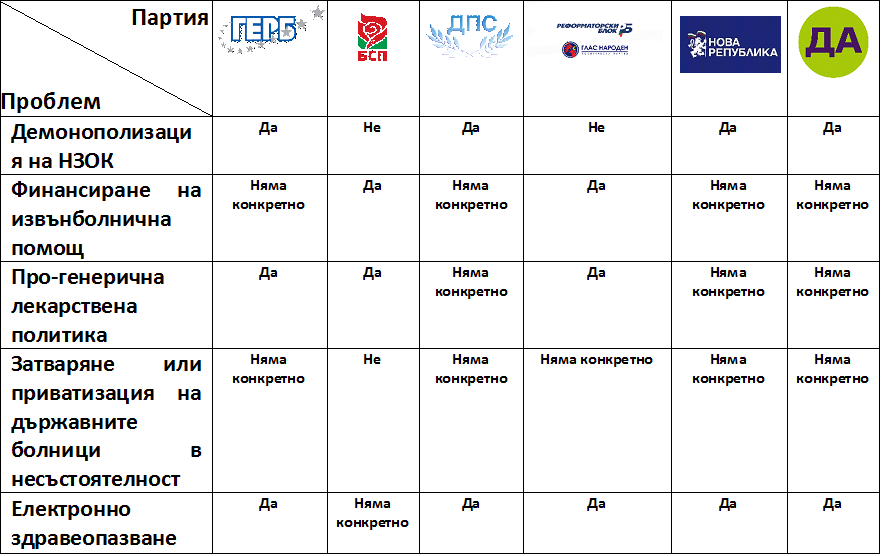
The fact is that from what has been seen over the years as reforms in the health system, it cannot be said that any of the above-mentioned parties has done anything significant. Rather, healthcare has been on its own since 2001, and every year each party speculates on the problems in the health system by presenting ideas for its “fixing”. It remains to be seen whether at least a small part of the above-mentioned measures will come true, of course depending on who comes to power. What is noticeable, however, is that in the event of a possible coalition between GERB and the Reformist Bloc - the demonopolization of the NHIF will remain in the background. If we talk about a coalition between the BSP and the MRF - again the main problem with demonopolization remains in the background, since the BSP would not support market measures in the field of healthcare. If New Republic and Yes, Bulgaria enter the National Assembly, they can only be an opposition without particularly strong support, since they fought and confronted the other four political formations mentioned above during the pre-election period.
Will there be real reforms in healthcare? It remains to be seen! Be sensible on March 26th!