EKIP– Expert Club for Economics and Politics A Different Opinion
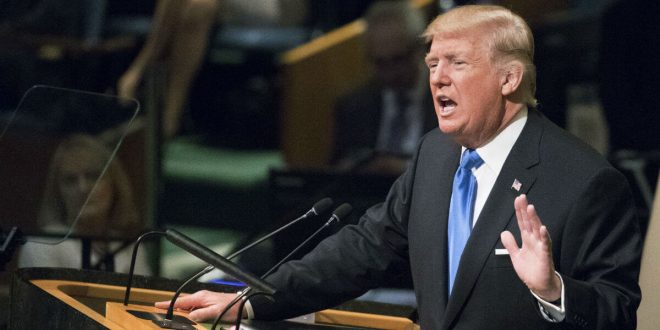
Donald Trump's speech to the United Nations General Assembly this week was one of the most anticipated political events of the past month. Traditionally, the first addresses of newly elected American presidents from this high rostrum receive great attention, as analysts, diplomats and politicians try to read the program of the new administration between the lines. Trump, true to his style, delivered an unconventional in its directness speech that is sure to stir the spirits of many people. In this article, I would like to briefly discuss the positive and negative aspects of the speech.
The good
- The speech was very powerful and impactful. Like the speech in Poland, Trump demonstrated the courage to speak directly, to name the issues directly, and not to shy away from qualifications. This behavior of his brings a dose of freshness to world politics, which is usually full of veiled and watered-down messages and statements. And, while many people will probably be affected by the content of the speech, none of Trump's messages will go unnoticed. It makes him seem sincere and confident (even when he is lying), which is a useful quality for a leader.
- National sovereignty is more important than globalism. It is often difficult for a freedom-loving person to decide which is preferable – the nation-state or supranational bureaucratic structures such as the UN and the EU, since both types of organizations oppose the ideas of individual freedom. The problem is indeed complex, but my interpretation of the principles of freedom is that, other things being equal, political power should be as decentralized as possible. The reason for this is that if the centers of power are more numerous, smaller and closer to the people, civil control over them and the possible limitation of their powers are much easier to implement.
Therefore, I consider the nationalistic overtones in Trump's speech to be positive. The world that the American president depicts is one of clear borders, strong nation-states that cooperate with each other, and cultures that respect each other but do not mix. In this world, the role of the UN is to facilitate communication between different peoples, rather than serving as a proto-international state administration. Trump's accusations of excessive bureaucracy and unfair funding of the UN also fit into this line of thought. - A clear condemnation of socialism as a discredited ideology.“The problem with Venezuela is not that socialism is not being implemented, but that it is being implemented strictly. (...) Those who preach these discredited ideologies only contribute to prolonging the suffering of the people who live under the boot of these regimes.” There is nothing to add. The sad fact is that leftist ideas are still strong in the 21st century, and that they are gaining momentum among young people in the West in the form of vaguely defined “rights” for this or that minority and “multiculturalism.” In this respect, Trump’s speech gave all those who fight against collectivism a great deal of courage.
- A call for a change in approach to migration and refugees. It is extremely useful that Trump used the high rostrum of the UN to emphasize an important fact, namely that from a fiscal point of view, resettling refugees in countries close to the conflict zone is many times more efficient than resettling them in countries much further west. This fact has long been ignored by multiculturalists, but it could become the basis for a completely different approach to humanitarian policy. Translated into concrete policies, this could both help the victims of brutal conflicts in the Middle East and Africa, and ensure the security and cultural independence of Europe and the United States.
The bad
- “Look at me, I’m strong.” Right at the beginning of his speech, Trump “brags” about peak employment, new heights in the stock market, and new spending on military power. The reality is that nothing has changed dramatically since his election. Obama boasted about the same “achievements,” which is a classic political PR trick. Many economists have warned that the rise in employment is related to the fact that many Americans cannot afford to live on the income of only one job and are finding a second one. The stock market, in turn, is a kind of casino fueled by cheap credit, its short-term ups and downs are rarely associated with any fundamental economic changes.
Last but not least, the increase in military spending is unjustified. The US is far superior to its geopolitical opponents in terms of military power, and its armed forces have suffered for years from an ineffective and redundant bureaucracy. Pouring more money will not solve problems, but will only subsidize the corporate military-industrial complex. Scoring cheap political points based on half-truths is practiced by everyone, but Trump has made a statement that he will be a “different” president, and this insincerity does him no favors. - Hypocrisy and irresponsibility regarding US policy in the Middle East. A significant part of Trump’s speech was devoted to his administration’s approach to the problems in the Middle East. The accusations of financing terrorism that the president leveled at Iran, while true, are extremely hypocritical, given that Trump is proactively deepening the alliance with Saudi Arabia – one of the biggest supporters of murderous Islamism in the world. Saudi Arabia itself was not mentioned or criticized; Trump made a veiled call to “kick terrorists out of our countries,” but nothing more.
This, along with the demand for a stronger presence in Afghanistan, shows that Trump’s foreign policy will follow the extremely dangerous and short-sighted policy in the Middle East bequeathed to him by the neocons and Obama. There is no longer any trace of his campaign promises to reduce the role of the US government on the international stage and focus more on domestic security. This is also a potential stumbling block for Trump’s re-election in 2020, as memories of the thoughtless and irresponsible rattling of weapons are still fresh in the American people’s minds.
The conclusion
Overall, Trump's speech is a net positive for freedom-loving people and is refreshing in a very interesting way. It paints a vision of the world and the United States very similar to that of the 1950s. On the one hand, national interests and peoples should be at the heart of the world order, and the United States should put itself first. On the other hand, the UN is charged with the hope and expectation that it can play the role of a mediator between different peoples and cultures in the name of world peace. In essence, Trump is calling for a return to the roots of liberal theory of international relations - sovereignty, international law and meaningful collective institutions. Whether this theory is valuable is a whole other debate. What is important is that Trump has the courage to clearly state his vision. Will it translate into concrete policies or is the purpose of his speech simply to amuse and please his supporters? We will find out.
Image source: Conservativereview.com