EKIP– Expert Club for Economics and Politics A Different Opinion
In September, the EKIP presented the analysis - "Economic Status and Development of Small Regional Centers in Bulgaria". The focus was on the 8 regional centers with the smallest urban population in the country since 2007-2008. These are the municipalities of Montana, Lovech, Silistra, Razgrad, Targovishte, Kardzhali, Kyustendil and Smolyan. The data we examined include both regional and municipal indicators and fall into 6 sections - Economic Activity and Investments, Demography, Labor Market, Infrastructure, Tourism and Financial Status and Tax Policy. You can read the full text of the analysis here. The aim of the study is to present the status and reasons for the lag in the development of small municipalities and regions compared to large ones. After a successful press conference at BTA, the paper was covered by a number of media outlets.
Stoyan Panchev was interviewed by Marta Mladenova in the show ''12+3'' on the Bulgarian National Radio: "The way to stimulate a better business climate in small municipalities is through decentralization - to give municipalities the opportunity to operate with their own budget, so that what citizens earn by working in these municipalities can remain at the local level," he emphasized.
The author of the report, Georgi Vuldjev, was also a guest on the Bulgarian National Radio, where he noted that municipalities do not have as many tools to stimulate their economic growth and one of the ways to have more flexibility and develop is to implement tax centralization.
The report was also presented on BNT. In online media you can read more in the newspaper "Capital" EKIP: Small regional centers in the country are lagging behind, Sega newspaper The gap between large and small municipalities is getting bigger, Banker Daily Tax decentralization is the salvation of small regional centers, Investor EKIP: Small regional centers in Bulgaria are seriously lagging behind the large ones, news.bg Montana Municipality has the lowest salaries among small regional cities and others.
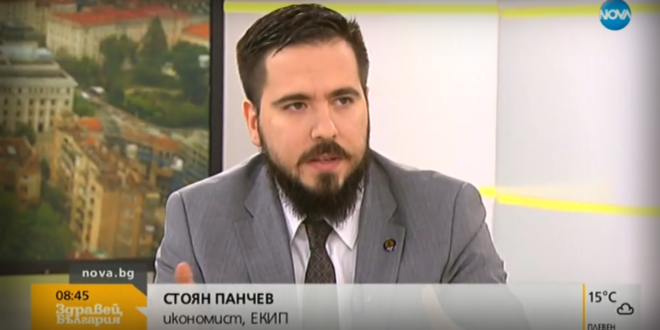
Another lively topic in September was eco-activism. The chairman of the Bulgarian Green Party, Stoyan Panchev, got into an argument with a Greenpeace representative on Nova TV's morning block. "She is a prophet of an apocalyptic sect that claims that a flood awaits us if we do not comply with the dogmas. 500 scientists had sent a letter to the UN to say that there is no apocalypse," Panchev said of the famous eco-activist Greta Thunberg.
In the show "More from the Day" on BNT, he also gave his opinion on the release of Jock Palfreeman, the economic situation of the capital, and whether a municipal company should be established to clean up Sofia.
Speaking to Eurocom TV's "Delnitsi," Panchev commented on the banking system and the macroeconomic situation in Europe, as well as the restriction of cash payments and Bulgaria's accession to the Eurozone.
EKIP Editor-in-Chief Georgi Vuldzhev made two appearances with trade unionist Mika Zaikova. The first question the economists discussed was “The Relationship Between the Country’s Credit Rating and Individual Income.” According to Vuldjev, the fact that Bulgaria’s credit rating has not changed over the past 15 years signals that we have structural problems in the economy and high levels of political risk.
In their second appearance on the topic "How much will pensions increase from 2020?", the two came to a consensus that the system is bankrupt and needs a comprehensive reform.
Meanwhile, Arkadi Sharkov took part in the program "Workdays" on Eurocom. As the main problem of healthcare in our country, he pointed out the lack of finances and the lack of reforms. The Ministry of Health is solving old and stunted problems. This is a major problem in the sector. We need to have rational, not political solutions. The budget for the treasury is thought out from year to year. "This is a totally wrong strategy," according to Sharkov. His article on the topic was published by the magazine "The Economist" under the title Migration to private healthcare.
On BNT, Stoyan Panchev and Mika Zaikova discussed what the 2020 budget will be. Panchev noted that this is an election year, and the deficit will most likely be 1%. He also emphasized that our country is not ready for the upcoming recession. The surpluses reported in the last 2 years should go into the fiscal reserve, and not be spent uncontrollably.
In the studio of "Hello, Bulgaria", Panchev warned of the looming new financial crisis: "Technically, a recession has not started, but observing what is happening in the eurozone and how severe the situation is there, I can say that we have not yet emerged from the 2008 crisis. We have had some palliative growth for several years, which was artificially created by a very loose policy of the European Central Bank, going back decades, we can see that we have very serious structural accumulated problems that were swept under the carpet," he added.
A post from the FB page of the chairman of the Bulgarian National Education Organization, criticizing the actions of the Ministry of Education and Science after the matriculation exams, was published in several online media: The average matriculation exam in mathematics is a two, A new low in the state education system.
On bTV Radio you can hear what Panchev thinks are the solutions to the problems of dirty air, traffic in cities, and the taxes we pay to municipalities.
On election day (27/10), he also took part in the discussion studio of BulgariaOnAir. "The role of the mayor and the local government in ensuring that a city moves towards development is insignificant. In places where there are large amounts of EU funds, problems related to debts appear. They begin to accumulate, and the local government creates infrastructure that it cannot repay," said economist Stoyan Panchev in Ivaylo Lakov's studio. He noted that what is set out in the Draft Budget for 2020 provides new opportunities for competition and productivity. But on condition that taxes or at least a part of them are transferred.
Health economist Arkadi Sharkov appeared on the show "Face to Face" on bTV. According to him, the first and most important step towards raising the financial and quality standard for both medical specialists and patients is to update the criteria for signing a contract with the NHIF and consolidate, privatize or liquidate bankrupt medical institutions.
In "More from the Day" on the topic of whether there is enough money for health, Sharkov shared that the number of health facilities is greater than the needs of the population. In addition, the main problems are in municipal hospitals, which absorb money from only one system, and the quality of services in some of them is not always good enough.
The editor-in-chief of EKIP, Georgi Vuldzhev, participated in the program "Referendum" on BNT on the topic of local government and business, municipal economies and regional development. In the program Business Daily, the economist talked about the economic benefits of high-rise construction. Towards the end of the month, he also commented on the draft Budget 2020 on the air of "Europe" TV, Bulgaria ON AIR and Bulgarian National Radio. Meanwhile, his article " Three fiscal ideas for Budget 2020 " was published in the newspaper "Sega".