 EKIP– Expert Club for Economics and Politics A Different Opinion

In connection with the upcoming parliamentary elections, EKIP decided to evaluate the election party programs of some of the more important players. We chose the traditional major parties along with most of the smaller parties that, according to sociological surveys, have a chance of crossing the 1% barrier that entitles them to state subsidies.
In view of the profile of the readers of EKIP, we focused our attention mainly on the programs of political formations that are considered to be on the "right" side of the political spectrum. We would like to explicitly emphasize that this analysis and assessment of the election programs in no way constitutes any political campaigning. This analysis is an assessment, according to the criteria of its authors, but not a recommendation.
Methodology
Creating objective criteria for evaluating something as complex as a party’s election program is not an easy task. In this line of thought, we do not claim that our method is the most accurate or the most “scientific”. Since the evaluation of individual policies in a program can be very difficult to objectify, we have opted for the following approach: three of our authors – Petar Karazapryanov, Georgi Vuldjev and Kaloyan Pravov, independently of each other , evaluated the programs of the selected parties using a strict point system.
Each program was divided into 13 categories - Public Order and Security, Energy, Justice and Anti-Corruption, Defense, Foreign Policy, Economy (which also includes the fiscal policy of each party), Regional Policy and EU Funds, Social System, Education and Science, Healthcare, Ecology and Transport, Agriculture and Culture. Each party received a certain number of points for each category, according to our authors' assessment of the quality of the policies set out in each program in the respective category.
A positive policy is any policy that would lead to:
- Reducing the state's role and intervention in every sector, both in terms of spending and regulations, which would stimulate private entrepreneurship and allow the market process to lead to more efficient and sustainable development of the Bulgarian economy.
- Lower and/or more optimized government spending. Reduction and optimization eliminates the negative effect that an overly disorganized public sector has on private investment and, accordingly, the sustainable development of each sector of the Bulgarian economy.
- A tax and fiscal policy that would leave more resources in the hands of Bulgarian citizens and would accordingly stimulate higher levels of consumption, savings, investments and, consequently, economic growth.
- Better quality of protection of private property and more personal freedom for citizens through thorough reform of the judicial system, curbing corruption and eliminating unnecessary legal restrictions, including for so-called "victimless crimes".
A negative policy is any policy that would lead to the opposite of the above-described results:
- More state intervention through government spending, regulations, taxes, etc., which would stifle private sector development and productivity growth of the Bulgarian economy in the long term.
- Lower quality of the judicial system and weaker protection of private property and personal freedom of citizens from encroachments by both their fellow citizens and state authorities.
If a party has not published policy proposals in a given area, we have given it a negative rating. The lack of desire or ideas for reforms in an area that needs reform (and in reality, state policy needs reform in every area) is undoubtedly bad policy.
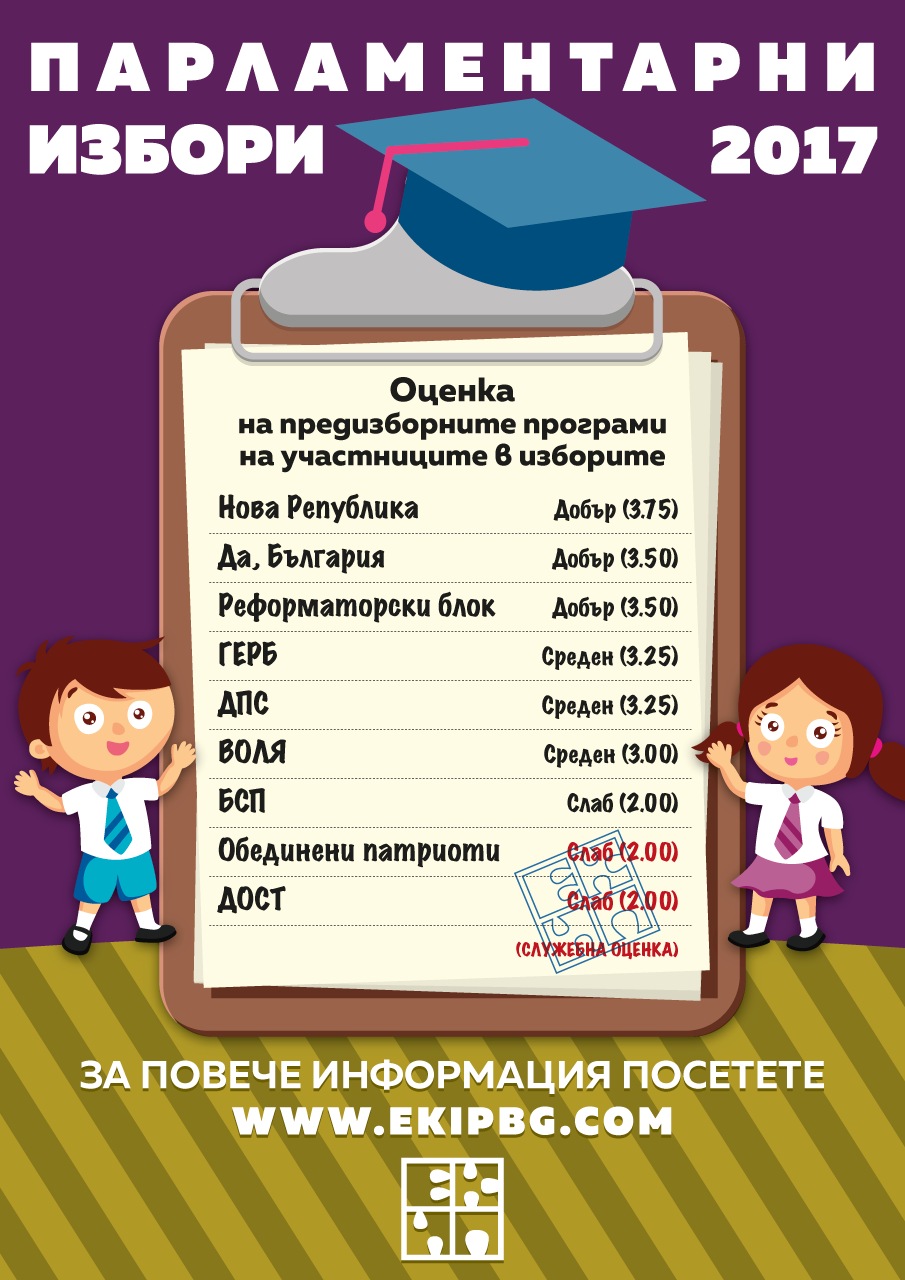
Finally, we averaged the ratings of the three evaluators and converted them into ratings on a six-point scale, which we now present graphically. Some political formations such as DOST and United Patriots had not published election programs on their websites (if they had any) at the time of the evaluation. For this reason, we have assigned them an “official pair”, as we believe that it is unacceptable for a political entity that claims to be represented in Parliament to not have a clearly structured program published 2 weeks before the elections.
What do the results of the evaluation of this year's party programs show?
The first conclusion one would draw from looking at the results is that there are no excellent candidates. No party offers a consistent political program in the spirit of a market economy and personal freedom that would stimulate the economic and social development of Bulgaria in a strictly positive direction.
The desire for more state interventionism is dominant among both the traditional left-wing formations and the "right", whether old or new. As an exception, in certain categories, some parties have positive policies, but they are rather exceptions and therefore extremely insufficient to have a serious impact on the overall assessment, which is extremely unsatisfactory for each party.
According to the arithmetic mean of the ratings given by our authors, the program of "New Republic" ranks first in terms of the overall quality of the proposals included in it. This does not mean that the NR achieves the highest score in terms of the quality of the proposals in each sector, but only that the quality of their program as a whole is relatively the highest, according to the arithmetic mean of the ratings of our authors. This does not mean that their program is "good" in absolute terms, but rather that it is the least bad compared to all the others. This also applies to the programs that rank immediately after that of the NR - those of the coalition "Reformer Bloc" - "Voice of the People" (from now on for short simply "Reformer Bloc") and the coalition "Yes, Bulgaria".
The worst results are for the parties in the sectors "Education", "Culture" and "Ecology and Transport". Regarding the first two, no party has a clearly structured vision of how the state of the specific sector can be improved, with only populist spending promises with an unclear purpose. It is extremely disappointing that no party makes any serious requests for the implementation of structural reform and the demonopolization of the education system.
Regarding the "Ecology and Transport" sector, perhaps the only positive thing that can be highlighted is the fact that there is widespread support among the parties for the introduction of a toll system on highways, but beyond that, the politicians' vision for the development and improvement of the quality of the road infrastructure in the country is extremely poor and in many cases counterproductive. In ecology, most parties are explicitly moving towards "green" populist policies with the aim of limiting entrepreneurship in sectors such as tourism through more unnecessary regulations that would harm the economic development and competitiveness of the country.
Only in the sectors "Economy", "Energy" and "Justice" are there clearly positive proposals in some party programs. Interestingly, with regard to justice, the proposals of most parties seem relatively satisfactory, at least on paper. However, the most clearly structured and detailed program for positive reform in this sector is that of the "Yes, Bulgaria" formation, and it accordingly receives the highest score in this sector.
In terms of economy and energy, to some extent quite expectedly, the Reformist Bloc and the New Republic stand out the most. Both parties propose tax cuts, deregulation, decentralization, and restrictions on government spending – all policies that would have a positive effect on the country's economic growth in the long run.
The RB as a whole presents the highest quality proposals in terms of economic and energy policy. What distinguishes the RB program the most in these sectors compared to the others are the proposals for a flat reduction in the VAT rate, the most serious increase in the threshold for tax registration, as well as the strongest calls for complete deregulation and liberalization of key sectors in the Bulgarian economy along the lines of the privatization of the Bulgarian Stock Exchange and the elimination of the monopoly model "NEK - sole buyer" in the energy sector.
We remind you that the fact that a party has included good proposals for reform in a given sector in its program does not necessarily mean that they will be implemented. The assessments we present are only of the stated intentions of the political formations in the pre-election context. Their actual actions in parliament are a completely different topic.
Application: Individual assessments
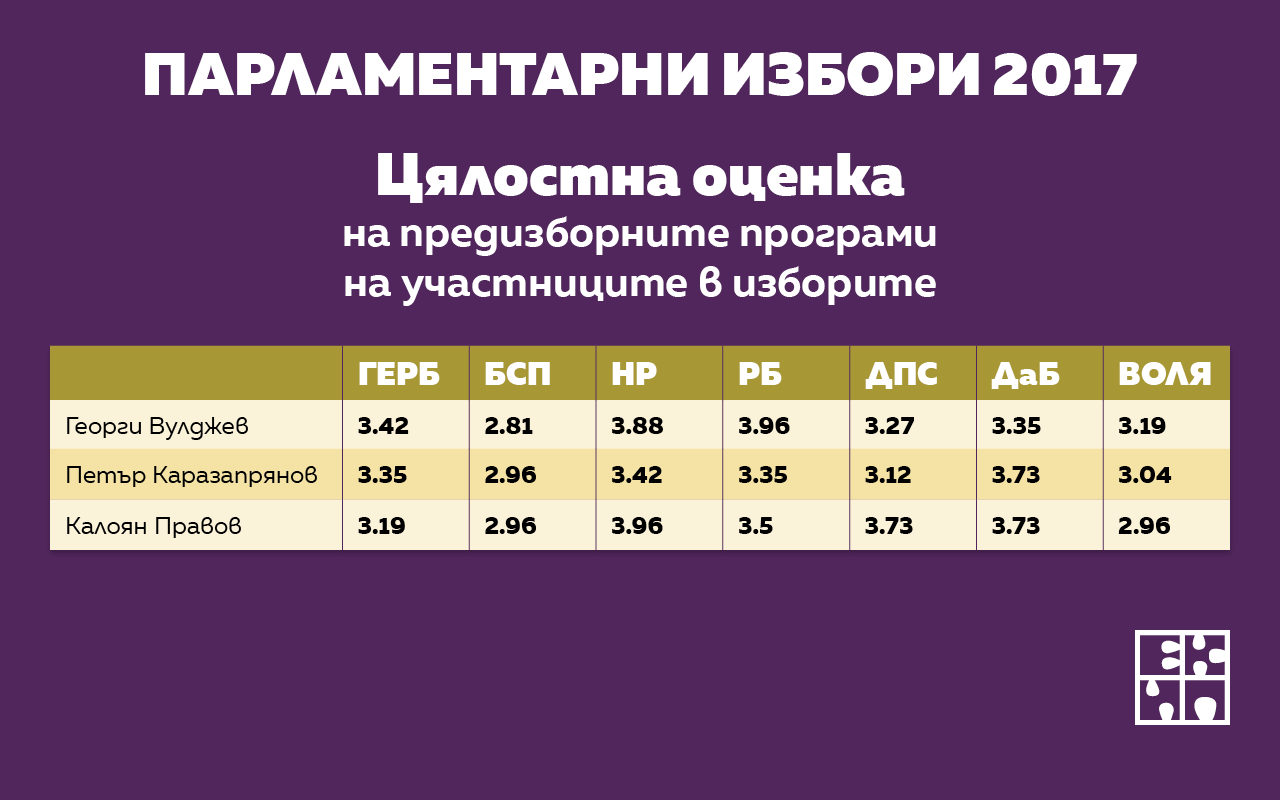
In the appendix below, you can see how each of the authors who participated in the preparation of the overall analysis individually assessed the program of each of the above-mentioned political formations. After the table, you can also read each author's justifications for their assessments.
Georgi Vuldjev
In these elections, no party program deserves to receive a full "Good - 4" rating. The main and widespread problems of the parties' election programs are the populist promises of a large-scale expansion of state spending in almost every sector, unrealistic promises to increase pensions and wages (especially the minimum wage), accompanied by the lack of any vision for structural reform in sectors where it is desperately needed, such as education and the social system.
This type of election promises – higher spending + lack of structural reforms – are, among other things, counterproductive in the long run, either worsening the state's fiscal position, or harming economic growth, or both. This seems to have been the formula by which all parties have written their election programs, especially as far as the BSP and VOLYA and, to some extent, the MRF are concerned. Although to one degree or another the programs of all parties suffer from this shortcoming, the programs of the three parties listed above are the worst in this respect. On the other hand, two of the party formations in these elections are distinguished by the fact that among the otherwise harmful proposals there are also a number of useful and necessary reforms to a much greater extent than in the programs of the other parties. These are the programs of the Reformist Bloc and the New Republic.
Overall, the Reformist Bloc's program is relatively the most acceptable compared to the others and ranks first in my ranking mainly because of the party's proposals regarding economic, fiscal and energy policy. In sectors such as culture and education, there are many things to complain about in the RB program and there it does not really differ much from those of the other parties and generally follows the formula more spending + lack of structural reforms. In the areas of economy, fiscal and energy, however, the picture is quite different.
The reduction of VAT, the highest of all proposed increase in the threshold for tax registration, as well as long-term deregulation are all reforms proposed by the Bulgarian National Assembly, which would stimulate business and accordingly lead to more investment and, accordingly, higher productivity in the long term. The Bulgarian National Assembly also proposes the privatization of the Bulgarian Stock Exchange, which is an extremely necessary measure to accelerate the development of the capital market in Bulgaria, which would also improve the business environment in the country to a large extent. The elimination of the monopoly of NEK and the liberalization of the energy market, on the other hand, would improve its efficiency and lower the real price of electricity in the long term.
The program of the NR is very similar to that of the RB and many of the proposals presented in one will be found in the other. The NR also offers some very positive proposals that would stimulate economic growth and in the long run improve the economic development of the country. But what limits the NR program is that it is simply not as ambitious as the RB's is in these areas. The devil is always in the details and the details of the RB program are simply better than those of the NR, even with all the negatives in other sectors.
There is not much to say about the others. The programs of GERB and Yes, Bulgaria are quite mixed, with in most cases the negatives dominating the positives, and therefore their rating is pegged at "Average" - 3, with a slight plus due to some more positive proposals that raise these two formations above the bottom of the ranking. It is interesting that GERB, at least on paper, adheres to some positive proposals, such as the complete liberalization of the energy market. Another question is to what extent such promises would be fulfilled in reality. It should also be noted that the biggest positive of the program of Yes, Bulgaria is their judicial reform. There, at least in terms of a clearly structured vision, DABg is an undisputed excellent.
Kaloyan Pravov
Given that the campaign rhetoric of almost all parties is based on the word “change”, this election season is rather notable for the lack of ideas for fundamental reforms in the political system. With the exception of small flashes, such as the social policy of Nova Republika and the health policies of “Yes, Bulgaria” and Nova Republika, the largest state activities – internal security, social policy, healthcare, education – will remain what they are at the moment – bogged down by bureaucracy and weak governance.
The main area in which we can expect some reform is the judiciary. It seems that the efforts of the reformers in the previous cabinet to focus on this problem are yielding results, as GERB is proposing sensible reforms. However, the revolutionary approach to the reform of the judicial system also hides many risks. For example, the proposals of Nova Republika for the election of a prosecutor general with a 2/3 parliamentary majority are rather negative, as they create a risk that the country will be deprived of a key institution for a long period of time. As expected, the most meaningful proposals in this area come from "Yes, Bulgaria".
Another area in which there are bold reform proposals is energy. Here, RB2 and NR have excellent proposals given the Bulgarian context. Unfortunately, the positions of most parties are too divergent (such as those of the BSP being extremely destructive) and the likely result is the preservation of the status quo or its deterioration through a consensus between GERB and BSP.
The attitude of the parties towards the external situation is disappointing. No party except the MRF demonstrates that it understands that the political positions in the European region are being rearranged and that Bulgaria needs a proactive position to guarantee its interest. The need for meaningful and deep reform in the EU is extremely urgent, but it seems that the Bulgarian political class has no vision for the role of our country in this process. Already outdated mantras for deeper European integration, strengthening Euro-Atlanticism and a “balanced” policy towards Russia are being repeated. There is also a lack of determination to act independently and at the national level on key problems for national security, such as the migrant flow, for example.
The economic programs of the two main parties are unrealistic and harmful. GERB's proposals can be summarized as more state support for the economy and central planning. BSP's proposals are in the same spirit, but with twice the scale and pace. And while Borisov's party has acknowledged the fact that at least some fiscal responsibility must be observed, the left refuses to explain to voters where it plans to find money for its massive programs. In the economic sphere, the reformist parties (RB2, NR and DaBG) have wonderful ideas, the best of which is Nova Republika's proposal to reduce VAT on food, books and medicines to 9%.
Nova Republika is also the only party proposing meaningful decentralization in the field of regional policy. The idea of 50% of personal income tax and profit tax remaining in the municipalities, combined with the consolidation of smaller municipalities, is a radical change in the approach to regional policy in a country that currently suffers from over-centralization.
In conclusion, looking at this year's party programs as a whole, I think that only Nova Republika has found a balance between good and bad ideas. In general, the trends are towards preserving the status quo or pushing through policies that worsen the situation. Even taking the best from each party, we would not be able to put together such a meaningful program that would not leave key sectors such as education, transport, ecology and internal security in the swamp. And considering the BSP's gaining momentum, we as voters should prepare for attempts to preserve and expand the statist approach to governing the country.
Petar Karazapryanov
If we had to summarize the party election programs in a few words, "lack of bold ideas" describes the situation most accurately. There are many sectors in the country that need serious structural reforms and on a very large scale. However, none of the parties is proposing anything like that.
Of all the parties, the BSP is the most consistent in its destructive ideas. In almost every sector they propose reforms related to increased state redistribution and regulations (only in the field of foreign policy does loyalty to the EU and NATO, but also a benevolent attitude towards Russia, make a good impression). Naturally, the assessment there is Weak.
The other major party – GERB does not surprise us with anything. As always, GERB does not propose any radical reforms, be they good or bad. The emphasis is on Bulgaria's European integration, mainly related to the absorption of EU funds (rather a negative point).
In terms of social and economic policy, GERB is lurching to the left, riding the populist wave of increasing the minimum wage, which undoubtedly has a negative effect. In the areas of healthcare and education, there are practically no ideas for reform. The same can be said for energy, ecology and transport.
In the area of justice there are some good ideas (such as the abolition of immunity and a complete change in the criminal process), but without structural reforms of the judicial system. In foreign policy GERB observes a tone of moderation, without radical swings to the east or the west. The overall score is Average 3.35, demonstrating the lack of any vision for right-wing reforms in Bulgaria against the background of individual good proposals.
The high hopes on the right are not justified. Yes, Bulgaria, New Republic and the Reformist Bloc are considered alternatives to GERB in the “blue spectrum”, but their election programs send us contradictory messages. All three parties have good ideas in the economic and social spheres (such as reducing VAT for some goods in the NR, easing regulatory regimes in the DaB and RB). Ideas for more active participation in private pension insurance (PN) are being floated, but at the same time none of the parties is taking on the difficult task of moving to a model of fully private pension insurance.
In the areas of health care and education, there is a lack of ideas for privatization and deregulation, which alone can solve the serious problems in these sectors. Instead, there is a desire for more regulations and increased government spending. In the areas of ecology and culture, there are clearly left-wing ideas, at times even with a fascist flavor (for example, the rationing of a mandatory percentage of Bulgarian production in public media in the Republic of Bulgaria).
In the public order and security sector, there is generally no vision for reforms, while in the Defense and Foreign Policy sectors there is a positive pro-Western attitude. The ratings of 3.35, 3.42 and 3.73 (for RB, NR and DaB respectively) show that RB and NR do not differ from GERB overall, while for Da, Bulgaria the positive moments are only slightly more. However, these ratings are disappointing for parties that claim to bring change to the right.
There are no surprises on the part of VOLYA. Mareshki's populist ideas are indeed in line with the ideas of the BSP, as he himself recently said. The party does not propose meaningful positive reforms in any sector and receives an average rating of 3.04 solely on the principle of "it could have been worse". The situation is similar with the MRF.
The final conclusion that can be drawn is that political parties in Bulgaria suffer from a chronic deficit of right-wing ideas, which does not bode well for the country's future.
Appendix 2: Assessments of party programs by sector






Over the last 30 years of neoliberalism, we have seen what has happened - https://www.facebook.com/atanas.shalapatov/posts/1752811994997027
According to BIS data, the debts of the Western world doubled between 1977 and 2007. During this period, the real indebtedness of non-financial entities increased by 200%, that of countries by 300%, and that of inter-firm indebtedness by as much as 600%.
In short - neoliberalism, especially in financial capitalism, is a crime even against humanity, and for industrial capitalism, I agree that there needs to be a little more deregulation in the sense that investments in energy efficiency, innovation, etc. should be exempted from tax.
Mr. Atanas Shalapatov,
So many accusations against neoliberalism, and not a word about the current improper state application of money, which is the leading cause of current evils.
If proper state application of money had been introduced, countries would not have the current debts. Then would neoliberalism still be to blame for countries not having debts?
Now, even if elections are held 100 times, they are not essential for achieving sustainable public prosperity, because it does not depend on elected politicians, but on the introduction of proper state implementation of money.
If the improper use of money by the state continues, the damage will increase.
About the situation:
http://spodeli.eu/izbori-pri-kovarna-darzhavna-greshka-articles-15423.html