 EKIP– Expert Club for Economics and Politics A Different Opinion
What is right-wing politics in culture? Are these ideas represented in politics and what do most parties actually say when commenting on this issue?
Everyone is united that "culture should be a priority", but this is a completely populist phrase. How will culture actually be important in Bulgaria, a priority - not for the parties, but for the people, how will it develop and will there be money in it?
What is the right in culture?
A popular, and hence exploited by politicians, opinion is that culture should be a "state policy" and that without a state and political will we would hardly have museums, arts, etc. However, what is the reality? Radan Kanev made a nice point in an interview with EKIP TV when he recalled that we had education and culture long before there were ministries of education and culture (whether his political formation believes and follows these ideas is a completely different question). That is, these things have already happened in Bulgaria - and some of our greatest successes in the field - without any "state policy".
A huge part of the valuable Bulgarian art was created under some form of free market. Although at different times in their lives they worked in government jobs (from the lowest in the hierarchy, for example, a postman - to a minister), the great Bulgarian artists did not create for some state subsidy, an opportunity for advertising or respect. Vladimir Dimitrov-Maistora, Zlatyu Boyadzhiev, Ivan Vazov, Aleko Konstantinov and all the others that we can now see in our galleries and museums, in textbooks and libraries, painted, wrote, composed, etc. without 0.5 or 1% of the GDP budget for culture. We will not go into the analysis of why they did it, but certainly - they were not stopped by the lack of a national strategy, Ministry of Culture, Culture Fund or anything similar.
This is exactly what the ideas of the right in the sphere of culture should be – guaranteeing freedom of creativity, freedom of expression, freedom to finance yourself and to be financed, decentralization, and personal responsibility. We must put the individual at the center, not the group; the private, not the general. And if this sounds good in words and every politician would promise it, in practice it is very difficult to achieve when financing is centralized. The proverb that applies here is “Whoever pays, orders the music”.
In other words, a center-right party should promote decentralization in funding and control, while also having certain incentives for businesses to fund culture (e.g. a truly meaningful Patronage Law). A truly right-wing party would not deal with culture at all, leaving artists free to do whatever they want and companies free from heavy taxation, so that they can have enough free resources to donate or invest in culture.
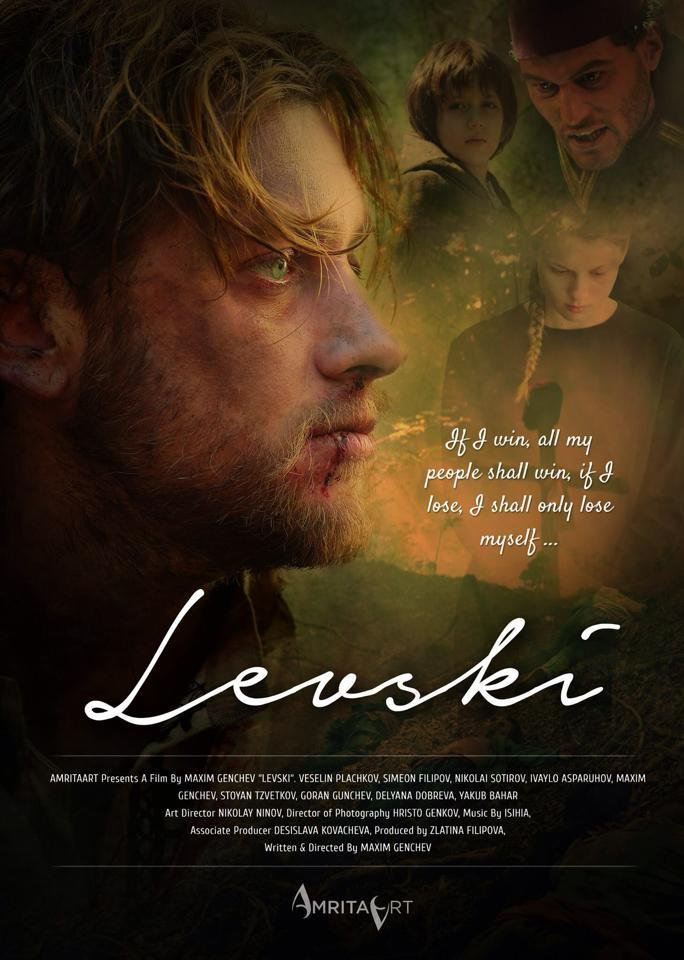
And another very important thing: the funds for culture in Bulgaria are not 0.5% of GDP, since culture is also created outside of state institutions and state-subsidized activities. Not one or two quality films, such as " Eastern Plays " or " Lesson " - or not so good in the "high culture" category, but with market success (which is not small and does not mean that they are bad), such as " Deacon Levski ", for example, were created without state funding.
The funds for culture are much more, because they include many other public funds that municipalities redistribute, as well as a huge amount of funds from private sponsors.
And to clarify what was said above – for a right-wing party, if it is the state's job to increase funds for culture from GDP, it should promote private donations. And politicians will not have to answer crazy questions like "where will you get it from to give culture 0.5%, to make it 1%".
Are there such ideas in the parties that are fighting for the next Bulgarian parliament?
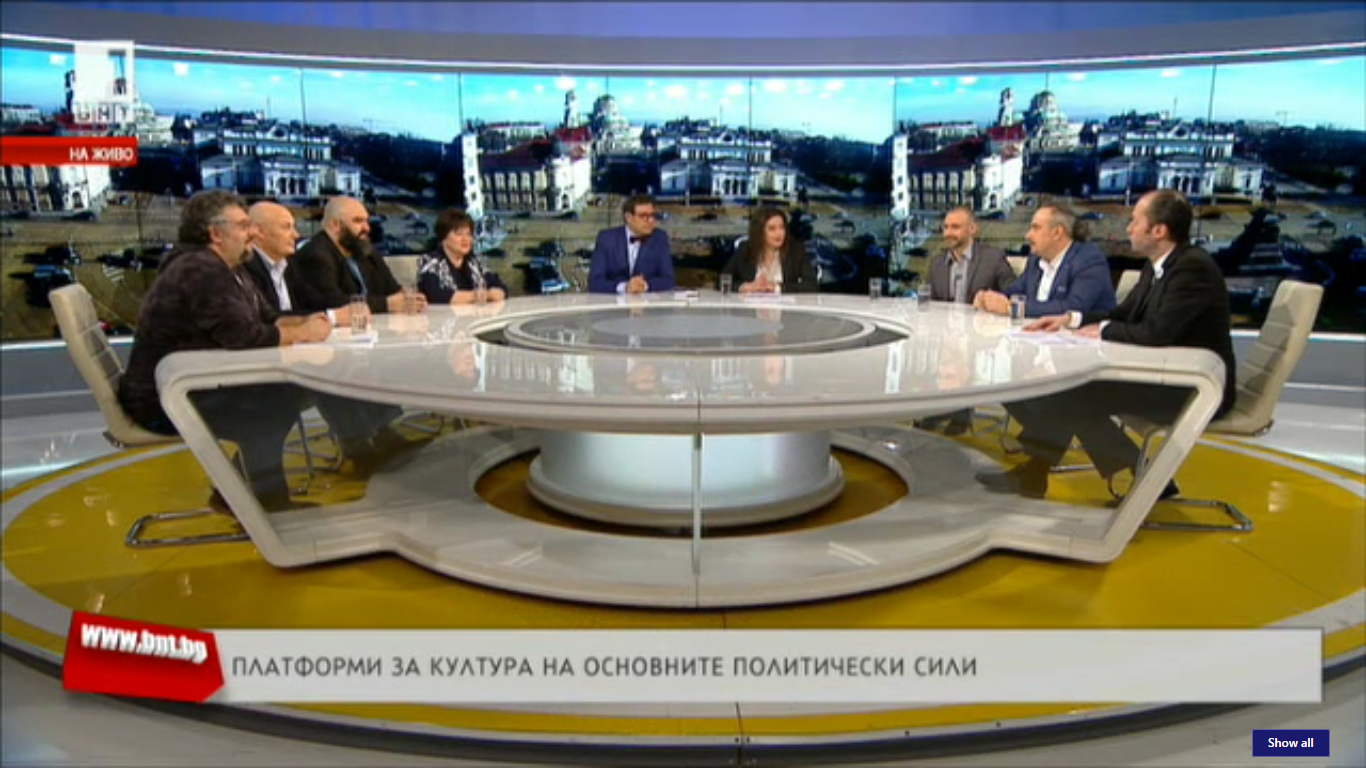
Representatives of the leading parties and coalitions with a good chance of entering parliament took part in a debate on "The Day Begins with Culture" on BNT, where they also discussed their political platforms and ideas in the field.
We will quickly skip over the three categorically left-wing political formations for which centralization and totalitarian rule are the rule, no matter whether it is about the economy, education, tourism or culture. It should not surprise us that the BSP, the United Patriots and the "ABV-Movement 21" coalition have or talk about a "clear vision", a "strategy", "this must be developed, specifically" and know very precisely how culture will prosper and suddenly we will start participating in world biennales, we will win awards not only from the Oscars, but also from the Berlinale, Venice, etc.
Just as centralization does not work in the health insurance fund or the prosecutor's office, it also harms the Ministry of Culture, and we dare say the Institute for Cultural Monuments. Unfortunately, the policy pursued in recent years has led today's intelligentsia to expect this institute to grow even more, even to become a Directorate, without seeing that it is precisely this centralization (and the completely logical politicization) that has created the majority of the shams that we have been ashamed of lately.
Including all parties, a "left-right" debate did not work, as the populist position "money for culture should be increased" and "money should be managed more strategically" dominated regardless of ideological color.
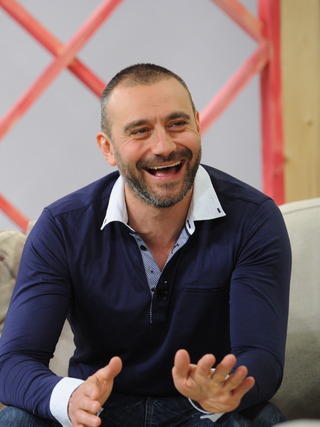
Within the debate, a relatively centrist position was taken by the representative of GERB Kalin Veliov, who, however, in essence also supported a completely totalitarian position. The ideas of an additional tax on computers, which would go to the Culture Fund, are an extreme anachronism. In fact, Veliov's main thesis was not aimed at any freedom or the removal of restrictions and regulations, but on the contrary - more control over the funds allocated for culture, which, of course, should be doubled. In the two incomplete mandates of GERB so far, this has not happened. The boom of Bulgarian culture promised by everyone, which is becoming more and more centralized with each subsequent government, has not happened either.
Thus, unfortunately, all the positions expressed tended towards totalitarian, centralized management, the creation of "commissions", "committees" and various methods for increasing state funding and control over culture.
Only three “right-wing” positions were expressed during the entire debate. One was for the abolition or reduction of VAT on books– which almost all participants agreed with. An addition to this idea was made by Kalin Veliov from GERB, who added music, theaters and other cultural products, which should also be exempt from VAT. Unfortunately, all this was ideologically undermined by a kind of “protectionism in culture”, according to which these tax breaks apply only to “Bulgarian cultural products”, as well as by the inexplicable equating of “foreign products” = “business”. The reality is that just as foreign cultural products can have difficulty surviving on the free for-profit market, Bulgarian ones can also be made “for business” and earn a lot, without additional subsidies. And there is nothing wrong with that.
The other “right” position was the opinion of Manol Peykov from “Yes, Bulgaria”, according to whom centralization is a problem and a possible solution is the creation of separate “cultural centers” that can freely dispose of their own budget. Although in essence, again tied to government funding, this idea is a very timid step towards the free development of culture. The fear of decentralization expressed by Kalin Veliov is actually a fear of unpopular measures – the fear that the non-functioning, but generously funded cultural centers in small towns (and in large cities) will stop working. Still, “X theaters have closed” sounds much worse than “there are dozens of theaters that offer absolutely profaned culture”.
The third statement, which leans towards the ideas of individual freedom, rather than supreme government control, was from Ivaylo Tsvetkov from the New Republic (with which Manol Peykov from Yes, Bulgaria agreed, albeit with the condition that culture should be supported by the state), who only at the end of the debate stated that “culture should be self-created” and should not be relied on by institutions to control it. He also gave specific examples that culture can and should exist on a market principle, which was the final point in the presentation of right-wing ideas in the debate.
" Best of" the most populist ideas
- "A tax on the sale of computers that would go strategically to culture" (Kalin Veliov, GERB) - punishing people who prefer to have a product in which you can collect all the world's knowledge, so that they can buy a paper book because it is more romantic, is extremely stupid.
- "The chance for everything we are talking about to happen is (...) in the one who has implemented the most projects" (Kalin Veliov, GERB) - Given that culture is in an unenviable state and in the days when the pièce de résistance of the last government - the "Square 500" museum is falling apart from the outside and the inside, we must be increasingly aware that the state/government simply does not know how to implement projects.
- "Reduction of VAT on books only for Bulgarian authors" (Dr. Krasimir Dimitrov, United Patriots) - Even in the otherwise absurd patriotic rhetoric, the ignoring of Bulgarian publishers, Bulgarian translators and all other Bulgarian creators and workers along the chain shows a rather serious ignorance of the subject of "book publishing"
- Tax on gambling for the Culture Fund (by almost everyone)– In essence, this idea says: "If you gamble, you support the Culture Fund - i.e. instead of stimulating people to directly invest/donate to culture, it will stimulate them to spend on gambling, then provide the salaries of a certain number of bureaucrats who will redistribute these funds to politically convenient people through the state fund."
- “Decentralization is great (…), but this will take time and will yield results at a much later stage” (Kalin Veliov, GERB)– This falls here because – strangely enough – it was said with a negative connotation. Quite the opposite – when we talk about policy in the field of culture (and not only), we should seek sustainable measures that will yield results at a later stage. It is this type of speech that shows that the interest is in quick and temporary solutions that will be forgotten until the next term.
- "Folk dances should be included in physical education classes" (Dr. Krasimir Dimitrov, United Patriots) - It seems that for some people "culture" equals "folk dances"
- The idea of increasing the percentage of Bulgarian music in state media (Ventsislav Mitsov, Reformist Bloc - Glas Naroden) - Forcibly doing something that is already happening in a free market (BG Radio, and to some extent pop-folk radio stations) will lead to a number of forced distortions and ultimately radio stations will be forced to play music that their listeners do not like.
- "I ask my friend who works there (at the British Museum) and he explains to me - "Why didn't you put the Varna Necropolis" (note mine. in flyers that are handed out at the entrance to the museum)" - (Prof. Lyubomir Halachev, ABC-Movement 21) - It seems that the level of cultural diplomacy in Bulgaria is to negotiate with a curator at the museum for advertising the state.
Honourable mention: "I live in Oborishte, I see an awful lot of Japanese tourists who are constantly taking photos ( sic!), but it is impossible for half of the municipal building stock in the center of Sofia to be populated with gypsies" (Dr. Krasimir Dimitrov, United Patriots) - the ability to bring this into a debate about culture is worthy of respect.
Summary
Ultimately, the debate about culture – and thus the party programs themselves – turned into a friendly conversation in which everyone agreed that culture should be funded more, should be controlled more, should be a focus in government policy, centralization, strategic planning, commissions and committees should be increased and have more and more power.
The only exceptions were wishful phrases about decentralization and a move towards more market principles in culture. The freedom of the individual to create was not commented on, and it seems that the result in the next four years, no matter who wins, will be more of the same as we have had in the last nearly 73.




You have missed real protection of copyright and related rights, i.e. protection of intellectual property. This protection is currently only on paper, or at least as far as individuals are concerned. The legal situation is not much better. You can't possibly want people to buy books when a pirated book site with tens of thousands of titles and hundreds of thousands of visitors per month is operating undisturbed. Nor movies, music, computer programs and games - when there are torrent sites that protect everyone's "right" to consume digital products for free and unlimited. Theft in Bulgaria is the norm! Who is this fool who would pay for an intellectual product when he can steal it with absolute impunity? That's why there is no market for culture in Bulgaria.