 EKIP– Expert Club for Economics and Politics A Different Opinion
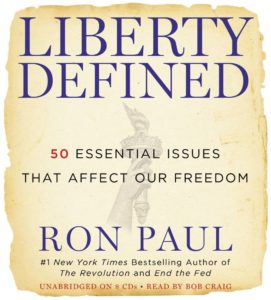
The Ten Principles of a Free Society is an appendix to Ron Paul 's book - Liberty Defined: 50 Essential Issues That Affect Our Freedom.
Expect the entire book translated into Bulgarian soon.
1. Rights are individual, belonging to individuals and not to groups of people, rights arise from our nature and can neither be granted nor limited by government.
2. All peaceful, voluntary, economic and social associations are permitted, consent being the basis of the social and economic order.
3. Justly acquired property is the private property of individuals and voluntary groups of people; this property cannot be arbitrarily taken away by governments.
4. The government cannot redistribute private wealth or grant special privileges to individuals or groups of people.
5. People are responsible for their own actions, the government cannot and should not protect us from ourselves.
6. Government cannot claim a monopoly over people's money. Governments should never engage in the official counterfeiting of money, even in the name of macroeconomic stability.
7. Aggressive wars, even when called preventive, and even when they concern only commercial relations, are prohibited.
8. The right of the court and jury to judge according to the law and the facts is the norm.
9. All forms of forced labor are prohibited, not only slavery but also compulsory military service, forced association and forced redistribution of wealth.
10. Government must obey the law in order to expect people to obey it. Government should never use force to shape people's behavior, to manipulate social processes, to manage the economy, or to tell other countries how to behave.
* The article is taken from Kiril Kirilov's blog: http://krlkirilov.blogspot.com/
-----------------------------------------------
Ronald Ernest "Ron" Paul (born 1971), American physician, writer, and politician, has been a longtime Republican congressman, a longtime member of the House Finance and Foreign Affairs committees, and a three-time candidate for President of the United States. He has broad support among conservative circles and has been the Conservative Political Action Conference's nominee for president for two consecutive years (2010 and 2011). In 2010, his son, Rand Paul, was elected to the United States Senate, becoming the first hereditary politician in U.S. history.




Why is the state not a bad employer in Scandinavian countries? Or does this joke only happen in Bantustans? Why is business responsible to workers there, but not here?
In the Scandinavian countries, the state is a relatively better manager than here. It is certainly not better than the private sector, because for politicians/bureaucrats there are incentives opposite to those that develop and manage property properly.
Otherwise, it depends on which business we are talking about - one that is controlled by politically connected oligarchs can thrive wonderfully even without good treatment of both workers and customers. Not to mention that I have also witnessed quite good treatment from Bulgarian businesses.
If anyone is at all interested in the facts and is willing to go beyond the stereotype about Scandinavian economies - if it weren't for the turn to the right over the last 20 years, including the reduction of the role of the state in the economy, the Scandinavians would be in a very bad situation.
The trend there is towards liberalization of the markets, not nationalization. But who can read, let alone think! The red bastards planted the idea of the Scandinavian "paradise" in the heads of the Bulgarians and now nothing can knock that idea out of them.