 EKIP– Expert Club for Economics and Politics A Different Opinion
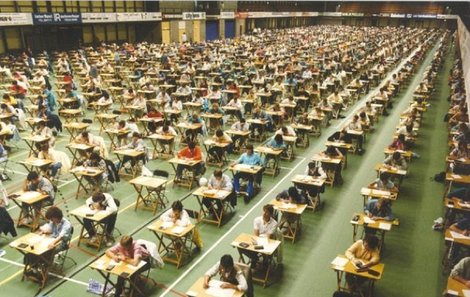
500 years ago, Martin Luther began a campaign against financial corruption and moral decay in the Roman Catholic world. At that time, the Western church had been transformed from a voluntary religious community into a totalitarian political institution with the aim of accumulating power and wealth. Luther rightly insisted that the long-delayed spiritual reformation could not be achieved without a return to the foundation of Christianity, the written Word of God. To achieve his goal, the German priest insisted on providing access to basic education for every citizen. Initially, for Luther, this was a policy that gave every Christian the opportunity to read and reflect on the Holy Scriptures.
So far so good. Luther's religious fervor inspired his followers to translate the Bible into all languages. Wealthier Christians began to allocate additional funds, supporting the efforts of their poor neighbors to learn to read and write. Unfortunately, the movement was not limited to the sphere of voluntary cooperation in pursuit of a common goal. To the misfortune of hundreds of millions of children in the Western world (to which we include Bulgaria), the father of the Reformation decided that it would be a great idea to put state power at the head of this new type of crusade. Thus, the spiritual struggle against the forces of hell was transferred to the newly built system of public schools.
Luther wrote a letter to a German prince, asking for help in the fight against the abuse of power by the then pope, a member of the Medici family. In the letter, the priest pointed out that civil authorities had the right to introduce compulsory military service when their borders were attacked. From this, Luther concluded that in a situation of constant war against the forces of darkness, the Christian state was obliged to “force people to send their children to school.” In just a few years, these ideas led to the laying of the foundations of the first universal compulsory state education system in the West. Municipal schools were opened in every city and village. Every child was forced to attend these institutions under the threat of fines and even imprisonment for the parents. The experiment began in Thuringia and Saxony in the 1520s. Very soon the system spread to other areas of Germany, which was then divided.
It soon becomes painfully clear that the purpose of public education is not to teach children to think critically. Secular or religious, the authorities have no interest in citizens gaining the skills to build and defend their own positions. In Luther's time, public education did not teach children to read and interpret the Bible for themselves, but rather imposed a sectarian dogma by force. Under socialism in Bulgaria, the dogma of Marxism was imposed with the same tools. Today, we imagine that in schools under the umbrella of "democratically" appointed bureaucrats in the Ministry of Education, we are free from ideologies. The truth is that today, as in the last 500 years, public education suppresses individuality and imposes collectivist ideals.
Author: Alex Tokarev, professor at Northwood University in Midland, Mich





Any education is presented in the context of a certain worldview and therefore indoctrinates. Libertarianism is no exception. As a fan of the purest of ideologies, mathematics, I thought until recently that it was the only one untouchable in this regard, but after the notorious task about the Roma and kebabs in the election campaign, I am not so sure anymore. By the way, it would be interesting to understand how the fair complaint against the education system is largely compatible with the vision of an educational qualification for voting.
@Krasimir Petkov
"By the way, it would be interesting to understand how the largely just complaint about the education system is reconciled with the vision of an educational qualification for voting."
Perfect. Democracy is a thorn in the side of every libertarian. Less educated people -> fewer voters -> making democracy meaningless.
Of course, the very educational qualification for voting presupposes some standardization of education, which is logically incompatible with the ideas in this article. However, this is not a problem either. Libertarianism excludes quantitative methods and mathematics from economic theory, i.e. in principle excludes logic.
So, everything is normal.
@Krasimir Petkov
"All education is presented in the context of a particular worldview and therefore indoctrinates. Libertarian education is no exception."
That's right. Make a distinction, however, that the article is not against education, but against STATE education. When education is state-run, it necessarily represents only one point of view, namely that of the state. These are its interests (maintaining the status quo) and goals. There is no possibility of teaching other points of view and it is not allowed.
Given that education was not controlled by the Ministry of Education, other points of view (libertarian, socialist, etc.) could have been represented. That is, it would have been possible for there to be a so-called pluralism of opinions. At the moment, this is not possible. Indoctrination is one-way and mandatory.
De facto, opinions are allowed to move freely within certain set boundaries, and when solutions to pressing issues are sought, they are sought again within these defined boundaries. Due to the fact that very often there are no solutions to the problem within these narrow boundaries, people shrug their shoulders and continue to live as before.
Just for example: think for a moment what would happen if a school decided to teach that democracy IS NOT a good thing. It would be immediately closed by the Ministry of Education and Science, because it is kicking against the foundations of the state, and the state has its own interests and pursues them.
"By the way, it would be interesting to understand how the largely just complaint about the education system is reconciled with the vision of an educational qualification for voting."
Here I want to express a personal opinion. My impression is that most libertarians are supporters of Hayek, i.e. they are for democracy. In this sense, the above question is important for them and it would be nice if one of them could answer you. I would be interested to hear opinions on the matter.
I personally consider this question artificial. It is based on the premise that we have a democratic system and tries to solve a problem that, for me, has no solution. My personal opinion is that when a system is built crookedly, there are very often no good and correct solutions to the problems caused by it. The educational qualification for voting is exactly such a "crooked" and artificial (from my point of view) problem.