EKIP– Expert Club for Economics and Politics A Different Opinion

It's summer, and the main topic of political discourse is the banking crisis, the recent resignation of the government and possible budget adjustments. However, a few days ago the World Cup in Brazil ended, and while sports passions have not yet died down, it's time to take stock of what happened in the last five weeks. Since EKIP is not a sports site, we will offer you a slightly different analysis of what happened - the standings and some of the matches.
Traditionally, success in sports has been associated with significant government investment and policies aimed at developing the “talent of the nation.” In this article, we will try to examine whether there is an inverse relationship between football success and the lack of government intervention and economic freedom. To this end, on one side will be the results and rankings of the just-concluded World Cup, and on the other, the Heritage and Fraser Foundation indices, which are considered the most accurate and representative in measuring economic freedom.
Let's look at the group results first. It is clear that the top teams are those that also lead according to the economic freedom indices. The big exception here is Brazil in Group A, but it should be borne in mind that it is the host country and enjoys the significant advantage of playing on its own field, and as many point out, it also enjoyed significant support from the referees. The other country with low economic freedom indicators that leads its group is Argentina - it should be noted, however, that it is in a kind of "group of oppressors", with all the countries in Group F ranking low in economic freedom.
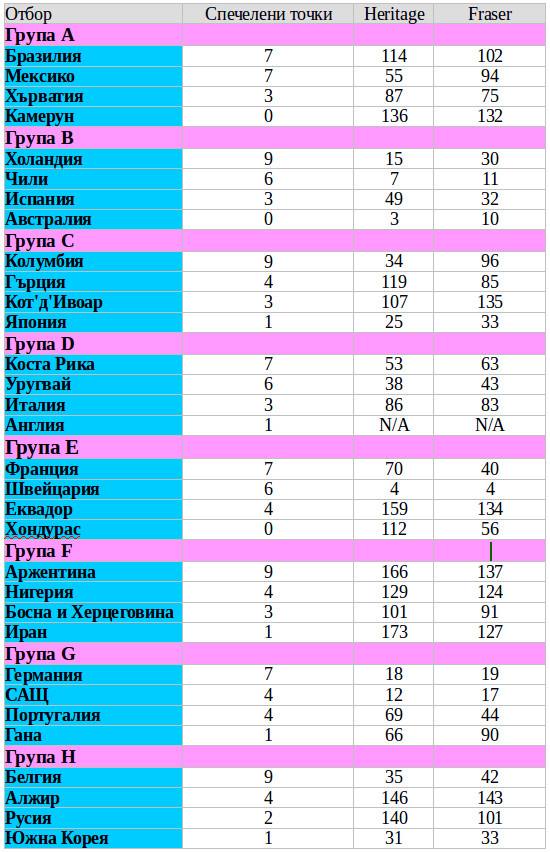
Table 1: Ranking of teams at the 2014 World Cup according to the Fraser and Heritage indices of economic freedom.
Conversely, two groups of “excellent players” are formed – group B and group G. With the worst indicator in group B is Spain, which everyone agrees is the big loser of the World Cup – a favorite for the cup, eliminated in the group stage after two heavy losses (coincidentally, the least free economy in the group). In group G, the distribution is even cleaner – the two freest countries, Germany and the USA, exit the group, with one of them eventually winning the title. In the other groups, the top positions are occupied by countries that achieve good results in economic freedom indicators.
The exceptions to this distribution are South Korea, Australia and Japan, which, despite their good achievements in the field of economic freedom, finished in the last place of the group stage. An explanation for this can be found in the complete absence of a football culture in all three countries, which traditionally focus on different sports.
After the group stage, the dominance of teams from countries with high indicators of economic freedom becomes even more obvious. France, Costa Rica and Uruguay “deservedly” achieved their victories in the round of 16 and quarter-finals. Here again, Argentina is the only example of a team from an unfree country that achieved good results. The teams of the “oppressors” Brazil and Argentina have had to win difficult victories, often after added time or penalties. The most indicative of this are the matches between Chile and Brazil and the Netherlands and Argentina, in which both countries barely managed to overcome their far freer opponents.
The conclusion that economic freedom is among the conditions for achieving football victories is reinforced by both final matches - the "small final", won unequivocally by the Netherlands, and the title match, in which Germany, although with difficulty, managed to win the trophy and call itself the 2014 world champion.
In conclusion of this – although not entirely serious – text, we should recall that economic freedom is of great importance for all spheres of human life and brings improvements in the quality of life of all of us. In other words, whoever wants to win football victories, it is high time to start privatizing, cutting government spending and removing obstacles to business!