EKIP– Expert Club for Economics and Politics A Different Opinion
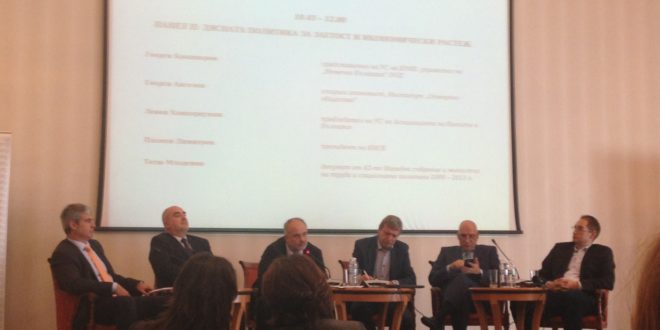
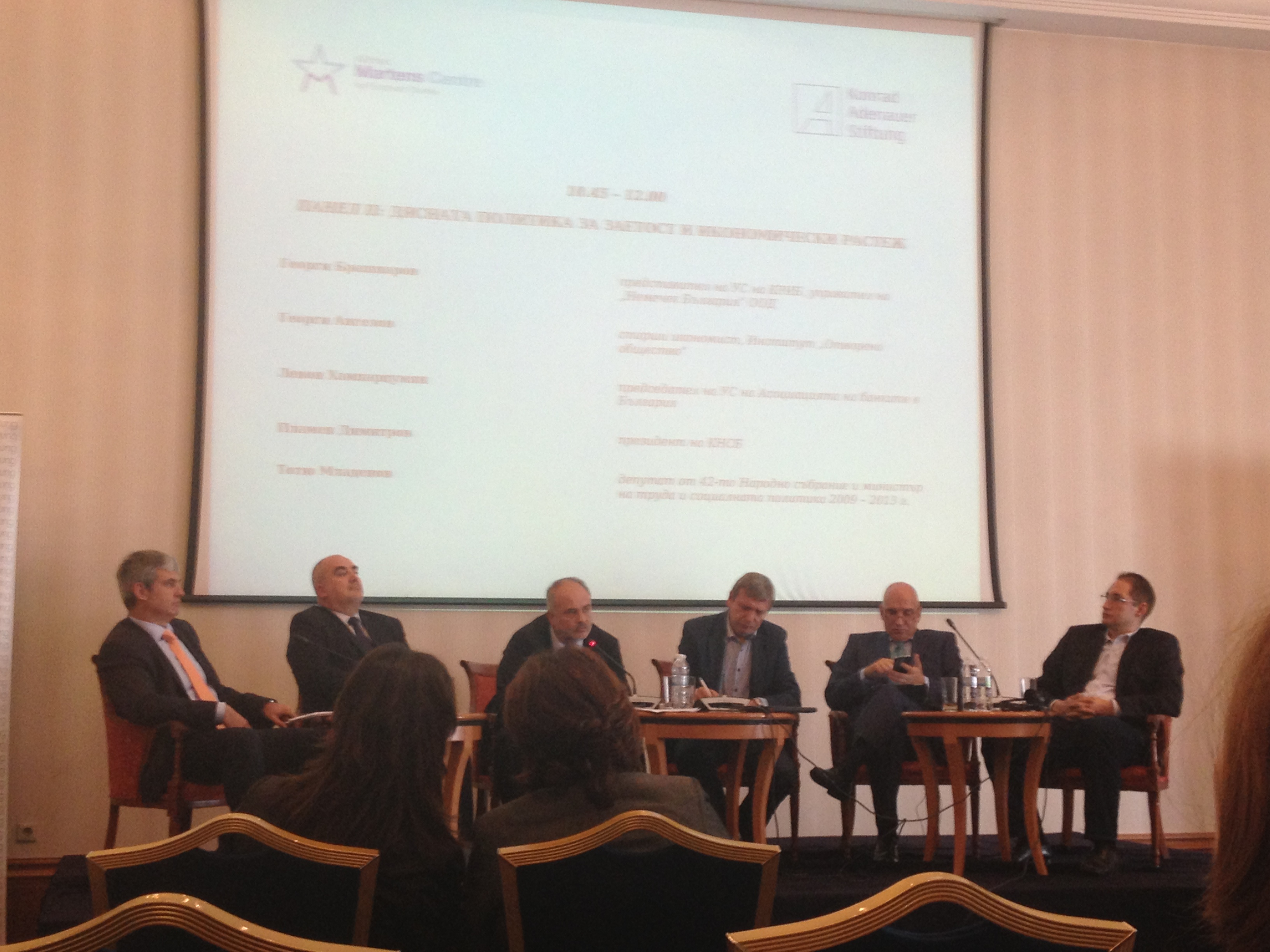
On July 17, in one of the smaller halls of the Balkan Hotel (former Sheraton) in the center of the capital, a conference was held under the title “Social Policy for Growth – the Right Path”, organized by the Konrad Adenauer Foundation, affiliated with Mrs. Merkel’s party in Germany. The main idea of the event, as the hosts explained, is to start a conversation about what good “right-wing” policies in the social sphere are – a truly interesting and important topic.
The event was divided into three long panels with a large number of participants - academic and NGO economists, politicians, political scientists, businessmen, members of the administration and representatives of trade unions. A variety of theses, proposals and comments were heard, which will be difficult to describe in such a short text, but the few hours were full of interesting and revealing comments.
Politicians
The representatives of the political class who had the most serious appearance were from the GERB family – Mayor Yordanka Fandakova, the President’s Secretary for Social Affairs Deyana Kostadinova and MP Totyu Mladenov. The main impression they left was of a rather serious collectivist bias in their statements and theses, as well as an almost complete lack of philosophical approach to “right-wing” ideas.
The talk (especially by Mladenov and Fandakova) was mainly about European programs and how they created a lot of jobs and prosperity (later the two were quite rightly pointed out by the representative of KRIB – Georgi Brashnarov – that these were temporary and not particularly sustainable measures). Fandakova made the absurd statement that somehow she had contributed to the low unemployment in Sofia, and not the fact that all business has been concentrated in the city for years. The representative of the presidency Kostadinova made a bad impression by reading several frankly left-wing measures from Merkel’s program and proudly stating that the right-wing ones could also be “social”. Still, we can give her points for mentioning the problem of TELK fraud and the failing pension system – of course, without providing a serious solution to either of them.
Fandakova also distinguished herself with her authoritarian speech on the subject of education, continuing to lobby the public vigorously for compulsory education from an early age. She was very pleased that the municipality had created its own "social program" and that it had the opportunity to spend more taxpayer money through European programs. Overall, an unideological and completely devoid of understanding of what "right" politics is, a presentation of the gerberas.
The trade unionists
Representatives of the two major unions, the Bulgarian Trade Union Confederation (KITUB) and the Bulgarian Confederation of Trade Unions (KT Podkrepa), were also an important part of the panels and discussions. Plamen Dimitrov from the Bulgarian Trade Union Confederation (KITUB) almost took on the role of something between a protected political insider (which he is) and a leftist student of OccupyWallStreet (which he tries to appear to be). He told us that the free market had failed, bringing about the crisis in 2007-2008, pulled out statistics on taxes and the Gini coefficient (which were refuted on the spot by Georgi Ganev and Krasen Stanchev), and boasted that he liked Juncker because, like him, he wanted to spend billions on “industrial policy” – which should only make fans of the top commissioner think about whether he is also a right-winger (or is he more like a Bulgarian trade unionist). Dimitrov brazenly developed the thesis (in front of representatives of serious, non-subsidized businesses) that all the growth of the economy during the transition was due to Peevski and Tsvetan Vassilev.
My favorite Dimitar Manolov (from Podkrepa) rightly stated that there is no good understanding of the “right” in Bulgaria and rather twistedly tried to suggest that only libertarians liked right-wing ideas, which is hardly the case, but it is true that they defend them most consistently and with arguments. Konstantin Trenchev (from Podkrepa) surprised me by speaking less socialistically than the right-wing politicians from GERB and the presidency themselves – mainly about decommunization and the moral collapse in Bulgarian society. Regarding the latter, it is perhaps important to note that the moral collapse dates from the time when a large part of those living in Bulgaria accepted the USSR and socialism with open arms, everything to that extent is a consequence – at least according to the author of this essay.
Economists and businessmen
Right-wing economists had a good performance again – Petar Ganev (from IME) enraged Dimitar Manolov (from CITUB) by mentioning the obvious truth of how the state controls all deeply problematic sectors such as education, healthcare, pensions, and then goes around pushing to regulate already successful and working things like supermarkets. Quite interestingly, Ganev also undermined the thesis of the “give money for education” group by mentioning that when you look at the data, the family environment comes out as a major factor for the future development of a child and going to university is more of a consequence than a cause of success. Something that anyone who has visited a Bulgarian state school/university would agree with.
Krasen Stanchev took it upon himself to correct Yordan Hristoskov, who had come up with some strange classification of the different social models and managed to pack more nonsense into one slide than Plamen Dimitrov did in his entire speech. Georgi Ganev explained Hayek's position on the rule of law, which will be very educational for many of his colleagues in the Reformist Bloc, because they have serious shortcomings in this area as well.
The business representatives also made an excellent impression. The aforementioned Georgi Brashnarov began with Reagan's classic quote that the best social policy is productive work/workplace. As a representative of the IT sector, Brashnarov said that they are doing much better than the others because they rely on themselves for training staff and for their "social" policy - without the state. With a dose of humor, he noted how the lack of unions significantly contributes to good working conditions.
Levon Hampartzumyan repeated a favorite thesis of mine - state services are so bad that people have already largely given up on them, which is why there are about 240,000 private security guards, as well as a huge number of private training centers and private teachers.
Conclusion
Unfortunately, Bulgarian "right-wing" politicians remain far from the dimension of ideas. What interests them most is which programs they can ride on to keep spending flowing. An ideological and principled compass (other than "I should redistribute more") is totally absent. It remains the job of others to change the climate of ideas in order to force the elected representatives of the people to become familiar with what right-wing policies actually are.