 EKIP– Expert Club for Economics and Politics A Different Opinion
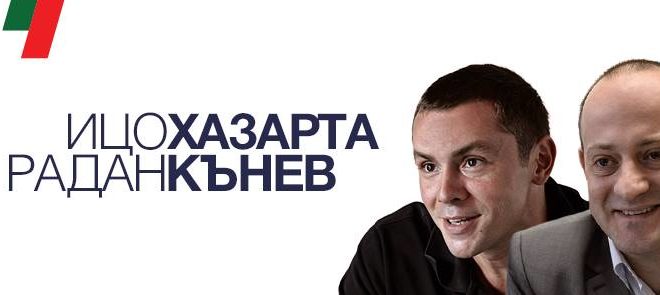
Yesterday, in a successful PR move, the headquarters of the Reformist Bloc managed to include in Radan Kanev's live interview with Kapital newspaper hip hop artist Itso Hazarta - making the conversation significantly more interesting and watchable. The Upsurt rapper himself insisted on camera that he wanted to support "Radan and the people around him" because of their ideas, so it would be interesting to write a review of at least those of them who were mentioned in the live broadcast.
The best impression was made by Kanev's position on Corpbank, which is diametrically opposed to that of his mentor-turned-lobbyist Ivan Kostov. The new chairman of DSB stood for taxpayers not to cover the oligarchy's bills, and the state not to save the bank with new public debt. Of course, Kanev then diluted his comment with personal ideas about how exactly to spend foreign money and confirmed the saying that the difference between red and blue statists is what they plan to use your money for.
Kanev's comment about Bulgarian emigrants, which followed the conversation about Corpbank, did not make much sense. After the journalists from Dnevnik asked him how he would convince the diaspora to return, Radan basically developed the thesis that the most important thing is to give them the right to vote (with preference) and mumbled something about electronic government. Of course, before that he explained for a long time how important Bulgarians abroad are and how much they communicate with him. The holes in the ideology began to appear.
After a long silence, Gazarta joined in, hopefully stating that people will vote “because they’re not stupid and they see things, they know they can make a difference…they’re not stupid, they’re not stupid.” Although the rapper presented an unqualified defense of voting as a method for achieving positive political change, I would direct his attention to the work of Nobel laureate James Buchanan and his colleague Gordon Tullock, who hold a different view. In The Calculus of Consent, they explain why and how systemic political decisions are actually made, and in The Vote Motive, why voter ignorance is completely rational (something that is proven to us in every election).
The icing on the democratic cake was the statement that everyone who votes (regardless of who) deserves respect...because that's how democracy works. That is, even if you vote for dark red class struggle or light brown Nazism, as many of our relatives, neighbors and friends like to do, you still deserve respect, because you bowed your head before the deified democracy, because "we are given this opportunity - to vote". We are deeply grateful for this unique opportunity, thank you for the opportunity, as they say.
Another serious topic that bothers the duo is education. The interviewers started with an inappropriate question about school toilets, but Hazarta and Radan wisely move on to another level by grumbling about what kind of heroes teachers are and how they would disappear. What worries Kanev the most are political appointments in education, here is a quote from the Dnevnik page:
"School principals are already party appointments, teachers and doctors are coming up," he said, adding that the moment party-based appointments begin for these positions, the last worthy people will withdraw from them."
I have a solution for Mr. Kanev, it is very easy to eliminate party appointments in all activities that the state controls by depriving them of their presence. Remove the monopoly of the Ministry of Education, remove the monopoly of the NHIF, separate both sectors from politicians and bureaucrats and let's see exactly what appointments there will be and what you will pay for the toilets.
After the weak question about the toilets, there followed a rather specific and serious one about one of the most rotten systems in the country - the judicial system. There, Kanev's words were rather reasonable, the reforms he proposed - in the direction of reducing the concentration of power in various judicial cabals and in the Stalinist (and according to Kanev himself) Chief Prosecutor's Office. It would be good if this was the only topic on which the former spokesman of the Republic of Bulgaria spoke, but alas.
In the last part of the conversation came the classics and the material for newspaper headlines. Gambling started "strongly" by stating that he had not noticed a problem with homophobia in Bulgaria, which would have been a good joke if it were not a more painful topic for many people. Then, in order to get out of the question, he said that he was not as capable as politicians and it was good that he would not solve these things. Radan, for his part, started to overdo it by saying how close he was to human rights activists, how many LGBT friends he had, but still gay marriages are impossible because violence would break out in society - so dear gay people, you will wait until the homophobes get comfortable.
Finishing with gay marriage, the interview moved on to drugs. Kanev expressed doubts that freedom is a good thing if it also includes drug use. No one should be punished "if a joint is found in their bag," the politician said, but on the other hand, he does not like the idea of Bulgaria as a destination for drug procurement, as we have become for alcohol tourism. That is, regardless of whether we want to dispose of our lives, sick people with their medicine, and entrepreneurs with their businesses, Kanev does not like it!
He also does not like the legalization of prostitution due to "unestablished legality" in the state, he prefers that this business continue to be underground, that those working in it are by definition criminals and that there is no possibility of solving possible health or violence-related problems in it. And they cannot be solved by criminalizing voluntary human relationships. As a conclusion on the topic, the legalization of prostitution would lead to "a nasty monopoly pimping", and why - science and Radan are silent.
The DSB politician also presented another prediction, something new for economic science called "monopoly cartels", which will appear if we legalize drugs. Here I will quote Milton Friedman (who may not be at the level of Ivan Kostov - recognized by Kanev as an authority in the field of finance), but he still knows something about the topic: "If you look at the war on drugs from a purely economic point of view, the role of the government is to protect the drug cartel". In a free market without heavy regulations, prohibitions and political interventions, neither a monopoly nor a cartel can exist for long.
In the end, we catch both interviewees in serious inadequacy on most of the topics in the conversation. It turns out that they are not just in the wrong position on drugs, prostitution or education, they have no idea how to at least partially adequately present a coherent defense of their theses. In the end, instead of hearing at least one new reason to exercise our vote in favor of the Republic of Bulgaria, we get at least three that make us do something more useful on Sunday – whether because the leaders and activists of the Bloc showed us that they do not understand how the democratic process works, whether because they have retrograde positions on serious topics or simply because they have no ideas.
P.P. for freedom lovers
A line that is shocking, but above all it betrays a way of thinking on Kanev's part - "as long as there is no state prosecution and state repression..." nothing can happen.






I appreciate the effort, but I don't understand what the condescending tone of the article is about.
It is true that democracy, which EKIP is clearly against, is not the fairest form of government. But considering that there is no prospect of it being replaced by something better in the next several decades, and that Radan Kanev is a representative of the Bulgarian organization that is closest to free market ideas, I find the attempt to denigrate his name and work inappropriate.
The condescending tone would be appropriate if the EKIP had achieved something equivalent to what the Reformist Bloc represents. Hopefully, this will happen, because even on the free market, talk is cheap. And it is a pity that, because they are unsupported, the words of the experts are accepted as empty talk.
P.P. Even in some dictionaries the expression "diametrically opposed" is inserted, but why should the TEAM use it? If something is "diametrically opposed", it is opposite. If it is "opposite" - it is diametrically opposed. But if it is diametrically opposed - then it is the same. Let the experts not contribute to the development of meaningless language.
PP
EKIP has no editorial opinion on "democracy", but I wouldn't say that Radan is particularly close to free market ideas. And the article is not an attempt to denigrate, but rather to present the meaning of his own words, which betray an absolute lack of information on the topics he comments on.
As for EKIP, we have never aspired to be a small party, ready to do almost anything to extract money from taxpayers, through subsidies, and to show up in parliament.
I did not intend to provoke a self-defensive reaction with my comment, but to understand the real basis for the "slander". The impression left by the article is such because of its condescending tone.
As for Kanev's accusation of "absolute lack of information", let's see two of your comments, briefly:
1. "The best impression was made by Kanev's position on CorpBank..."
I think the TEAM takes the same position.
2. About the Judicial System: "Kanev's words were reasonable, the reforms he proposed - in the direction of reducing the concentration of power ..."
I think that here too, the positions of Kanev and the TEAM coincide (one would say diametrically opposed 😉 - identical.
This shows that it would be true if the article exposed Kanev's not absolute but _partial uninformedness_.
On the other hand, partial lack of information - or partial erroneous positions by Kanev - is an indicator of existing common positions.
Of course, I am far from thinking that the TEAM could support people with whom it has even some common and positive positions. It would be very strange for the Bulgarian scene.
The article is very good, including the condescending tone. I don't feel like writing justifications, so I'll just say that if the condescending tone (such as that of the Republic of Bulgaria) towards Boyko Borisov is appropriate, then such a tone is also appropriate towards the Republic of Bulgaria when it clearly has something to do with it.
А по въпроса за демокрацията (за която EKIP няма мнение), се изкушавам да кажа следното:
Демокрацията е не състояние, а процес, който е започнал преди няколко века и ще продължи още неизвестно колко. Същността на този процес е, че все повече хора вземат някакви управленски (засягащи цялото общество) решения. Започнало се е с един вожд/цар, който е имал цялата власт, след това възниква разделението на властите (законодателна, изпълнителна, съдебна), парламентите (поделящи властта между няколко десетки или стотин човека), независимите органи (като Централните Банки) и т.н. По отношение на гласуването пък, в САЩ например, в началото са гласували само земевладелци, бели, мъже. След това започват да гласуват и не само земевладелци, не само бели, а днес и жените. Т.е. (да повторя) - все повече и повече хора вземат някакви управленски решения. Така стигаме до представителната демокрация, която всъщност си е пак авторитарна система, в която обаче властта е доброволно делегирана на определен брой индивиди (които, както виждаме, спазвайки някакво фасадно приличие, пак могат да злоупотребяват както си искат с нея). Но това все пак е по-добре от преди (когато властта е била не доброволно, а насила узурпирана) и така представителната демокрация се явява необходима еволюционна стъпка към истинската демокрация, която (както подсказва и самото име), е ПРЯКАТА демокрация. Което значи, че разширението, което вече е достигнало максималния брой хора (всички пълнолетни), ще продължи в дълбочина и тези хора, ще вземат все повече и по-съществени управленски решения.
...What has been said about democracy is in the hope of helping to form an opinion (about it).
Here's another piece of material with a condescending tone (and fueling the idea that politicians are in serious need of education):
The political views of a public school teacher accidentally elected as a deputy
(Teacher Anna Barakova to Diana Naydenova in "Drive Straight", Nova TV, 19 Oct 2014)
http://novanews.bg/news/view/2014/10/19/89851
Радан Кънев най-близкия до свободен пазар... не беше ли точно неговата партия, която предложи price controls за "чувствителни" стоки или нещо подобно. Възмножно най-anticompetetive мярката, която съществува, директно водеща до изритване на малките фирми и завземане на пазара от големите (заради economy of scale).