 EKIP– Expert Club for Economics and Politics A Different Opinion
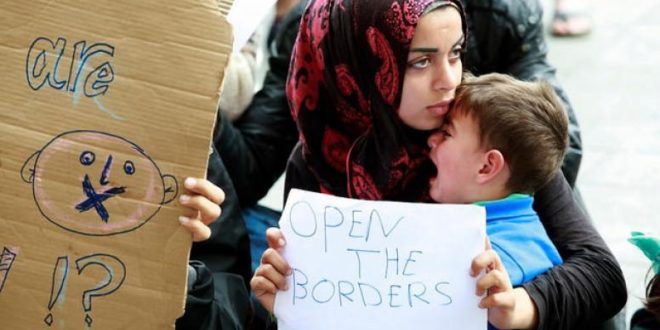
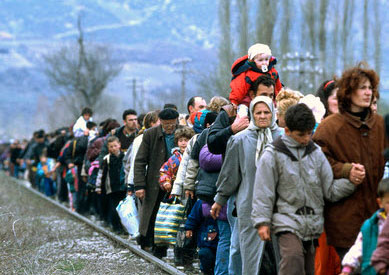
This article will not appeal to many libertarians. The reason is that in it I am trying to follow general moral principles on a subject for which society as a whole wants temporary immoral measures. Many libertarians, in my opinion, have succumbed to this general attitude in society, and have unwittingly abandoned, at least temporarily, their stated moral principles. Specifically, the principle that the state cannot be trusted, and the state should not be allowed to control individuals who have committed no crime. And also the principle that what is not a moral crime, that is, no individual victim is harmed, cannot and should not be a crime under state law. That is, the state should conform to what is moral, not the other way around.
I believe in the free emigration of non-criminal individuals. Free, meaning that no government has the right to take away the freedom of people to travel and seek a livelihood wherever they wish. The only exception should be a crime committed against specific other individuals, or an openly declared political position of threat to the legal order. State borders are state borders, they are designed to stop not individuals, but other states and their ambitions. When an individual crosses a border to find a livelihood or safety for himself and his family, he is not a state, nor is he a representative of a state, nor is he an invader. He is doing what every conscious person should do. Criminalizing such people is barbaric. Modern immigration laws in the West are barbaric, from a moral point of view. If it is a question of someone who has openly made threats against the legal order in Western countries and is a proven criminal, that is another matter. It is not a question of immigration, but of fighting crime. And very often it is criminals who legally obtain visas, so in reality immigration laws do not stop criminals, they stop honest people. Not to mention the excessive power in the hands of government officials, which ultimately extends to their own citizens.
The question, then, is, given these views, what do I think Europe should do about refugees from Syria?
Are they not a threat to European culture, as many claim, and should we not stop them because they rape, destroy, defile, etc. If I am so “principled” in my libertarianism, what are the “principled” libertarian solutions, in my opinion, to this developing immigration crisis? Are there principled libertarian solutions that do not give more power to the state over the individual, do not oppress decent people, and at the same time protect European culture from challenges such as increased crime and the formation of radical Muslim enclaves in its heart that will undermine it?
My answer is: Yes, there are such principled libertarian solutions.
First of all, of course, we need to truly inform ourselves about the real situation and the real dangers of the refugee wave.
One would think that after decades of communist propaganda and false alarms about apocalyptic threats to humanity, at least the more intelligent part of the population would have learned to separate the wheat from the chaff. I have developed a protective habit: When a given “information” tries to scare me with bombastic direct apocalyptic threats, promising me immediate disasters if I don’t quickly and mindlessly do something or demand that politicians do something, that information is just propaganda and should not be taken seriously. For example, “TERRIFYING ATROCIOUSNESS!!! THOUSANDS RAPE IN GERMAN CITY BY REFUGEES!!! MASS ARSON AND LOOTING!!! ISLAMIC STATE FIGHTERS TAKE UP POSITIONS!!!”, is clearly a piece of crap of the lowest quality and should not receive any attention from serious people, let alone libertarians. Such clichés should not govern our responses to the situation, and are in fact far more dangerous to European culture than the worst that Syrian refugees could do to it. So the best response to these clichés is to ignore them.
Other partners are more subtle, they do not use bombastic phrases to intimidate, but simply provide distorted or false information. For example, photos of refugees in Germany together with photos of them with weapons in the Middle East, and a “professional” comment, “Jihadis are arriving in Europe as refugees.” To many unfamiliar with the Middle East, this seems convincing, but not to those of us who are informed and understand Islam as a religion. Radical Islam is a legalistic religion and has a very strict dress code for Muslim men. There are specific rules about beards, clothes, hair, tattoos, etc. A young man in jeans and a T-shirt with an embroidered emblem or some drawing on it, clean-shaven and with hair cut in a Western fashion cannot be a jihadist, even if he is holding a weapon in his hands. He is most likely a Maronite, i.e. a Syrian Christian, and the real jihadists would most likely execute him if he were among them. An equally clean-shaven middle-aged man, wearing a Russian camouflage uniform from 15 years ago, an American bandana, and holding a PK with a battered cartridge box, is also not a jihadist, but most likely a member of the secular Free Syrian Army, which is fighting both Assad and the Islamic State, and in its areas of operation is actually protecting the population – Muslim and Christian – from the atrocities of both great powers. To abandon our friends in trouble is unacceptable enough from a moral point of view; but to openly and irresponsibly count as our enemies those who by nature and conviction – and at the risk of their lives – are our friends is truly the height of moral perversion. I am not saying that it is not possible for there to be jihadists who have slipped in among the refugees; The problem is that by making our friends our enemies, we only help our enemies.
There are also more sophisticated partners. For example, some follow groups of refugees and take compromising photos. A large group traveling in buses was stopped somewhere in the middle of a field to decide where they would travel, and then suddenly rushed in some direction. The people in the group used the opportunity to have lunch, and when leaving, they left their trash. And so, these people are dirty, unbecoming of Europeans, have no hygienic habits. And almost none of the readers stop to think that there are no trash cans in the middle of a field, and that people are being herded like cattle without knowing where they are being taken and what they will do, and carrying their trash with them in addition to the little luggage they can take is not the most sensible thing they can do. Or that they were given food and they left it, so they were not hungry. Well, they are in a foreign country where they know there is plenty of food, but at the same time the climate is colder, and they still don't have a roof over their heads. With limited luggage space, what is more sensible to take, food or clothes?
Or this: They weren't real refugees, most of them were young men. What kind of argument is that? Isn't that proof that they are serious? I know many young Bulgarian families who emigrated to the States and Canada like this: first the man to find a job, then the family. This rather suggests that these people are serious about settling down and finding a job; if they planned to live on welfare, it would have been much easier for the women and children to end up in social care.
Such propaganda does not help solve problems. Rather, it is designed to frighten European populations into submission, making them even more susceptible to state control. As Henry Louis Mencken noted nearly 100 years ago, “The whole purpose of practical politics is to keep the population anxious (and then ostentatiously led to safety) by threatening it with an endless series of demons, all of them imaginary.” A frightened man is always ready to accept the “patronage” of the stronger, and politicians know this psychology well. So the first libertarian solution is to ignore such statist propaganda, and even to denounce it when we have the opportunity. Yes, the arrival of so many refugees will bring with it new challenges and new problems—cultural, legal, economic. But distorting information about these challenges and problems will only complicate them, not solve them.
But let's assume that there really is a problem with crime among refugees, and there really is an increased risk of rape. After all, we know that in the Muslim world, women are not particularly protected, and with the arrival of many Muslim refugees, this attitude could be transferred to European soil. This brings us to the second solution.
The second solution
It consists of two components: (1) to encourage Christian churches in Europe, official and unofficial, traditional and non-traditional, to evangelize among refugee groups, and (2) to allow the free bearing of arms in Europe.
Here I have certainly lost at least half of the readers who instinctively disagree with one or the other point. But the truth is that both points are rational, and are consistent and consistent with both libertarian values and the realities of the modern world. They are related to that concept that is at the heart of all libertarian thinking: individualism. Every problem in society, and every solution to a problem, ultimately comes down to the individual level. Formulating problems and searching for solutions at an aggregate, collective level never works; a person may consider himself part of some groups and collective, but in the end he makes individual decisions tailored to his individual interest. Thus, the problems in education are not problems of funding or structures, but of individual motivation in students and individual conscience in teachers. The problems in the economy are not problems of mechanisms and cash flows and interest rates, but of individual work ethic, entrepreneurship and innovation. And so on.
Therefore, the problem with any crime is primarily a problem at the individual level: the criminal attitude of the perpetrator of the crime and the defenselessness of his victims. Until these two factors at the individual level are addressed, there is no solution to the problem of crime.
It should be obvious to everyone that the problem of criminal attitudes among refugees and immigrants is primarily a religious problem. Or perhaps not just primarily, but completely. All the news about the problems with immigrants in Europe, all the commentary about refugees, assumes that the cause of the problems is not any immigrants or refugees, but Muslim immigrants or refugees. Of the 130,000 Iraqi immigrants in Sweden, 120,000 are Christians, but we do not hear of them creating any cultural or social problems. Arab Christians in the United States make up two-thirds of all Arab immigrants; Arab Christians are seven members of Congress and the Senate, many are in politics and local government, and even in high positions in the armed forces, but there is no visible cultural difference between them and other Americans. Six million Arab Christians in Brazil do not create any problems with enclaves and crime. About 70% of immigrants in France are mostly Christian or Buddhist, but even these immigrant groups are not heard of as being a problem for French society and culture. The problems always come from a specific religious group: Muslims. Obviously, there is a problem with their religion.
Ultimately, whether we realize it or not, whether we acknowledge it or not, Henry van Til's words are true: "Culture is religion externalized." Or, in the words of Richard Weaver from the title of his 1948 book, "Ideas have consequences." There is something in the religion of Islam, something in the ideas it instills, that makes Muslims culturally unsuitable for the modern world and its mainstream culture. Some idea that gives transcendent, divine support to the criminal and antisocial attitudes of many Muslims; and thus justifies in their eyes the crimes they commit. And if attempts to solve the problem do not address religion, they will not be successful.
The good news is that a person’s religion is not something that is fixed. A person can abandon the religion they grew up with and adopt another religion or another ideology. And changing religion or ideology inevitably changes a person’s cultural outlook. And of all religions and ideologies to date, Christianity has proven to be the most successful in converting Muslims from their religion. In 1895, a Cairo newspaper owned by an influential Muslim merchant asked in an editorial, “Will Islam Survive?” and concluded that Christianity was the religion of modern times, and therefore there was no hope for Islam. More than a hundred years later, senior Muslim clerics acknowledged that over a million Muslims a year were converting to Christianity (15,000 a year in France alone, according to Muslim figures); and traditional Muslim communities even in the Middle East – in Kurdistan, Morocco, or Mauritania, for example – that until 20 years ago had not seen a living Christian, now have growing churches started by Christian missionaries.
If these Christian missionaries can be successful in the very heart of the Muslim world, how much more so among refugees who are uprooted and therefore have weakened ties to their inherited religion? This religious energy and enthusiasm can and should be used to change the religion, and therefore the cultural views and habits, of refugees from the Middle East.
(Of course, the objection here would be that one does not have to be a Christian to be moral. One can be an atheist. Of course. But it is difficult to imagine vigorous organized activity of atheist missionaries, combined with preaching ethical and cultural values based on atheism. You can't beat something with nothing.)
The free ownership and bearing of weapons is no less controversial, but this decision is supported by both rational logic and the realities of the world today. When the criminal mindset of a person has not yet been eliminated, the ability of the individual victim to defend himself is a reliable means of preventing crime. Opponents of the free bearing of weapons like to refer to the high rate of deaths from firearms in the United States (which, strangely, continue to occur in areas where guns are banned). What is rarely mentioned is the extremely high rate of rape in Europe compared to the United States: Various European countries have 5 to 10 times more rapes per capita than the United States. Given the frequent use of personal weapons for self-defense in the United States, one can conclude that the low number of rapes is at least partly due to the higher number of deaths from firearms - some of these deaths are of rapists, of course. The lack of personal weapons in Europe clearly creates a fertile environment for rapists; when this environment is combined with a religion that does not consider rape a crime – and even blames the victim – it would be a miracle if rape did not increase.
At the level of individual motivation – at which level libertarians, if they are consistent with their views, must reason and find solutions – the rapist does not usually risk his life to rape. (The desire for carnal pleasures and the willingness to sacrifice are diametrically opposed as psychological attitudes.) Nor do rapists engage in gunfights to achieve their goal – again, there is a risk to their lives. Even the smallest and seemingly harmless gun in the hand of a potential victim evens the odds. This applies not only to rape, but also to other types of crimes, such as robberies, racketeering, and premeditated murders. The history of Bulgaria in the 1990s would have been different if ordinary people and small business owners had the legal right to shoot boys with bats who entered their property. Similarly, today, the rate of rape in Europe would be much lower if victims had cheap access to personal weapons and the legal right to use them.
These two – Christian evangelization among refugees and free gun ownership – will be a serious factor in preserving European culture against challenges from Muslim immigrants and refugees.
Of course, we should not overlook the role of the judicial system. But the judicial system cannot function without the support of a large section of society – and specifically, that section of society that is closest to the criminal and can therefore bring him to justice and testify against him. This leads to the following libertarian solution, which, as one might expect, is again based on the principles of individualism:
The third solution
Treat refugees as individuals, not as members of a group. That is, refugees should not be herded like cattle into refugee camps, but should be released immediately to begin the process of their integration into society as individuals – to find work, housing, etc.
Each individual views his membership in groups in the same way he views any other activity: through the prism of benefits and costs. If the group brings him more benefits (work, entertainment, income, friends, prospects, psychological satisfaction, etc.) than costs (missed opportunities, boredom, etc.), he will hold on to his membership in the group. When the larger society brings him more benefits as an individual than the group, he will prefer to live as an independent individual, and his loyalty to the group will decrease. When his loyalty to the group decreases, he will be less likely to tolerate criminals simply because they are part of the same group, and he will be more likely to cooperate with the courts in convicting these criminals.
This analysis, however, holds only when the paths to exit or entry into a given group are completely free and there are no social pressures or constraints on individuals' decisions about whether to belong to a group and which group to belong to. Freedom weakens loyalty to groups and strengthens loyalty to moral principles—primarily because most individuals personally benefit from an increased level of integrity in society. When these paths are not completely free, then the situation changes.
In the presence of some social stigma or government restrictions on leaving the group, the cost-benefit analysis changes completely. In the larger society there may be some theoretical benefits to the individual that outweigh the benefits of the group, but if the individual is prevented from accessing them, these benefits will not figure in his personal cost-benefit analysis. His loyalty to the group will then be strengthened, if for no other reason than because the group is all he can have. This increased loyalty will lead him to side with the other members of the group against the larger society—after all, the larger society is the real oppressor, seemingly providing opportunities but in practice taking them away. In such a tightly knit group—because of social stigma or government restrictions—criminals will always find easy refuge from trial and punishment: the whole group will support them because they have no choice.
The same applies when there are artificial positive incentives to remain in the group: for example, state policies for “Roma integration,” which are reduced to monetary “rewards” for remaining in the Roma community – because social benefits are nothing more than a reward for remaining in the same social status.
The almost supernatural internal loyalty and cohesion of the Jewish community, inexplicable for medieval Europe, which made it possible to create the first transcontinental banking syndicates, finds its easy explanation in the Netherlands, England, and the United States: Where the ghettos are gone, the social stigma of being Jewish is removed, and access to the larger society is free, loyalty and cohesion disappear within a generation or two. In the United States today, the Jewish community – if one can even speak of a “community” – is as divided politically, economically, and culturally as society as a whole.
The continued policy of state relocation of refugees as whole groups will increase internal cohesion and loyalty among them, and will also increase resentment towards the larger society. Therefore, the current policy not only does not solve the problem, it complicates it, and sets a time bomb. It is obvious that if we want their integration into European society, the last thing we should do is keep them isolated as individuals from European society, forcing them to rely on the internal ties of their community. Every one of these people must be released as soon as possible and encouraged to find a livelihood and housing separate from their environment, to live as independent individuals and reap the benefits of society. While they are forcibly kept in their “ghetto” and moved around like cattle, this will create a favorable environment for criminals who will take advantage of the loyalty and cohesion in the “ghetto” to evade justice.
These three: (1) better information and rejection of cheap scaremongering; (2) encouraging evangelization of refugees plus liberalization of the regime of personal gun ownership; and (3) giving refugees individual rights to participate in society, rather than being treated as a group or herd, should be the libertarian solution to the problem. The three solutions are based on the basic methodology of libertarianism – individualism – and reject the basic methodology of the total state – collectivism.
There remains, of course, one final question: Should we care? Can't we not deal with the refugees, but simply want them to be sent back to Syria or wherever they came from, and not deal with them? Would there be any problem for European culture or for libertarianism as an ideology if we simply wanted Europe to close its borders to various immigrants, and that would be the end of the matter?
There probably won't be any immediate problem. After all, Europe has existed without Arab immigrants, and it probably will continue to exist for some time to come.
The problems, however, will manifest themselves in the future.
First, returning refugees to the conflict zone will only postpone the problem for a later date, and probably make it worse. If most of these people are sincerely seeking salvation from their problems, the refusal will embitter and radicalize them. The next generation will grow up to be ready-made material for terrorist propaganda. Then our children will have to deal with the same problem, on a larger scale. The solution is for us, Europeans, to establish control over the minds of their children through our culture before they are radicalized.
Второ, неотменимото правило при всяко политическо действие е, че каквото държавата направи на по-слабите групи в обществото, утре ще го прави на цялото общество. Думите на немския пастор Мартин Нимьолер важат за всяко време и за всяко общество:
First they came for the socialists; I didn't protest because I wasn't a socialist.
Then they came for the union members; I didn't protest because I wasn't a union member.
Then they came for the Jews; again I didn't protest because I wasn't Jewish.
Накрая дойдоха и за мен – и нямаше кой да протестира за мен.
Our duty as libertarians is to advocate for the freedom of all individuals who have not committed crimes. When we allow the state to take away the freedom of one group today, tomorrow it will take away our freedom as well.
And third, for us as libertarians, the issue of ideological consistency and fidelity to principles is important. Ayn Rand finds the reason for the victory of the communists in Russia not in their strength, but in the fact that they had an idea and were consistent with it. Their opponents, according to Rand, did not even have an idea, and where they did have one, they were not ideologically consistent with it. Ultimately, any conflict of ideas in society is won by those who are consistent and true to their ideas. Inconsistency weakens the ideological position.
Thus, if we as libertarians support a collectivist, statist solution to refugees, instead of seeking the solution of individualism and freedom, it will compromise our principles, and ultimately weaken our position. We personally will not suffer if refugees are deprived of the opportunity to find safety and sustenance; but the ideas of freedom will be compromised if we do not find and propose solutions based on our moral principles, individualism and freedom.
In conclusion
We cannot deny that European culture and Western civilization are facing a serious challenge posed by the refugee wave. There is a problem, and a solution must be sought. On the other hand, there have always been challenges, and today's is no greater than other challenges that the West has experienced since the collapse of the Roman Empire. There is no reason to panic to the point of rejecting any moral rules in the search for a solution. A few thousand refugees are not the end of European civilization; this civilization is stable and strong enough to withstand far greater shocks. Losing our common sense because of bombastic propaganda is more dangerous and harmful than anything that refugees could do to us. Solutions must be sought in our moral principles, and especially in our dedication to individual freedom as a moral principle; not in panic and fear and in insisting that the state act against refugees in a way that we would not want them to act against us. Because like other imaginary threats, this one will pass; but in order for us to work for freedom in Bulgaria, we must maintain our libertarian sanity, and act and think like libertarians.






I don't have anything against immigrants if they enter through the official doors at the border, but there needs to be order, starting with their accommodation and investigation, and ending with the explanation that the economy of the country or the EU as a whole cannot absorb them because unemployment is high and everything will collapse.
When individuals are heavily in debt, they need to earn good wages to service the debts and keep the economy going, meaning that immigrants can work for less money because they don't have a loan, but that will ruin everything, meaning that corporations, etc. employers, should pay less because they are also heavily in debt (27 trillion according to the IMF).
For the wheel of the economy to turn, there must be finite demand, and recently data came out that 25% of the world's workers earn $2 a day, so what consumption can there be with that $2?
Separately, final demand is stimulated by lending and distribution, and Silvio Gesell's negative interest rates and the successful experiment in Austria are a separate topic, but this will no longer work, although at the IMF scientific conference in November 2013, former US finance professor Larry Summers proposed negative interest rates as the only way out, supported by Nobel laureate Paul Krugman.
In other words, 51% of the world's problems come from banksters and other financial speculators, that is, from the deregulation of financial capitalism, and for industrial capitalism, it is a separate topic, such as deregulation and the "invisible hand" of the "free" market.
Telling the truth is a kind of help for the purpose of repentance and perhaps it should start with - ''In 1975, the UN General Assembly voted Resolution No. 3379, which condemned Zionism as a form of racism and racial discrimination.''
and I have explained what Moses said, "Give to a foreigner interest," that is, everything - https://www.facebook.com/atanas.shalapatov/posts/1552051295073099
to encourage Christian churches in Europe, official and unofficial, traditional and non-traditional, to evangelize among refugee groups”
From the thorn of a hawthorn. We will make Christians out of Muslims... And how will that help? Well, these two religions are almost the same. The fact that Christians massively violate the principles of their religion (or do not know them) does not cancel this fact.
According to Christianity, a woman is the property of a man (like cattle), the same is true for Muslims.
Rather, they should be exposed to atheistic propaganda, not Christian propaganda.
The author does not understand atheism when he says:
"Of course, the objection here would be that one does not have to be a Christian to be moral. One can be an atheist. Of course. But it is difficult to imagine vigorous organized activity of atheist missionaries, combined with preaching ethical and cultural values based on atheism. You can't beat something with nothing."
Atheism is nothing.
Mr. Atesite is right,
Atheism is nothing. Atheism is nothing of the second degree. It begins with the presumption that man comes from nothing (evolution) and ends in nothing (lack of view of eternity). Moreover, the morality of atheists is not transcendent but situational (the right of the strongest and the right of the herd). Atheism deals with the so-called situational ethics. These two things - evolution and situational ethics - make atheism nothing of the second degree.
You cannot oppose a religion that has transcendent morality, albeit incorrect, with situational ethics for squeamish people and a fragmented view of history.
Moreover, Islam and Christianity are far from the same thing. The second part of the Decalogue begins with: "Thou shalt not kill!", and in Islam this moral commandment does not appear. Even the killing of infidels is considered a holy cause.
You are also wrong about women. You are simply speaking unprepared. The Bible teaches that women and men are ETHICALLY equal and FUNCTIONALLY different. I will not take the time to explain to you in detail what this means, but it is not right to speak like that without having done your homework based on prejudice.
And last but not least, civilized Europe owes its civilization to Christianity, not to atheism.
Now tell me what are the ethical and moral values at the heart of atheism?
I am an Orthodox Christian, but I cannot distort my soul, Protestantism and Catholicism in those centuries have tarnished Christianity a lot. You are a sectarian using cheap sophisms. And you are an illiterate ignoramus, there is no word in the Bulgarian language "homemade". If atheism were nothing, you would not mention it, no one else would mention it, it would not exist. If we look at things realistically, most prominent philosophers, physicists, psychologists, doctors, biologists and other scientists in Europe were agnostics, anti-theists or atheists. Newton, Tesla, Protagoras, Spinoza, Darwin, Nietzsche, Servetus, Copernicus, da Vinci, Protagoras, Plato, and all the other ancient Greek scientists who formed the basis of our civilization were not Christians, even deists like Einstein and Kant were not Christians. The earth is spinning, Mr. Sectarian, it is spinning.
Turlyugyuvech with telling half-truths and outright lies - there is no greater profanity and sloppiness!
Congratulations on the wonderful article!
Since the beginning of the crisis, I have expressed a similar position - few have heard me, but most people succumb to petty, everyday fascism. But nothing is better than a voice in the wilderness than no voice.
The author claims that "there is no individual victim harmed". Not true! The immigrants are using public property that is not theirs. Those who disagree with accepting them are harmed, since they did not voluntarily give money or property (the owned ideal shares of public property) for these people.
Inviting someone to live in the common areas without the consent of all owners goes against libertarian principles!
In my opinion, there is a simple and fair solution. If someone is for accepting immigrants, let them accept as many as their personal home or other property and funds allow! If they want guests, let them bring them in and not ask others to welcome their guests!
Otherwise, no one is against the free movement of people. As long as people follow the accepted rules for movement through the given territory. After all, the owners of the property/territory also have rights!
It is not Christian to give something that is not yours!
If someone wants to give to the immigrant, no one stops them from inviting him into their house, feeding him their bread, and spending their money on him.
But if he asks others to take care of his guest, that person is two-faced and arrogant!
The author of the article is a liar!
These are not refugees, they are immigrants.
It's not thousands, it's millions.
Has anyone seen a Syrian Christian enter Europe? And there are many Christians there. But people can't escape!