EKIP– Expert Club for Economics and Politics A Different Opinion
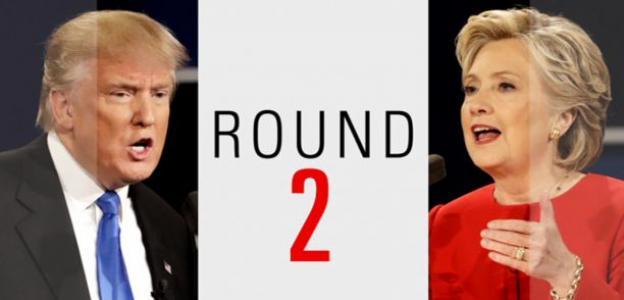
We have gathered the comments and first impressions of various EKIP writers on last night's debate between Hillary Clinton and Donald Trump. The compilation will be updated throughout the day.
Dimitar Karagegov: In the first part of the debate, Trump was tragic and I started writing about how much he failed. However, I think the second part was a tragedy for Hillary. It's hard for me to say that one defeated the other. Rather, both were tragically unconvincing. Ever since the official campaign began, I have been increasingly convinced that Trump's role in the whole game is to make this tragic and incompetent candidate Hillary Clinton electable. The way Donald answered the question about his attitude towards women was learned and PR-oriented. If you are the president who is going to break the status quo, corporatism in politics and PC culture, you don't get out of your role to repeat your PR words. This prevented him from taking advantage of the compromising question to Hillary - the one about the emails, because he did the same thing she did - a learned answer that we hear and will hear until the end of the campaign. Questions about domestic policy suited Clinton better, those about foreign policy leaned towards Trump. The failed foreign policy of the United States comes precisely from an administration in which Hillary is a top figure, while the lack of concrete proposals in domestic policy is evident in Trump. I cannot help but miss the blatantly biased attitude of the presenters in support of Clinton. Every time the audience applauded Trump's speech, they were reminded that this was not allowed during debates, while applause for Hillary was not sanctioned. The same was true with speaking time. On several occasions, the leading lady even took over Clinton's role and began debating against Trump instead. We have a similar case in Bulgaria, when all the media were against Boyko Borisov. Let's see if this painful lesson of how not to approach things will be repeated in the USA.
Kaloyan Pravov: Similar to the first debate, Hillary Clinton managed to stand more convincingly than expected on stage next to Trump. The general impression of her was that she had more experience and knowledge than her opponent on some key topics (foreign policy, energy, the Supreme Court), as she was able to give more confident and comprehensive answers. On the other hand, the most serious criticisms of her (the scandals with her emails and the manipulation of the internal party elections) were met with hesitant and meaningless answers, which raised even more doubts. This, together with the failed coordinated attempt between her and the moderators to attack Trump at the beginning, made her lose a lot of the debate in the first half and only look competent in the second.
Donald Trump managed to downplay the main attack against himself (his "sexist" comments) and turn the weakness into a strength. The Republican managed to counterattack by comparing himself to Bill Clinton, thus highlighting the hypocrisy of the attacks. This, combined with other very accurate criticisms of Hillary (the emails and the manipulation of domestic elections), ensured Trump's victory in the first half of the debate. To this asset, he added strong and well-argued positions on the most important economic issues (taxes, jobs). In the second half of the debate, however, Donald Trump was not so convincing. Several of the issues (the Supreme Court, Muslim immigration) were almost completely ignored by him, as he repeated campaign slogans. Another big minus was the fact that he was unprepared on key foreign policy issues, speaking in general terms. And although he won the debate as a whole, his hesitation on non-economic issues prevented him from securing the total victory he needed.
Finally, I would like to comment on the moderators. Unfortunately, the constant one-sided discrediting of Trump has become the norm. The subjective attitude is evident this time as well through the behavior of the moderators. At the very beginning of the debate, they attacked Trump with statements disguised as questions (“Do you realize that you are bragging about having committed sexual harassment?”). Their manipulative attitude was evident throughout the debate – at times the supposedly independent moderators “explained” Clinton’s positions to the audience and interrupted the audience when they applauded Trump. This attitude is unacceptable for anyone claiming to be objective, and I believe that the outrageous behavior of the media and the drastic decline in their legitimacy is the most key story of this presidential election.
In conclusion, the debate was a clear victory for Trump, but it wasn't the big win he was looking for. We look forward to the next presidential debate.
Nikola Filipov: It is very important to note that these debates are primarily a battle for “undecided voters”. Both Trump and Clinton have a solid electorate that has already made up its mind on who to vote for. The elections, however, will be decided by those people who are still wondering how, or whether to vote at all, especially in the delicate situations that both parties find themselves in. These voters are not so much interested in state policies and ideology, but rather in specific solutions to current problems and which of the two candidates would better cope with their solution. Trump’s strategy worked because he showed that Hillary is part of the cause of a significant part of the current problems of the United States.
Zdravko Barov: Both US presidential candidates had scandals they had to shake off.
But Hillary definitely had to be more vigilant. For every attack she threw, she had to expect a return blow with double force. Whatever she accused Trump of, she could be accused twice as hard for the same or similar thing: using tax breaks, mistreatment of women, raising the issue of the current president's birthplace, etc. In this debate, she really received these backlashes. Blows that she could not avoid. At least not convincingly. Her answers were reduced to completely ignoring the accusations or reducing her defense to the phrase "That's not true". An answer more characteristic of Trump than of her. She was unable to distance herself from the failing Obamacare experiment. She tried to defend this project until she was unable to offer any solutions on how to reduce the price that every American will pay. She was unable to shake off the scandals with government emails, her paid speeches to Wall Street, her accusations of corruption, her foreign policy. As a seasoned politician, she failed to be credible, charismatic, and decisive—qualities people look for in a leader. And most importantly, she failed to sell herself as a candidate for change (as her predecessor Obama and her Democratic rival Bernie Sanders did).
That was one of Trump's most convincing moves - to present her as a candidate for the status quo; as part of the political elite, with no merit for "change." As for Trump - he was not convincing on foreign policy, nor in his decisions to deal with potential terrorist threats - the second biggest issue worrying Americans, according to surveys ( the first is the American economy ). He said nothing substantial or concrete. His answers were rehearsed phrases that did not suit a spontaneous character like him. But he also presented some pretty bold positions - cutting taxes, acknowledging (without apologizing) for using tax breaks, eliminating Obamacare. Definitely in stark contrast to his opponent.
Briefly about the moderators – in my opinion, they played in Trump’s favor, even though they didn’t realize it. People love to watch how, despite everyone’s efforts to sabotage him, to mock him, despite the negligible chance, the “little candidate” turns expectations around and manages to win. Just like in a typical American movie – People love the underdog. Despite the moderators’ visible bias towards the Democratic candidate, Trump attacked successfully for the most part. He made several precise short answers and interruptions of his opponent (the so-called zingers), which were in rotation in the media and social networks.
Regarding the recent and spicy scandal with the ten-year-old Trump audio recording - it was more worthy of a column on TMZ or some other American gossip outlet than being a separate issue (or even two) in a serious presidential debate. But since such "news" sells like hot cakes, it was needed to raise the debate's ratings.
More comments to come...