 EKIP– Expert Club for Economics and Politics A Different Opinion
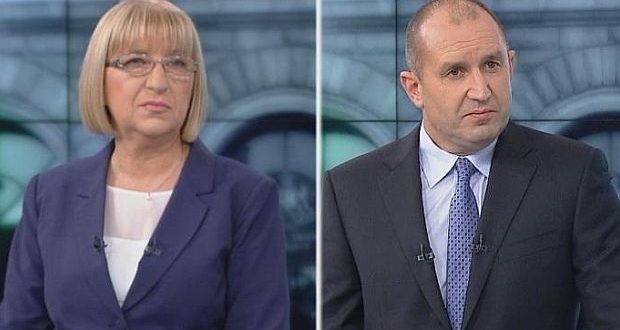
There has hardly ever been a debate in political history where one candidate did everything right and the other did everything wrong. This happened in yesterday's debate between Rumen Radev and Tsetska Tsacheva, during which the red general gave a lesson in politics.
The game of expectations
People do not perceive reality objectively, but refracted through our expectations. For a military man like General Radev, there is an expectation that he will be as dumb as a galosh – I doubt anyone has joked that while God was giving out brains, the military was on maneuvers. For a speaker of parliament like Ms. Tsacheva, there is an expectation that she knows statehood and the regulatory framework to perfection – which was also constantly insisted on by GERB as a fulcrum and its strength. In the debate, the two presented themselves relatively equally in terms of expertise – they cited several laws, several regulations, argued about 2-3 articles and threw out 4-5 numbers. None of us has any idea which of the two was right in this argument, but they both sounded equally good. What happens when we refract this through the initial expectations?
- Victory for Radev: "Hmm, this general is not as stupid as I expected - he knows the laws at least as well as the speaker of parliament"
- Loss for Tsacheva: "Hmm, this head of parliament seems to be more unprepared than I expected - she doesn't know the laws better than a stupid general"
When a bandit enters the house, you run to your father.
One of the theories in psychology (Jung) is about so-called archetypes – certain basic images and concepts that are embedded in our psychology very deeply on a subconscious level, and it is even possible that they are part of genetics – the mother, the father, the earth, the villain in the dark, etc. GERB deliberately played with one such archetype – the mother. She is gentle, caring, calm, smart and wisely guides the child in life. Accidentally or not (if not, I suspect American or Israeli intervention, not Russian), BSP bet on another archetype – the father. He is strong, rude, unshakable, covers the child with his broad back and protects the home.
Now think about today in Bulgaria and the environment in which the elections are being held. The most important issue for the voter is national security, and the number one threat is the wave of legal and illegal immigrants flooding Europe through Turkey and the Mediterranean. Behind them, the ugly muzzle of radical Islam and terrorism peeks out.
So, when a bandit breaks into your house, who will you run to for help? Your mother or your father?
The element of surprise
Political debates follow a pattern – endless regurgitation of clichés and memorized phrases, with the ultimate goal being to leave a lasting emotional impact on the viewer/listener and to deliver 2-3 heavy and surprising blows that will then “stick” to the candidate or his opponent. Ronald Reagan did this with his infamous line “There you go again” and the joke that he would not make his opponent’s youth and inexperience a campaign issue, Trump fired off the fantastic “Because you would be in jail”, Bush Jr.’s nod to Al Gore, who was once again coming at him, etc.
The only such powerful single and surprising blows in the Bulgarian debate came from Radev - "Ms. Tsacheva, in Turkey you collected 12,000 votes and you just crushed me", "Apparently this also applies to "Stolipinovo", because you are smearing me there" and the thunderous blow from the right "Why are you afraid of Monica Makovey?".
Tsacheva tried to catch Radev in the act with questions about Russia, but she didn't succeed for many reasons - anyway, everyone expected it, Radev had already countered this skillfully, and out of embarrassment, he didn't deliver his attack verbally well.
Cognitive dissonance as a defense
Rumen Radev knew that his biggest weakness was the question of whether he was dependent on Russia, whether he was a puppet of Putin, and whether he would come into contact with Tsatsarov and the DPS. To protect himself from this, he created cognitive dissonance with Euro-Atlanticism and the constant avalanche of images with which he bombarded the viewer's mind. Radev never once mentioned Russian President Putin, but he did name Donald Trump and told us that he would discuss national security with him. Tsacheva did the opposite, directly named Putin and invited him to Pleven for the panorama. The use of a name immediately forms an image in the viewer's/listener's mind. Today, we all have in our heads the images of Radev next to Donald Trump and of Tsacheva with Putin at the Pleven panorama. So, who will we subconsciously perceive as a pro-Russian and pro-American candidate?
On the topic of judicial reform, Ms. Tsacheva cited some laws and explained how well Minister Zaharieva is doing. All of this is most likely true and wonderful, but it does not present us with anything new. Radev surprised everyone by mentioning Monica Macovei and promising to go to Romania on the spot. Again, a brilliant defense with cognitive dissonance – how will we perceive Radev in harmony with Tsatsarov and the MRF, when today we imagine him next to Macovei in the Romanian anti-corruption service?
The strong leader
Voters around the world are united by one common characteristic – the most important thing they look for in their candidates is to be a “strong leader.”
In a rarely emotional and probably sincerely delivered personal confession, Tsacheva recounted her personal ordeal with the attacks against her for being a communist and unattractive. And finally, she burst into tears on air.
Radev throughout behaved like an emotionless Roman general from a Hollywood movie, riding his warhorse on a hill and overseeing a bloody battle in the lowlands. His personality totally dominated the room and twice, with short gestures, he literally subdued the moderator of the debate. And at the end of the debate, he briefly showed human emotion with his notes about the book he had read, describing the adventures of a refugee traveling to the West.
Which of the two left an impression of a strong leader who would protect the Bulgarian people from the incoming hordes of refugees and the great powers rattling with weapons? Who is the strong leader – the unwavering general on a war horse or the sincere and vulnerable woman who showed her tears and aroused sympathy in all of us?
Yesterday's debate was a rare case in which one candidate made all the right moves and the other made all the wrong ones. And it would be fair if it entered more than just Bulgarian political science and marketing textbooks.
Rumen Radev delivered one of the best performances in political history for the given situation.
All conclusions in the article are based solely on the candidates' presentations from a PR perspective. My personal positions differ radically from the views of both candidates.





Very good, accurate and clear analysis! Thank you for deciphering. I just want to ask, does anyone think that this latest debate can change people's mood, poverty and anxiety, fear of immigrants and so on and so forth?
Quite a one-sided analysis. It's obvious who was paid by whom.
Tsacheva's tears caused me disgust, not pity. I don't understand what the fate of her grandfather, which she didn't suspect until the changes, has to do with how convenient it is for her to go from a communist to a democrat. Am I the only one who finds it funny and pitiful? She interrupted the person, repeated herself, made excuses, and had nothing meaningful to say. I haven't voted for the communists yet, but I certainly won't vote for Tsecka on Sunday.
The wise people, after the debate, know the outcome. To lie twice, about the same thing, will be irreparable...
Elections are coming. Radev has a brilliant future ahead of him if he believes in himself, and not in the radiation behind his tow truck...
And against this background, let us remember what Mr. Borisov said - that Tsetska Tsacheva is the most prepared and most worthy candidate of GERB. I immediately imagined the level of the others. And what is this hysteria that Mrs. Tsacheva might not win?!... Haven't we been wanting independent authorities for 27 years and not an authoritarian regime?! Or am I mistaken?...
PS And if possible, don't threaten me, don't insult me, and don't underestimate me, as I am an honorable, responsible, and dignified citizen of Bulgaria.