EKIP– Expert Club for Economics and Politics A Different Opinion
Author: Rositsa Garcheva
There is only one day left until the first round of the presidential elections in France. On April 23, 47 million voters will give their preference to one of the 11 candidates, because in French politics the maxim applies: “In the first round – you elect, in the second – you eliminate”. That is, all eleven have their greater or lesser chance – to be elected, or simply – to be heard.
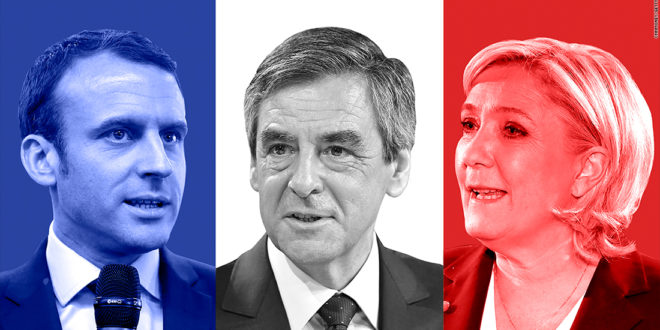
After a "crazy, unusual, unprecedented" campaign, according to observers, marked by corruption scandals and media twists and turns that deprived it of the opportunity for a real debate and clash of ideas, the candidates are divided into two groups: the "big ones", who have an extremely close chance of reaching the run-off and the "small ones", for whom between 1-3 or even less than 0.5% are expected. The latest polls measure 22% for the leader of the right-wing nationalists Marine Le Pen and the same for Emmanuel Macron - the young leader of the centrist movement "En Marche" (Forward). They are followed by the chosen one of the classical right (Republicans) François Fillon with 21% and with 18-19.5% the leader of the "left" left Jean-Luc Mélenchon ("Rebellious France"). The Socialist primary candidate for President Hollande's successor, Benoit Hamon, is theoretically out of the race with a modest 8-7.5%. The other candidates are only sharing 1 to 2 percent.
Unfortunately for sociologists and even more so for voters, the real ideological debate in the election was drowned out by Fillon's scandals and judicial investigation. This false campaign also explains the expectations for an unprecedentedly high number of abstainers or blank ballots (38%).
And there was room for debate, and it had to address the essential problems of French society, which defines itself as being at a crossroads in its development, with high and persistent unemployment, declining purchasing power, increasing helplessness of farmers, deindustrialization, an unsatisfactory education system, ... and most of all - overwhelmed by a strong sense of insecurity (terrorist attacks) and discontent, reaching the point of denying any system, especially the pan-European one.
The last question clearly outlines the dividing lines between the presidential candidates. All of them did not fail to reflect it in their programs, and for some, Brussels turned out to be the center and essence of their messages. The common thing is that no one declares himself satisfied with the way in which the unification of Europe is being carried out. All candidates have sensed that this is the deep and comprehensive feeling of the French voters.
Two of the leading candidates, François Fillon and Emmanuel Macron, as well as the socialist Amon, are campaigning for strengthening pan-European integration by improving its treaty base.
Three others – Mélenchon, Philippe Putou (left-wing trade unionist, Ford worker and environmentalist - 2-1.5%) and Nathalie Artaud (teacher representing the far left and communists - 1%) propose repositioning the EU on a less liberal basis and strengthening its social components.
Replacing the current EU with a new organization, the "Community of Sovereign States", is advocated by the Gaullist-sovereignist Nicolas Dupont-Aignan (3-4%), and Jacques Cheminad (Solidarity and Progress party, a Eurosceptic with less than 0.5% influence).
Marine Le Pen promises a national referendum on leaving /remaining in the Union within the first six months of her possible government. The National Front, and she herself, are implacable opponents of the Brussels administration, in whose person they see the main culprit for France's troubles. However, if the national referendum shows that the people want to remain in the EU, Madame Le Pen promises to resign and leave the presidency.
And last (with 1% of electoral intentions) – François Asselino would implement France's direct exit from the eurozone, the EU and NATO. Mr. Asselino welcomes Brexit and advocates for the elimination of the traditional right-left-center party division.
From the above, it is clear that two of the potential winners will fight against the current European Union – either for Frexit or for its fundamental restructuring.
And because the polls are within the expected error, no one is trying to predict the final pair. Everyone still believes that both Fillon and Macron would defeat Marine Le Pen in the second round. And what would happen in a Le Pen – Mélenchon clash, so far no sociologist or political scientist has been brave enough to make a prediction. The surprising thing is that Marine Le Pen ran a weak campaign, although she was known as the unappealing candidate of her party and her candidacy has been expected since 2012. She started as a favorite with more than 25% of the electoral attitude and failed to increase her percentages, even losing a few points. She could not even reach her successes in the regional elections, when she led the first political force in the first round (30%). Conversely – the rebel Mélenchon started from very low (about 10%) and managed to overtake all representatives of the left. His idea of replacing the Fifth Republic (presidential) with a Sixth - parliamentary - seems to be finding more and more fans.
For financial circles, high intelligentsia, big business, and the official media (i.e., those who benefit from globalization), the favorite and most convenient president is Emmanuel Macron. He is neither right nor left, he will draw ideas from both sides, and he will agree with everyone.
Polling agencies are right in their concerns to refrain from announcing predictions for the outcome of the first round on Sunday. France is something of a “monarchical republic”. The French people were the first in Europe to wish for and implement a republic, beheaded the king, but elected a president clothed with power “like a king”. Since General De Gaulle, the president has had enormous prerogatives. Much depends on him, and France is the founder and pillar of European integration.
And the Frenchman – eternally dissatisfied, striking, fighting for his rights. Will he follow the "British lion" or will he remain a "Gallic rooster", only making noise...
Even more interesting - will we see Frexit, and will the EU have to change its name to "Union of Germany and several smaller states".