 EKIP– Expert Club for Economics and Politics A Different Opinion

"Your capitalist attitude towards women is absent under communism."
These were the words of Soviet Premier Nikita Khrushchev to Vice President Richard Nixon at the opening of the American National Exhibition in Moscow in 1959. Nixon was there, representing not only the American government but also General Mills, Whirlpool, and General Electric—or what he and Khrushchev perceived to be the essence of capitalism.
What provoked this reproach from Khrushchev?
"In America," Nixon declared as they introduced the latest kitchen "helpers," "we want to make life easier for women."
According to Bay Wilson, who recounts a story known as “Kitchen Debates” in her book “Consider the Fork,” the top communist “suggests that rather than making life easier, these machines confirm the American view that women’s calling is to be housewives.”
"And maybe," Wilson added, "he's right to some extent."
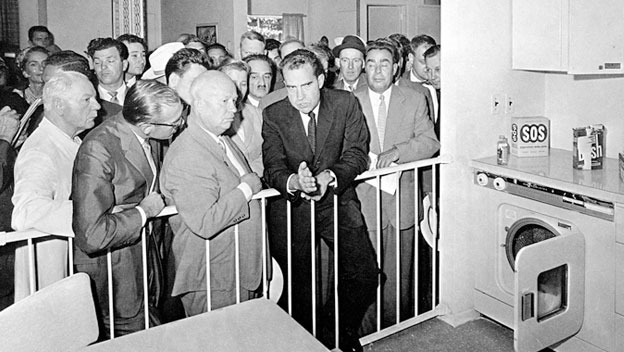
Vice President Richard Nixon (right) presents American-made household appliances to Nikita Khrushchev (left)
East meets West
There is something captivating about the story of the so-called “Kitchen Debates.” Instead of the abstract issues of economics, ethics, and power struggles of the mid-20th century, this story presents us with a clash between two men who embody East and West, communism and capitalism.
In my book How Ice Cream Won the Cold War, I used the American National Exhibition to explore how luxury contributed to the economic boom. But there are some misleading moments in this scene that make it too obvious to use as a clear example of the clash of two economic systems.
We may consider Khrushchev to be the embodiment of communism, but to define Nixon as a representative of the free market is completely wrong.
Nixon was never pro-capitalist. He was anti-communist. He built his reputation as a pro-capitalist by pushing out communist infiltrators from the ranks of the government. Later, when he occupied the highest position in the White House, Nixon increased the amount of federal regulation of industry, killed the last vestiges of the gold standard, and imposed controls not only on prices but also on wage growth in an already sluggish economy. In his foreign policy, President Nixon supported petty dictators around the world who were far from friendly to the free market, as long as they opposed the red menace that Khrushchev represented.
The economic organization that Nixon adhered to throughout his political career had more in common with Mussolini's corporatism than with Adam Smith's "invisible hand."
Who governs free enterprise?
But there is a more fundamental problem. Even if Nixon had been a true free-marketeer, the economic system of competitive trade cannot have a representative. Communism is fundamentally centralized, whether run by a small Central Committee or by a single leader. Capitalism, on the other hand, is radically decentralized. No committee can run a thriving economy. No one person can run the show. The more he tries to do that, the less the economic system can be defined as capitalist.
When Nixon told Khrushchev, “We like to make life easier for women,” he implied that the latest kitchen conveniences were created by someone else’s benevolence, as if successful entrepreneurs—or worse, politicians—were directing market resources toward a specific social goal: more leisure time for American housewives. When Khrushchev responded by accusing capitalism of being a sexist doctrine, he was falling into the same fallacy: the idea that capitalism was run by capitalists.
It doesn't matter whether businessmen are benevolent or indulgent, progressive or reactionary: in a free and competitive economy, the successful entrepreneur maximizes his profits through mutually beneficial exchange - by anticipating the products and services for which customers will be most willing to pay.
Economist John S. Goodman, writing in another context, clearly explains this phenomenon: " The market has the remarkable property of combining altruism and self-interest. Consider Bill Gates, the man who first introduced the personal computer. By spreading his product everywhere, he became the richest man in the world - and now he gives away all his wealth. What motivates him to do this? Selfishness? Or is he trying to create the greatest good for the greatest number of people? The beauty of how the market works is that it doesn't matter what Gates' motivation is. Either way, the result is pretty much the same.
Women's Liberation
Yet Nixon's argument is not entirely wrong. Capitalism does make life easier for women. It makes life easier for men, too, but as historian Stephen Davis points out, "women have a special reason to be grateful beyond the gains in material well-being they share with men."
This was true even before the advent of the household appliances that Nixon introduced in Moscow. “Since the Industrial Revolution,” Davis writes,“women have for the first time been given the opportunity to earn their own living and support themselves, something that had been practically (as well as legally) impossible in a strictly patriarchal society. This means that being unmarried and independent is no longer a catastrophe tantamount to a death sentence.”
“For those who marry,” continues Stephen Davis, “ modern capitalism creates a range of devices and innovations that physically free women from the constraints of domestic labor. Take, for example, the modern washing machine, which frees women from the obligation to spend one or two days a week doing laundry. Many other household appliances have a similar effect.”
From our perspective in the 21st century, we can now question whether laundry is a woman's job because:
Capitalism does not create a gender division of labor – on the contrary, it initiates the process of eliminating it.
This is possible because labor has become less burdensome, which has made women's independence a more realistic possibility, and has finally created a world in which individuals can afford to reject the dependence of tradition, as well as try to convince others to join them. If feminism is about liberating women from millennia of oppression, then capitalism is feminism's friend, not its enemy.
That is why, according to Davis, the earliest feminists "were ardent laissez-faire liberals and supporters of capitalist industry. They were well aware of the connection between the autonomy and freedom of choice they wanted to win for women and the economic transformations that made freedom possible."
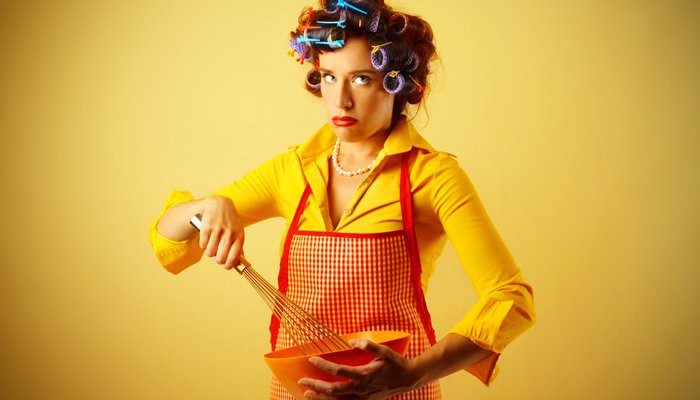
Pity the poor housewife
Khrushchev suggested that the modern housewife was created by capitalism—and he was right. He implied that the proliferation of housewives in America in the 1950s was a shameful stain on the market economy, and many women in the Western world since the 1960s have tended to agree with this statement.
The reputation of housewives may never recover because of Betty Friedan's book, published a few years after "Kitchen Debates," "The Feminine Mystique," in which the author spoke of the so-called "problem without a name."
“Simply put,” writes liberal feminist Wendy McElroy, “Friedan believed that domesticity deprived women of their human potential, causing them to suffer both physically and mentally. Friedan described the typical 1950s family as a “comfortable concentration camp.” As prisoners, suburban housewives had adapted psychologically and become “dependent, passive, childish,” living at a “low human level.”
After The Feminine Mystique became the foundation of second-wave feminism, Friedan, who co-founded the National Organization for Women (NOW) in 1966, began to downplay her political activism: “she had been a staunch political activist on the communist left for decades,” according to McElroy, and she probably didn’t want the movement known as “women’s liberalization” to be associated with the popular image of radical socialism. This association was not unfounded, however.
Down with the capitalist patriarchy
As Davis and McElroy point out, most individualist traditions of feminism embrace capitalism.
Yet, the foundation of modern feminism is significantly influenced by socialist theory.
“In the 19th century,” McElroy writes, “the two main traditions of feminism that fundamentally questioned the political system were: socialist feminism, from which modern radical feminism was created, and individualist feminism, sometimes called libertarian feminism.”
The language of these traditions may seem similar, using the same terms and stating the same goals, but "the key concepts of feminism within individualism—such as equality, justice, and class—have so little connection with the concepts used by socialists that the definitions often conflict." For example, the socialist "approach to justice is end-oriented and defined in terms of a specific social situation," including economic equality.
When Nixon acknowledged that kitchen innovations directly benefited women, as opposed to men, this distinction was, from a socialist perspective, not only an admission of differences between modern American men and women, but also an admission of inequality in the socialist sense of injustice.
Libertarian feminists, by contrast, believe that justice is defined by the absence of coercion. "What is voluntary is 'just,'" McElroy summarizes, "or at least it is as close to justice as is possible in the real world."
To the extent that women have legitimate options other than housework, the choice to stay home and manage the household is a product of their freedom.

Change
We could argue that a combination of legal and cultural assumptions limited women's opportunities in the 1950s, and that the widespread prevalence of housewives was in some sense an injustice because it resulted from a lack of real freedom for women. As we noted in the Nixon case, the people in the American government are not champions of personal freedom. They have a vision of how society should work, and they use the coercive authority of the state to enforce it.
But capitalism undermined their vision. Nixon welcomed the latest gadgets that made life easier for American women, but these dishwashers and fancy refrigerators had a less obvious long-term effect: by reducing the burden of housework, a new world of options and choices opened up that those in power would not be so happy about.
Свободното време не представлява просто липса на труд: то представлява и възможност да се търси по-удовлетворяваща работа.
“It is undoubtedly true,” McElroy writes, “that ‘The Feminine Mystique’ resonated with many women whose lives were changed as a result of reading the book. For them, homemaking was a denial of their potential as human beings, and they found the courage to make another choice.” But whether these women realized it or not, it was the wealth of the market economy that enabled them to defy tradition and pursue other careers—perhaps even when public opinion and culture would not tolerate it.
Capitalism, in other words, is not identical with Western culture. To equate them is to ignore the ongoing struggle between the two. The market undermines traditions by testing their value against changing social arrangements. Those customs that depend on a particular historical condition will lose out because as the economy grows, the rules change.
Капитализмът не се съпротивлява срещу подобни промени - той е техен катализатор.
Profit and progress
Епохата на домакинята бележи преход в историята на Западния свят. Жените винаги са били отговорни за управлението на домовете си. Това е било така по цял свят, в най-различни политически и икономически системи. Появата на съвременната домакиня е резултат на по-голямото богатство и свободно време, както и нарастващата свобода на жените да приемат или отхвърлят ролята си още преди 50-те години на миналия век.
Хрушчов представя Никсън като културен реакционер „и може би,“ коментира Уилсън, „той е бил частично прав за това.“
Може би американският политик се е отнасял с пренебрежение към жените. Такива може би са били и капиталистите, чиито продукти са изложени в представената от Никсън изложба. Но икономическата система, която произвежда тези стоки функционира с или без регресивни нагласи и до 1959 г. тя създава безпрецедентно ниво на богатство и свобода за всички – и конкретно за жените.
Ако повече от половин век по-късно можем да хвърлим поглед към миналото и да се абстрахираме от фините нюанси на това, което тогава е било представяно като прогрес, осъзнаваме, че търговията и предприемачеството продължават да създават условия и двата пола да търсят все повече възможности да преследваме своята лична свобода и реализация.
Оригинал: Capitalism Doesn’t Care about Women, but It Does Liberate Them
Превод: Ивелина Й. Петрова
Източник на изображенията: Google






If I may point out, the people who introduced the personal computer are called Steve Jobs and Steve Wozniak.
Хехе, феминизмът е измислен, за да бъдат накарани и жените да работят и съответно държавата да прибира данъци. В същите тези 50 години на запад един мъж е можел да издържа семейството си, без да се налага жената да работи. В един момент обаче нещо нещата се променят и за да се прикрие обедняването на работещите се развява байряка на феминизма. В днешно време малко семейства могат да си позволят лукса един от двамата да не работи. Интересното е, че и при нас е било същото, нищо че сме били в соца. В първите години на соца, повечето градски жени не са работели, за селото не говорим - там работата никога не свършва, независимо дали си официално назначен на някаква длъжност. И в един момент и при нас настъпва обедняване, тоест мъжете вече не смогват да издържат семейство с една заплата и се налага жените да тръгнат на работа и да дават децата си на ясла на 3 месечна възраст, както е в Щатите и досега. Соца донесе огромната социална придобивка на дълго майчинство, която сега разните измислени работодатели и псевдокапиталисти искат да премахнат. Феминизмът, пропагандирайки свободата на жените да работят, да градят кариера, да са независими, перфидно подминава факта, че жените нямат свободата и избора да не работят, ако пожелаят, защото съпрузите им не могат да си позволят да издържат семейство. Това е истината, а другото е плява в очите на несъзнаващите робството си.