EKIP– Expert Club for Economics and Politics A Different Opinion
John McDermott, MEL Magazine
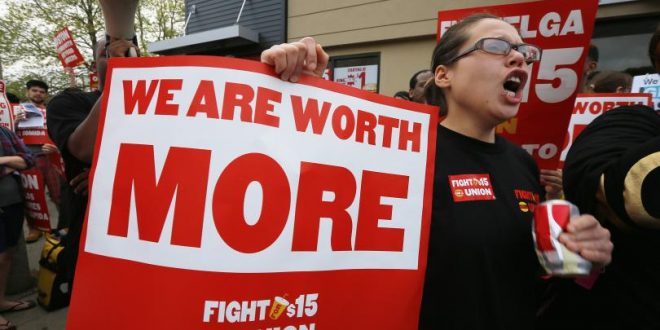
 Преди няколко седмици, изследователи от Университетът във Вашингтон, публикуваха ново изследване, според което опитите на Сиатъл да подобри икономическата перспектива на работническата класа в града, са произвели обратния ефект. Сиатъл е един от многобройните американски градове, които плавно увеличават минималното заплащане до $15 на час през последните години. Но въпреки по-ранно изследване, според което увеличенията са имали минимален ефект върху пазара на труда, то проучването от Университетът във Вашингтон установи, че тази политика е във вреда именно на работниците, на които е предназначена да помогне.
The main reason: As more workers start making $15 an hour—and in Washington state, the hourly wage was $9.47 before the new legislation was passed—employers hire fewer people, or lay off and/or reduce the hours of current workers due to increased labor costs. The average low-wage worker has lost $125 in monthly income because of the $15 minimum wage, and collectively, the losses amount to $100 million.
Conservatives are no longer the only opposition to the minimum wage
But instead of the news being negatively reported by conservative media outlets, Breitbart, a site that proudly defends the working class, responded to the study with satisfaction. Breitbart has been strongly opposed to the $15 minimum wage for years. “Wow, the unintended consequences of progressive policies rear their ugly head again. What a surprise,” was the most popular comment on Breitbart’s page dedicated to the study.
For decades, conservatives have opposed minimum wage increases and other labor market policies, arguing that they are an attack on American capitalism and its ideals of laissez-faire and private enterprise. Recently, however, a new wave of opposition has emerged, this time from fiscally conservative working-class groups who (in theory) stand to benefit from minimum wage increases. They argue that such increases would encourage companies to outsource, automate, or reduce their workforces, and that a job that pays $8 an hour is better than no job at all.
“The company I work for already knows how to automate its factories and production lines. The only thing holding them back is the capital investment required,” said Juan, a 30-year-old financier living in Toronto who frequently contributes to the private Facebook group “Liberals and Conservatives.”
According to some workers, raising the minimum wage speeds up the automation process
Juan is a first-generation immigrant from a third-world Latin American country and worked in low-wage jobs in the service and retail sectors until he was 24. But he opposes a $15-an-hour minimum wage despite his background, precisely because he believes that such an increase will accelerate the trend toward automation that he talks about above. According to Juan, “with the recent increase to $15 an hour, automation projects will be set in motion and carried out, resulting in a hell of a lot of part-time workers becoming unemployed next year.”
While it's true that automation is inevitable, it's not necessarily the biggest concern of those opposed to raising the minimum wage. Mainly because this change is likely to happen over several decades. And their concern is that a $15 minimum wage will make the job market inaccessible to young, unskilled workers who want to gain vital experience today.
Or at least that's what scares Sean Morrissey. A U.S. Army veteran who identifies as lower middle class — "only Walmart and Aldi for us" — Morrissey says he never would have had the opportunity to start his career if the minimum wage hadn't been $7.25 an hour. "Some of the jobs I've worked in weren't worth $15 an hour. If they had made that $15 mandatory back then, I would have been unemployed," Morrissey says. "I'm grateful it was $7.25 back then. It gave me the opportunity to start working, gain experience, and eventually move up to a higher-paying position."
Raising the minimum wage eliminates jobs for the young and inexperienced
Joe Simpson, 28, tells a similar story. Simpson lives in Baldwin, Wisconsin, with his wife and their daughter and makes more than $60,000 a year as an accounting manager at UPS, where he has worked for the past 10 years. He says he wouldn’t be able to live the life he does now if UPS hadn’t hired him at $8.25 an hour. When he was a student at 18, it gave him the opportunity to move up in the company. “Raising the minimum wage will have a negative impact on young, unskilled workers and small businesses,” Simpson says. “Families from poor neighborhoods who have less access to education will have a harder time finding jobs than they do now.”
It’s tempting to dismiss these arguments, especially when they fit so neatly into the well-worn arguments conservatives use to argue against regulations and publicly funded programs. But economists are as divided on the efficacy of a $15 minimum wage as liberals and conservatives are, and the University of Washington study lends tangible weight to the argument against raising the minimum wage to $15.
So what will happen to people like Juan, Morrissey and Simpson, each of whom started in low-paid jobs and gained qualifications?
Unemployment, at least according to them.
Original article: Former Working-Class Men on Why They're Against a $15 Minimum Wage
Translation: Dimo Chankov