 EKIP– Expert Club for Economics and Politics A Different Opinion
Графика 1: Ученици като % от населението на 10 000 души население (1900-2016 г.) 
Източник: НСИ
There is a demographic crisis in Bulgaria. The number of students is decreasing. It is normal in such a situation that the number of teachers is also decreasing. What is actually happening is shown in the NSI infographic, which was published yesterday. Another thing is happening that is happening all over the world - the ratio "number of students per teacher" is decreasing. That is, at the moment there is nothing dramatic about these numbers from the point of view of the education system itself.
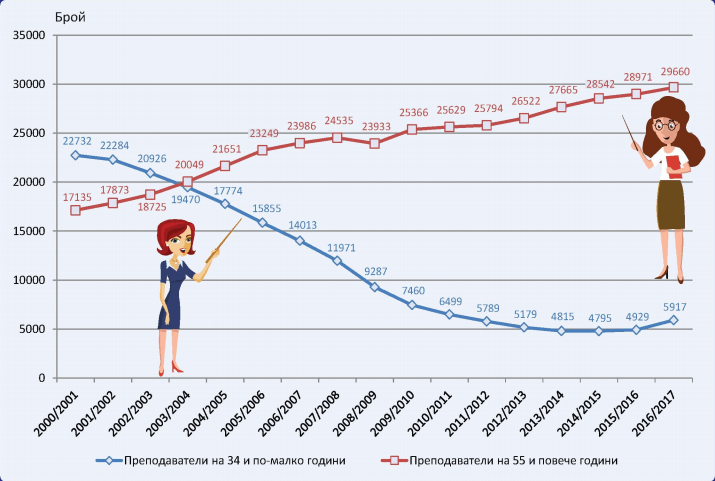
This is how I interpret these data. The demographic crisis is very acute. On the other hand, the education system has been very conservative in terms of its personnel policy - when a school reduced the number of students, they did not lay off teachers. The problem with "excess staff" was postponed and resolved over time, by simply not hiring young staff!
After a long period of not hiring young teachers, the following has quite naturally happened:
- Interest in the profession drops to a critical minimum - you can't possibly want to work in something for which there are no jobs.
- The average age of teachers is gradually increasing
The end result: the current education staffing crisis. The teaching profession is outdated, and there are very few young people in the system.
Table 1: Students and teachers in schools (1895/96 - 2016/17)
 Source: NSI
What will happen next? I'm not Vanga, but I'm going to make a prediction. Most likely, there won't be any drama.
- The problem of retiring teachers is overexposed, because there are already a lot of teachers in Bulgaria anyway. The average number of students per teacher is lower than the EU average, and we are not one of the rich countries that has to squander its budgets. If you have wondered why salaries are not growing fast enough, here is an objective reason - the limited budget is being shared among too many people.
- The problem of the lack of young staff has been overexposed, because until now it has been due not to a lack of candidates, but to a lack of jobs. But this problem is still real. Opening new jobs will attract candidates, but not "from one day to the next". It will take years.
Chart 2: Teachers in schools by age (2000/01 - 2016/17)
 Source: NSI
That is , what the government should do to solve these problems is the following:
A. To retire those who should retire;
B. Reduce the total number of teachers to at least the EU average, and allocate the free resources to salaries;
C. To announce job vacancies and within 2-3-4 years interest will return. After another 8-9-10 the problem with young people in education will be solved;
D. Never again make this purely populist mistake of artificially retaining staff who should be laid off.
And so the problem of the lack of young teachers will be solved.
Author: Filip Petrov
Image sources: Nsi.bg, Jenatadnes.com






I haven't read the article yet. I am a teacher by profession, I taught for a while during my studies, and I was interested in the topic (I applied for a job for a year and talked to teachers and principals when I had the chance). In the end, I gave up. The problem has several interesting perspectives.
One of the main reasons (and it is not discussed) for the lack of young, let's say 7% of teachers are under 35, is the interest group, economic and ideological, of the old generation of teachers. They stick together and do not like young teachers. Young teachers, especially men, avoid old teachers due to the fact that their methods and understandings are achraic, authoritarian and morally worn out. In general, young teachers are more liked, closer morally to children, and this threatens the existential position of old teachers. They prefer old teachers under the pretext of "being experienced", one of the excuses. But the profession of a teacher is not the same as that of a car mechanic, the accumulation of knowledge and skills in this case, due to the history of our society, actually goes negatively towards growth in experience.
What you will find in schools is a clique of teachers between 40 and far from retirement age, who know that they have to look out for each other and look out for the younger teachers. The only ones who have left are in the fields of foreign languages and IT, where you will see these 7% of young teachers. They cannot find good staff from the old generation there and therefore they have to hire new staff in these fields.
Students are subjected to archaic authoritarian morality that they cannot tolerate. Young teachers who have infiltrated the system usually have no choice but to partially adopt the morally outdated pedagogical methods of the old teachers, so as not to remain isolated and not fall into conflicts.
In whatever "problematic" classes and "students" I have entered and spoken to about topics - politics, psychology, sociology and logic, the children, if you speak to them like Ben Shapiro, Joe Rogan, Thomas Szazs, Ron Paul, Thomas Sowell, etc. allow and conduct their dialogue with their guests and audience, then you cannot stop the children from asking questions and being enthusiastic.
Part of the problem is the clique of old teachers who want to dominate children in order to feed themselves, educating them pedagogically in morals and understandings of the world that are nihilistic while pushing competition aside.
I read the article, it was interesting to me. I think it shows the idea of the group of economic and ideological interests that are the old teachers. They don't want to retire, they don't want to hire new and young staff, they want more money, they also want more power over the students (for example, behavior grades).
In order for there to be education reform and changes, this established group of "old teachers" who have seized most of the power opportunities in education must be taken into account. They do not want changes, reforms, new young staff or anything good for students, they want to maintain the status quo and take more money from the budget. And since children cannot vote, but teachers can, politicians listen to the clique that has spread its tentacles everywhere in the field of education and as a bonus can cast the ballot with a voice.