EKIP– Expert Club for Economics and Politics A Different Opinion
Very often, when a given object from the cultural and historical heritage of Bulgaria – and around the world – is in some unenviable condition, the reactions are that “the state should take care of it”. Care, of course, must be there, but the fact that state care is expected is no guarantee of quality. If the object is owned by the state or a given municipality, every citizen has the right to demand better treatment of the given cultural value. However, if it is private property, calls for nationalization are completely utopian.
The starting assumptions are that cultural heritage is a top state value, and therefore the state will always consider them a priority. On the other side are private owners, who are usually entrepreneurs who – so it is claimed – seek only financial gain and would destroy any archaeological site just to build a housing cooperative on top. And if we have enough examples of the second (destruction by a private investor), then we also have many examples that refute the first statement (that the state is a good manager). There are numerous cases in which the state destroys priceless archaeological sites– whether due to ignorance; whether due to stupidity; or because cultural heritage is not always the highest value. Higher sometimes can be various economic projects, urban planning, infrastructure or other sites. Even in cases where both the knife and the bread are in the hands of the state, we have examples of cultural heritage destroyed. We will give you examples from different periods of Bulgarian history in which the legislation and nomenclature were different.
Early Christian Painting and the Kingdom of Bulgaria
Early Christian art is a topic that is rarely touched upon – even less its development in the Bulgarian lands. However, it is extremely interesting, because since the beginning of the 4th century, with the adoption of Christianity as an equal religion throughout the Roman Empire, the cities in our lands have been participating in the process of forming Christian iconography. We are part of this beginning and there are priceless monuments from this period in our lands. Such is, for example, a tomb discovered only a few years ago in Plovdiv with a painting, including an interesting scene of Christ resurrecting Lazarus. It is painted in the same way as the scene is painted on the most expensive sarcophagi in Rome itself, and shows that early Christian art had common features both in the Balkans and in present-day Italy (and throughout the empire, but this is a long topic).
Cultural heritage objects are the tangible evidence for any such scientific hypothesis. That is why concepts for the preservation of tangible heritage exist – because theories change, develop, propose and prove new and different things all the time.
Unfortunately, in the 1920s, Sofia – a large and important city during the Roman era – a huge amount of material heritage from the era was destroyed. Under the square around the current Alexander Nevsky Cathedral, there was a necropolis in which there were many tombs. Some of them were frescoed. When the municipality built the streets and infrastructure, these tombs were completely destroyed. Archaeologists only had the chance to make sketches of a few of them. If this necropolis had not been destroyed by the capital municipality itself in the 1920s, it would probably have provided some of the most magnificent exhibits in Bulgarian museums. And at that time, the first Law on Antiquities was already in force.
The Second Varna Chalcolithic Necropolis and the People's Republic of Bulgaria
The knife, the bread and the cutting board were entirely in the hands of the state during the 45-year period of totalitarian communist rule. However, the destruction of cultural heritage was no exception. There are plenty of examples – from the deliberate destruction of entire neighborhoods with beautiful old buildings for the construction of huge squares in the center of almost every city, through the construction of boulevards without any concern for archaeology (such as Plovdiv's Gladstone Boulevard, which cuts through the ancient Forum of Philippopolis), to a series of ridiculous restorations, such as the reconstruction of several churches in Veliko Tarnovo and the striking example of the Patriarchal Church of the Holy Ascension of the Lord, whose murals in the socialist style from the late 1970s are a mockery for every Orthodox Christian.
It is difficult to determine which is the most unique, significant or important monument for a given region. However, a candidate for this title in Bulgarian lands would certainly be the Varna Chalcolithic necropolis. Numerous graves have been discovered there, in which there is processed gold and finds that give an idea of a developed culture that traded even with the Mediterranean. We are talking about a period of about 1000 (thousand) years before the "first civilizations" in Sumer and Egypt.
“The first gold in the world” is known to every high school student. However, it is not particularly well known that next to the popular Varna Chalcolithic necropolis, called Necropolis I, a second one was discovered – Necropolis II, about 2 km from the first. It was discovered in the mid-1970s and, based on the scant data, it is believed to be even older than the first. However, its fate is unenviable. It falls under the territory of the Varna Housing Construction Plant. It is not surprising that there is a lack of official data, but unofficial data is that due to the intensive housing construction, there was no opportunity to change the plans for the Housing Construction Plant, and the excavations were hastily stopped. Hypotheses of those familiar with the Varna complex are that the second necropolis may have been even larger and richer and would certainly complement the idea of this period. However, the housing construction plant was more important, and although everything was "in the hands of the state," this priceless object was destroyed.
Pliska and Bozhidar Dimitrov
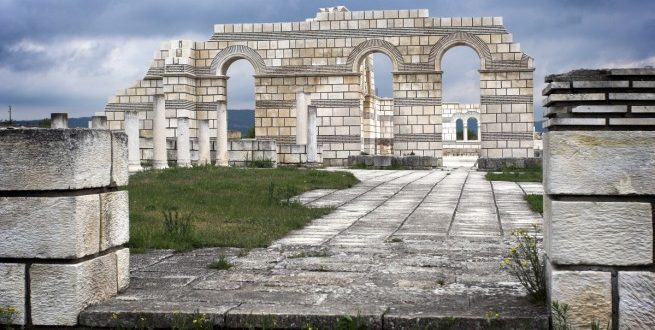
One of the great crimes committed in recent years in Bulgarian history is the so-called "restoration" of the Great Basilica in Pliska. Driven by a desire to glorify the past and play on the thin thread of the greatness of the Bulgarian state, Bozhidar Dimitrov managed to gather a serious group of supporters for the restoration of the Christian temple "down to the tiles", as he himself likes to express himself.
Early Bulgarian art and architecture, however, is still the subject of scholarly debate. In scholarly texts, disputes continue about the various influences that the first Bulgarian churches after the baptism during the reign of Prince Boris I received – from Byzantium, from Western churches, from earlier local architecture in the Bulgarian lands, or from more distant regions. The Great Basilica in particular has been studied in considerable detail, but there is still no scholarly consensus on it either. Its completion in exactly the way that Bozhidar Dimitrov liked, however, will “concrete” (in a direct and figurative sense) the idea of this temple in one of its forms.
Contrary to the notion that the state should be the pillar of science, impartiality, etc., it turns out (as, in fact, has always happened in history) that the state acts according to its own principles in order to assert its power, albeit through such "soft" interventions through culture. Every average Bulgarian would be happy for our first great Christian temple to be restored, but if after 10 years it is proven that it looked differently, it will already be too late - or simply too expensive - to remake it. And it is possible that evidence will be destroyed during this restoration. The fact that artificial stones are used and the space between the walls is filled with construction waste is also offensive to Bulgarian history.
And this is far from the only case in which the state or local authorities have destroyed cultural heritage by not complying with their own state regulations; or when they have done so out of ignorance, even without being lawbreakers. There are thousands of municipal houses throughout the country that local municipalities cannot take care of. The dozens of fortresses "restored" in recent years in a sham manner with European funding and state co-financing are also a thorn in the side of anyone with a basic knowledge of history.
History shows that the state cares only about cultural heritage, according to the current fashion, and all other things are left behind. When it was fashionable to study Bulgarian history, such studies were financed and supported, when it was fashionable to study Thracian history, state finances were directed in this direction. And even in these cases there is no guarantee of quality - like any "greedy capitalist", the state also usually expects a quick result and great discoveries, with which the respective ruler can prove himself as a minister concerned about the history of the people, who achieves what he was appointed for.
Image source: Vesti.bg