EKIP– Expert Club for Economics and Politics A Different Opinion
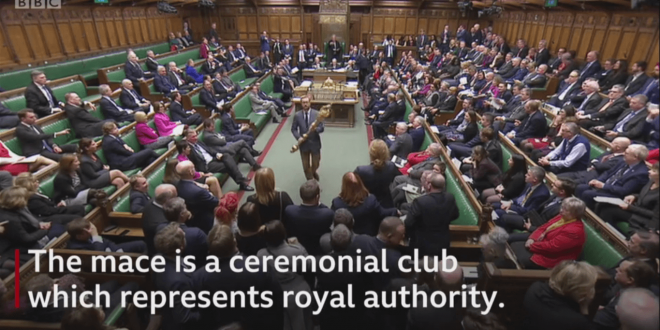
A young, blond man in a blue blazer approaches the golden ceremonial baton in the center of the chamber. For a moment, the House of Commons falls silent, then erupts in outrage as he defiantly raises the symbol of royal authority with both hands and carries it out. Without the golden ornament, laws cannot be voted on. Speaker John Bercow orders the baton back and the young Labour MP to leave the room.
The reason for the demonstration? Theresa May's decision to blatantly miss the deadline and postpone the vote on the agreement for leaving the European Union, which she herself negotiated with Brussels. Despite repeated assurances until the last minute from the entire cabinet and from the Prime Minister herself that the deal would be put to a vote by MPs today (11.12.2018), May surprisingly announced yesterday that she was returning to the continent for meetings with Angela Merkel and Dutch Prime Minister Mark Rutte to receive "further assurances" on the most sensitive issue of the agreement, namely the so-called "brake" for Northern Ireland.
Forced renegotiation
The additional diplomatic shuttles are a last-ditch effort to find the votes needed to push the deal through the British parliament. There is currently no majority in the House of Commons to support the proposed agreement, and it is unlikely that further talks with EU leaders will change this situation. Especially since both sides have firmly stated that there will be no new renegotiation – i.e. changes to the text of the agreement – will take place. Either way, it has probably bought Theresa May about another month at the helm of the country. Without a specific new date for the vote being set, it is likely to take place on January 21. Just two months before the automatic Brexit without a deal under Article 50.
What kind of Brexit we will see (and whether we will see it at all) is the most important political question in Europe. At the same time, British politicians, and to a large extent the entire society in the United Kingdom, are in a deadlock. (At least) four camps have formed in Parliament with different visions of what should follow in the relations between the Island and the Continent. These visions are so different that finding common ground between them or reaching a general consensus seems almost impossible at this stage.
The different camps in the British Parliament
The first camp supports Theresa May's deal. It includes the core group of the Conservative Party - fans of both leaving and remaining in the EU. We are talking about those politicians who are looking for some kind of compromise solution that would satisfy both sides of the barricade. They are behind the thesis that the deal presented by May is the only possible one and that a better one cannot be obtained. The problem is that for now the hard cores are repelled by the compromise.
The second coalition is of the "hard" Brexit supporters. Mainly formed by the Conservative Party backbenchers in the so-called European Research Group, led by MP Jacob Rees-Mogg, with some individual inclusions from Labour and supplemented by the coalition partner in the government, the Northern Ireland Unionist Party. They create the most serious problems for the Prime Minister, because they perceive (in the author's opinion - correctly) the deal put on the table as a betrayal of those who voted to leave the EU. They openly aim for a Brexit without a deal under the rules of the World Trade Organization.
The third camp is formed by the majority of the Labour Party, which in recent months has been openly mocked for being a fairy tale. Jeremy Corbyn's people are demanding Theresa May's resignation, new elections and their own cabinet to negotiate a better deal. The problem is that their party also has severe internal divisions over whether to have Brexit or not. They are trying to maintain all positions at the same time so as not to suffer an electoral collapse. At the same time, the message from Brussels is that there will be no new negotiations, including with Corbyn.
The final party in the great Brexit debate is the coalition that supports 100% remaining in the European Union. It is made up of a diverse alliance of politicians from almost all parties, including the Liberal Democrats, the Greens and the Scottish Nationalists. Their strategy is to trigger a second referendum, the so-called “people’s vote”, through which they can reverse the direction of the previous consultation with the British people.
Will May be able to save her deal?
Theresa May has given herself until the end of January to find more allies. So far, that seems like an impossible task. Even more interesting is whether, when all this is over, the old British parties will still exist, rather than four new ones.
We are in times that will decide the political future of both Britain and the European Union. We will have to watch whether and how one of the cradles of civilization will resolve its most serious internal conflict in decades. We will also see how far the boundaries of democracy extend.