 EKIP– Expert Club for Economics and Politics A Different Opinion
The gender pay gap is a topic that has rocked Western societies for at least a decade. Fortunately, in our country, despite attempts to create a local activist buzz, the topic is still being viewed with a sober mind. There are good reasons for this, but it is still useful to look behind the numbers and processes.
The gender pay gap is the difference in average gross hourly earnings between men and women in an organization across all positions (vertical and horizontal). Equal pay between the sexes applies to equal work positions and the same type of work and is protected by law in most countries.
Therefore, the difference is not derived from whether men and women receive the same remuneration for equal work, but by using the average hourly wage of full-time and part-time workers (excluding overtime).
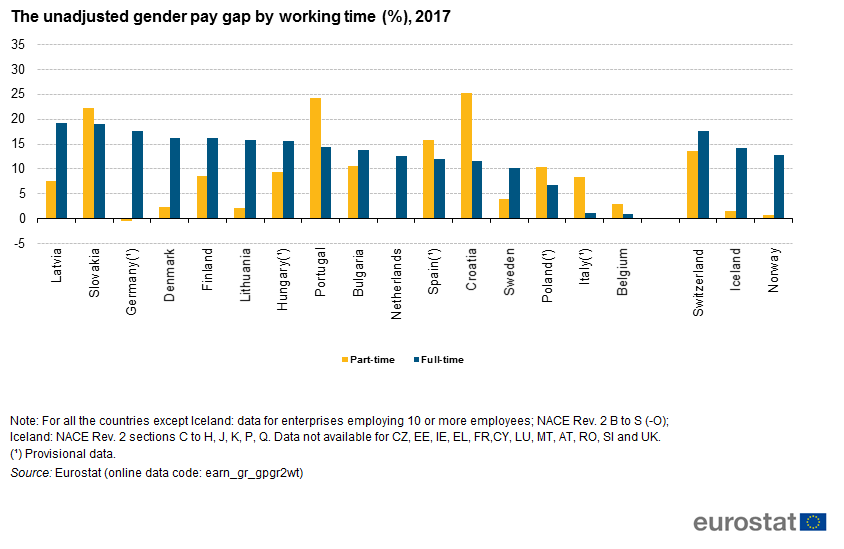
A Eurostat study shows that in 2017, women in Bulgaria received an average of 13.6% less than men in gross hourly wages. It is important to examine the real processes behind the statistics.
Prerequisites for pay gaps
Women are more likely to choose to raise children, care for elderly family members, or do housework rather than pursue a career. According to NSI data, in 2018, 250.8 thousand women were out of the labor force due to "personal and family reasons," compared to only 72.1 thousand men.
Another part of women, with family care as a priority, work part-time. People who work fewer hours receive lower incomes and move up the career ladder more slowly. Some methodologies do not separate full-time and part-time work, making it difficult to determine whether the pay gap is the result of gender discrimination or the nature of a person's employment.
The gender pay gap increases between 35-44 years, probably due to motherhood and childcare. The average age of women at birth in 2018 in the country was 27.2 years, and for the capital – 30.2 years. In Bulgaria, motherhood is 2 years, which is a prerequisite for difficult adaptation to the work environment afterwards. It also represents a pure time lag in the career development process.
The specifics of industrial work also determine differences in pay. Female models earn many times more than representatives of the "stronger" sex in the same field. The same applies to physiotherapists, nurses, personnel engaged in sales, administrative activities and human resources.
Men are more likely to pursue careers in technology and the sciences than women, and they are more likely to take on more stressful jobs and work longer hours. Economist Thomas Sowell notes that women tend to choose careers that are more conservative and don’t change dramatically over time. If you’re a computer engineer and you take a five-year break to have children and raise them to kindergarten age, the nature of your work will have changed significantly in that time. You’ll have to start over almost completely. On the other hand, if you become a librarian, teacher, or other similar profession, you can take five years off and then return to roughly where you left off. Predictably, the more demanding tech jobs pay better than those that don’t require the same amount of time, knowledge, and effort.
Why regulations hinder the narrowing of the pay gap
The BBC recently published an article that named EasyJet as one of the employers with the largest gender pay gap. The article itself lacks any justification for the problem, but fortunately the Institute of Economic Affairs in London has provided one, backed up by data from the company.
The company’s average pay gap has widened to 54.1% (the average pay gap for the UK economy as a whole has also increased from 45.5% to 47.9%), according to 2018 figures. This seems like a discriminatory policy. However, a breakdown of the pay gap tells a different story. EasyJet’s cabin crew make up the majority of jobs at the airline, and 71% of these positions are filled by women. EasyJet’s pilots make up 26% of jobs, of which 5% are filled by women. When comparing the pay of male and female cabin crew and male and female pilots separately, EasyJet reports that women earn more. The large number of women employed by the company as stewards and the relatively small number employed as pilots leads to a pay gap of 54.1%. EasyJet is even campaigning to have 20% of its new hires be women by 2020.
The percentage of female pilots at EasyJet is roughly the same as the number of female pilots registered worldwide. The increase in female pilots employed by the company – 128 in 2015 to 222 in 2018 – is even more significant when one considers the limited availability of women with the right training and interest. EasyJet could significantly reduce the pay gap, even to 0%. It simply needs to hire fewer women in lower-paid roles (flight attendants) than more female pilots. As we can see, however, despite regulatory pressure, there are natural processes that drive the pay gap.
Can the gender pay gap disappear?
As it becomes clear, before we declare discrimination and sexism as the main cause of the problem, it is good to inform ourselves about how the world around us actually functions.
The Austrian School of Economics knows that eliminating wage inequality in a free economy is beyond the capabilities of the state. The central political apparatus cannot objectively measure the true productivity of the factors of production: machines, land, natural resources, and workers. To calculate this, factor valuation must be made, which in a market economy is done through the process of free competition. Therefore, we cannot expect some form of social engineering to smoothly or even successfully change the millions of personal preferences and decisions of men and women so that the statistics correspond to a certain ideological ideal of equality.
The preachers of modern feminism must understand that women themselves choose their priorities: to stay home with their children or, conversely, to pursue a career. Personal choice is stronger than state attempts to equalize certain statistical indicators.





,_2017.png)
2 коментара
Pingback: Commissioners in Western Universities – War and Peace
Pingback: Commissioners at Western Universities