 EKIP– Expert Club for Economics and Politics A Different Opinion
Author: Rashid Rashid
I remember 2006, when I was a third-year student majoring in Ecology and Environmental Protection at the University of Forestry, Al Gore's An Inconvenient Truth was screened in our auditorium. I was under the influence of the film for several days. I was completely convinced that global warming was the thing I had been waiting to fight all my life (I was 21 years old). I must admit that Greenpeace (their lavish actions against nuclear power plants, refineries, etc.) played a huge role in my choice of professional development. I was convinced that a day would come (and I would live to see it) when a tree would be more valuable than a human life. I was ready to tie myself to trees to save them from excavators. I was ready to give my life for this cause, which is why my decision to choose a profession was predetermined back in the 8th grade.
After An Inconvenient Truth, I started reading and becoming more interested in how to reduce carbon dioxide emissions and decarbonize our economy. In parallel, I had lectures and exercises in various disciplines. Almost every professor said that the main goal was to release more CO 2, because this is an indicator of complete combustion, and complete combustion is “God” in industry. All engineering thought after World War II was aimed at improving processes and increasing efficiency, i.e. maximum CO 2 and minimum emissions of pollutants (especially carbon monoxide (CO)) and energy loss.
On the one hand, I was receiving an education that worshipped CO2, and at the same time, I was reading interesting proposals for combating global warming. Some of them are really worth mentioning:
- Building a shield between the Sun and the Earth;
- Painting mountains white to reduce captured solar radiation;
- Machines for capturing CO2 from the atmosphere and converting it into fuel;
- Storage of CO2 in caves, gas storage facilities and mine galleries.
I saw some madness in the articles that I read outside of university lectures, but I remembered the ideas of Thomas Malthus and the Club of Rome from my 9th grade Geography textbook, according to which natural resources would be exhausted and humanity would perish. At that time, the term “rational use of resources” was relevant. Yes, we definitely had 40-50 years, after which we would no longer have coal and oil. We really need to act immediately.
In 2007, Al Gore and the scientists from the Intergovernmental Panel on Climate Change (IPCC) received the Nobel Prize. For peace…
In 1989, my family and I were expelled from Bulgaria and instead of Turkey, we decided to go to Sweden. Sweden is a wonderful country that accepted political refugees from Eastern Europe and the Arab world. We lived there for a year and a half. That's why I have a special interest in Swedish culture. I follow the Nobel Prizes. I remembered that in 1994, Yasser Arafat was among the laureates. But there is still no peace in Palestine today. And so most laureates of this prize are more for encouraging positive actions aimed at a more peaceful world, rather than for real achievements. The Peace Prize is definitely social and political. Something was wrong with a politician (Al Gore) and scientists receiving this prize together, but I didn't know what it was. Apparently, the situation was truly extraordinary. Nothing...
Despite the strange measures that were proposed to combat global warming and the strange participation of a politician, a candidate for the US presidency, in “scientific debates” (I remember how Gore predicted that our planet is only 10 years old and then there will be no turning back), I decided that it does not prevent apocalyptic pictures from being described in the name of the good of the planet, but people still need to be awakened. I accepted that a noble lie is an acceptable approach in the name of this grandiose cause.
In the specialty I studied, all the disciplines were interesting to me. From air quality, water pollution, soil, silviculture and the concept of the eternal forest to erosion control, dendrology, dendrochronology and even photogrammetry. I had decided that I would trust LTU and did my best to complete every task.
The topic of my thesis was related to dendrochronology and dendroclimatology. Dendrochronology is a science that dates various events in the annual rings of trees. I started reading more on the topic. And not because I liked it, but because it was complex and challenging, unlike other subjects that I liked much more. Annual rings with climate or pollutant data can say a lot about the past of a given region. That's how I got acquainted with the work of Ned Nikolov, a Bulgarian scientist in the USA. I recommend that everyone familiarize themselves with his work.
Before the Swedish embassy in Sofia closed, I received a symbolic mini Nobel Prize for ecology. My prize was to visit the factories of SAAB, AstraZeneca and Oriflame in Sweden. I remember that in Stockholm in 2010 there were fast food restaurants with calculated CO2 emissions for each burger, and the inscription was next to the price. The carbon footprint was already a currency that measured how green we were. Western society was definitely taking global warming seriously.
The day after graduating from university, I started working at denkstatt. The topic of climate in the sustainable development sector was a total furor. The main goal of any company that wanted to be green was to calculate CO2 emissions and find ways to compensate. Today, it seems to me like a very detailed book of all sins and an assessment of what indulgences they have to pay to have their sins forgiven. My boss (Boyan Rashev) was fascinated by the topic and every month he checked the NIMH bulletins to check how much the average monthly temperature for Bulgaria was higher than the average, and this difference was called an anomaly. It was good that we had other interesting and environmentally beneficial activities.
Years passed, the predictions of the IPCC scientists did not come true, the planet was not heading towards an apocalypse as Al Gore predicted, and the doubt in me that something was wrong continued to live. Was the state of the environment perfect? No, not at all, but that is exactly what changed my opinion. Why did the state of certain components and factors not change? Hundreds of scientists are working on this, aren't they?
The key moment for me was to accept that the truth is just the truth and nothing more, and that white lies may be a good approach to dealing with problems in personal life, but they are not welcome in science. So I started reading other authors. There were indeed many scientists who were commissioned by the fossil fuel lobby. However, there were also other scientists who were far from repeating the IPCC mantra. At work, I had colleagues who were still under the influence of Al Gore, with enormous enthusiasm for climate issues. No matter what happened, the climate was always blamed. Too much precipitation - the climate is to blame. Too little precipitation - the climate is to blame. Hurricanes - the climate is to blame. The climate could now explain everything.
Global warming had already replaced all environmental problems. What happened to the forests and their problems, for which so much time was spent at LTU? And when were we going to introduce the concept of the eternal forest? For climate policies, forests were just tons of CO2 and nothing more. No, forests are not that, at least they didn't teach me that at university.
And what happened to the heavy metals? Heavy metals from industry will not be cleaned up for another 10,000 years, but they were forgotten. In areas with heavy metal pollution, there are still problems with their accumulation in plants, animals and humans. These are real environmental problems that we live with every day and that are killing us.
And what about poaching and illegal trafficking of protected species? They are at their peak and threaten hundreds of species with extinction. But they are not important either, because the climate is more important. The EC does not fund such activities as a priority, and universities, scientific institutes and organizations are obliged to work on the “problems” for which they receive funding.
And what happened to air quality? Air quality was not in the focus of almost anyone until 2015. Not only in Bulgaria, the whole of Europe was not interested in air quality. The problems that I studied from 2004 to 2010 continued to exist in 2012. The same elementary problems - cars without catalysts, burning waste to extract metals, wood and coal stoves in the 21st century. Moreover, politicians, journalists and even experts were talking en masse and are still talking about reducing CO2 emissions as an approach to dealing with air pollution. CO2 now had a new role - a pollutant, not a source of life, as it is written in thick books. I still meet people who think that clean air means air without CO2. As a professional, I can compare the feeling in this situation to a doctor who is confronted with an anti-vaxxer, and when environmental organizations from "colleagues" tell the same lies - it's like a doctor confronting his homeopath colleague. The noble lie had long ago become a disgusting manipulation and a "machine" for directing attention to the climate.
I can say that the only place I could read anything about air quality that didn't include CO2 was in my university lectures. The environmental sector was already accepting CO2 as an air pollutant. Yes, this life-giving compound was already the ultimate evil. I wondered why we artificially increase the concentration of CO2 in greenhouses?
The first ray of hope came from my former boss Boyan Rashev (2014), who had established a connection between the pollution levels in the EURO standards and the climate policies in the EC. The EC had allowed diesel engines to have higher levels of pollutants in the name of saving the climate. Now there were numbers, not just doubts and misunderstanding. Climate policies and air quality were not compatible. Maybe a year later the Dieselgate scandal broke out. It was no wonder that the public was left with the impression that the car manufacturers were to blame, we all knew that in fact the EC was the inadequate party in the case. I admit, I was very happy that someone outside of academia started talking about air the way it should be talked about. Boyan was already making remarks to his interlocutors when he heard that CO2 was a pollutant. It took about 2 years for the topic of air to become relevant, but it did.

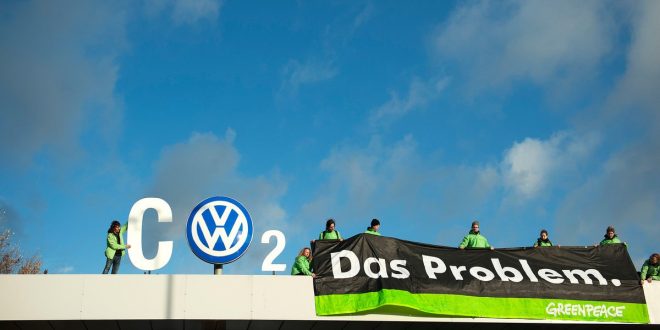
Dieselgate found that car manufacturers had manipulated pollutant emissions software, proving that EURO standards for pollutant levels were not being met in real-world conditions. In this moment of triumph and the need for action to reduce pollution from transport, Greenpeace turned its attention back to the climate and CO2. Dieselgate had nothing to do with CO2 emissions, but that didn't stop the activist organization from trying to bury the problems of air pollution by presenting a completely different problem. Even more disgusting is that Dieselgate is a product of climate lobbying. Diesel cars have lower CO2 emissions (the diesel engine is more efficient in terms of CO2 emissions), which is why the climate lobby in the EC has been turning a blind eye to the real problems in the name of climate for years. With this move by Greenpeace, the hope (Esperansa was my favorite ship of the organization) in me that they were working to protect the environment evaporated.
Today the climate lobby is on the attack again, this time using a child (Greta) as the face of its campaign. The world has once again been misled and manipulated. The climate lobby hides behind Greta and does not show its true face. Once again, a prophet appears, who is sent to save humanity from the approaching apocalypse. The prophet has risen, and the religion is recruiting new members. Climate activism has a clear agenda:
- Fewer children;
- Less and more expensive meat;
- Less and more expensive milk;
- Fewer and more expensive cars;
- Less and more expensive air travel;
- Less and more expensive energy.
Failure to comply with the program means total destruction of the planet within 10 years... once again.
I do not define myself as a climate skeptic, because I do not exclude that anthropogenic activities have an impact on the climate. However, for now, no one can say what the participation of man in the formation of the climate is. For this reason, I do not think that we should drastically change our way of life or destroy everything that humanity has achieved over the past few centuries. Moreover, our current civilization has reached this level of development precisely after industrialization. And it is industrialization that will help us not to follow the fate of extinct civilizations. Today, we plan to populate even other planets, i.e. to create suitable conditions for living outside the Earth, but at the same time we believe that the Earth may become uninhabitable. It sounds like a cheap fantasy book…
My criticism of climate alarmism is more about the approach to work, rather than the scientific part of things. We are flooded with information about how IPCC scientists claim one thing or another. IPCC reports are not written by scientists, but by politicians. Putting politicians in charge of defining and leading science is a proven mechanism of anti-human political dogmas. I also do not accept the presentation of climate change in the style of communist slogans instead of practical examples. Any politician or scientist or Greta herself who dares to say in plain text what the fight for the climate actually aims for will not only not receive support, but will also be condemned by the masses of eternal isolation.
Yes, Greta is fighting to make us vegan, not to have a private car, not to travel by plane and not to have more than one or two children at most. She believes in this and is ready to sacrifice even her own mother's career. But what do those behind the scenes want? Greta shared in an interview how frustrated she is with certain people who claim to be green, but actually eat meat, drive cars and fly by plane. She described this behavior as hypocrisy. She is right. Indeed, personal example is important, especially for such restrictive measures. It is strange to be a climate activist and have a private plane that you fly with to get your "green award" or to have a mansion on the ocean. What Greta cannot understand and perhaps never will understand is that the people behind her do not want a ban on meat, cars, planes, children. They just want these things to cost more, fewer people to have access to them, and the tax money collected to go into state budgets so they can decide what happens to them.
If we really were facing an apocalypse, not in 10, but even in 30-40 years, would I agree to fight for the climate? No, not in that way, but I would devote myself to attracting followers with one single goal – to voluntarily become vegans, give up their cars and stop flying on planes. Maybe I would not succeed in my goal, but I would have tried approaches that are not anti-human and do not take away the most important thing – freedom and the right to choose. To devote myself to such a thing, solid scientific evidence would be needed, not political slogans, of course.
Now I know that a tree will never be more valuable than a human life. Even more, the entire Amazon is not worth as much as a human life. My cause remains unchanged, but now realized, it is still tackling environmental problems. Carbon dioxide is not a pollutant, but a source of life, and the carbon footprint in no way measures how green and sustainable we are. I have unexpected obstacles in the face of climate alarmists, who not only want all the attention and funding, but also do not realize how much they can harm the green cause by forcibly privatizing it, replacing it and causing a loss of trust in a large part of the people by presenting it as a dirty national socialist ideology, but the fight is still ahead.
The article is reprinted from the author's blog.






Западните "зелени", еко-талибани или каквито там са се нарекли са нов вид обикновени левичари. Западното левичарство е диагноза. Хора болни за власт. След като се провалиха с комунизма, продължават да пробват със социализма и социал-демокрацията, но това не им пречи да опитат и нещо по-ново - екологията.
Когато отстраним всички омайни приказки, всички красиви лозунги и заклинания, зад фасадата на великите им илюзии, в сърцевината на всяко левичарсво откриваш същността му - неистовият стремеж да се разполага с чужди пари. И левичарите да се разпореждат с тях.
Чужди пари са се отнемали още от древността, най-вече чрез лъжа и насилие. Това отнемане при всички народи и през всякакви епохи се е наричало кражба. Или обир. През всичкото време на съществуването на човечеството кражбата се е наказвала. Единственият случай на ненаказано отнемане е когато го осъществиш чрез закона. За да имаш подходящия закон ти трябва власт. Ей заради това всичките левичари, независимо как се назовават, се стремят неистово и неудържимо към властта.