EKIP– Expert Club for Economics and Politics A Different Opinion
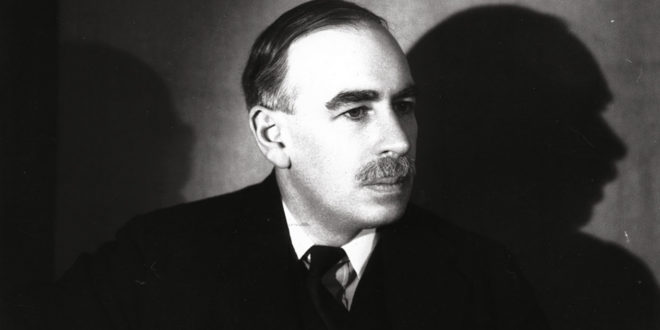
Many of the policies that our and foreign leaders are proposing in the context of the Covid-19 pandemic can be defined as Keynesian, named after the English economist John Maynard Keynes (1883-1946). He was born in Cambridge, UK, his basic education was in mathematics, he listened to lectures on economics from brilliant scientists such as Alfred Marshall and Arthur Pigou. Keynes' intellectual qualities are undeniable, but from a very early age he moved in circles that questioned traditional moral and social foundations.
Keynesian medicines are an inappropriate therapy for the modern economy. A close look at some of them reveals the presence of poisons that threaten to kill the patient rather than cure him.
Keynes and the Great Depression
John Maynard Keynes gained international fame as an economist before the onset of the Great Depression in 1929. In late 1919, he published his book The Economic Consequences of the Peace. In it, he criticized the positions of the victors in World War I towards a defeated Germany, which was being forced to pay exorbitant reparations.
Keynes's most significant work is The General Theory of Employment, Interest and Money, published in February 1936 and subsequently translated into many languages. It is this book that associates his name with the Great Depression, its causes, consequences and ways to overcome future crises. In this treatise, Keynes rejects the then dominant thesis of the market economy as a self-balancing mechanism in which there can be no sustainable states of unemployment. Another key element in the book is the proposition that demand, not supply, is the most important variable that governs the general level of economic activity.
According to superficial supporters of Keynes, his ideas helped the United States emerge from the Great Depression of the 1930s. However, the truth is that the policy measures with which the United States tried to deal with the crisis, besides being unsuccessful, began to be implemented long before the publication of the General Theory. The Depression itself continued well after the publication of the book. The mass adoption of Keynesian ideas in both theory and economic policy became a fact after the end of World War II.
Keynes and the "benefits" of wars
There is a sentence in the General Theory that concerns the social results of wars. Keynes writes: “ The building of pyramids, earthquakes, and even wars may serve as incentives to increase wealth, if the education of our statesmen on the principles of classical economic theory does not allow them to choose some better way.” Let us clarify that the quote is not about increasing the wealth of a privileged few through military supplies, corruption, etc. His thesis is that war helps to increase social wealth, i.e. everyone benefits from it.
Keynes's statement has a dubious moral value. Even if it is ignored, the question remains how his words relate to the accumulated historical experience of the effects of wars. The monstrous number of lost human lives, material destruction and financial losses of the First and Second World Wars are a well-known historical fact. It is worth remembering, however, that they were not the only devastating wars in European and world history. During the so-called Thirty Years' War from 1618 to 1648, the German states lost about 1/3 of their population, etc., etc.
The deadly consequences of wars are not only the result of direct military action and its financing. Wars and armies are a major vector for the spread of deadly infections. The Spanish flu pandemic began at the end of World War I. The gathering and transfer of huge masses of people over great distances in a short time certainly contributed to the global scope of the disease and the millions of victims it caused. The history of the plague in the 14th century also proves the stated thesis. The plague infection was brought to Europe by the Mongol troops who besieged the Genoese fortress of Kaffa in the Crimea. During the occupation of the Swedish islands by Russia in the early 19th century, the mortality rate of the local population increased without any hostilities. During the Franco-Prussian War of 1870-1871, Prussian troops in France contracted smallpox. After their return, they caused an epidemic of this disease in their homeland. Several deadly diseases were brought to Latin America by European conquerors after the discovery of the New World. According to various estimates, they led to the destruction of between 70 and 90% of the native population. During World War I, about 35% of Bulgarian casualties were not caused by battlefield losses or wounds, but by disease.
Keynes and the Bulgarian case
Bulgarian economic problems, for better or worse, rarely attract the attention of major economists. Although Bulgaria is present in Keynes's writings, albeit very peripherally, it is not for the better.
Part of Keynes' fame is due to his criticism of the harsh conditions imposed on defeated Germany in the peace treaty after the end of World War I. He accused the heads of state of England, France and the United States of ignoring economic problems and of blindly seeking revenge on the enemy. In the book, he predicted the grave future consequences for international relations of the thoughtless burdening of Germany with unbearable reparations payments. His predictions, although vague, came true when World War II broke out 20 years after the end of the First.
In World War I, Bulgaria was an ally of Germany. Because it was among the defeated, harsh peace conditions were imposed on it with the Treaty of Neuilly in November 1919. These included restrictions on the conduct of an independent economic policy and later the obligation to pay reparations worth 2,250,000,000 gold francs. Economist Kiril Popov notes that initially the idea of post-war reparations originated from the practice of the German command during the war to destroy buildings, factories, infrastructure, etc. in the parts of Belgium and France it had conquered. The purpose of such a policy was to reduce the enemy's military potential and to limit the production capabilities of the defeated after the end of the war. However, similar actions by the Bulgarian army could not be detected because it operated in territories populated exclusively by Bulgarians. In addition, the Bulgarian military authorities found during the fighting that the German allies were systematically robbing the country of resources necessary for it.
Keynes's criticism of the inadequate post-war peace settlement of Europe, and in particular of the German reparations obligations, seems like an authoritative, albeit indirect, defense of the Bulgarian cause. In The Economic Consequences of the Peace, however, Keynes defends the Germans by stating that they are being asked to pay reparations without taking into account whether some of them are not for damages caused by the German allies. Later in other works, he concretizes his thought by writing that the allies of Germany, including Bulgaria, should be responsible for some of the damages attributed to the German army. It turns out that the Bulgarian reparations are not only fair, but should be increased in order to reduce the claims and burdens of the great ally. If such ideas had been implemented, the economic recovery of Bulgaria after the First World War would have been much more difficult.
Flirting with Totalitarianism
Keynes cannot be defined as a supporter of any of the totalitarian systems of the time. However, he tried to save capitalism by allowing a dangerously close flirtation with totalitarian systems in some of his ideas. It is a well-known fact that he wrote a special preface to the German edition of the General Theory, in which he noted that his ideas could be more easily applied in a totalitarian system. In 1932, he spoke positively about centralized economic planning in a radio broadcast. According to him, the appeal of planning was due to the failure of "unplanned economic systems", and examples of planning were the five-year economic plans in the USSR and the planning in Mussolini's fascist Italy. In 1930, Keynes spoke positively about some of the ideas defended by the British fascist Oswald Mosley. Last but not least, among the concepts that Keynes supported were those of economic nationalism. In an essay read to the BBC in 1931 he declared himself against austerity, saying that every five shillings saved puts one man out of work for a day. Conversely, the purchase of goods increases employment, but the goods purchased must be British to increase local employment. Contrary to a number of the achievements of classical economists, Keynes declared himself in favor of protectionism, forgetting the old rule that if goods do not cross borders, then armies do.
Why can't Keynes help in the current crisis?
The answer to the question now seems easy. He justifies wars, seeks to justify the benefit of the big at the expense of the small, and flirts with totalitarianism. The banal truth is that wars bring death and destruction. Totalitarianism too. Wars are indeed companions in human development, but unwanted companions. Therefore, if Keynes also goes away with the victory in the war against Covid-19, we will not miss him. At least at the level of economic policy.
P. Penchev