EKIP– Expert Club for Economics and Politics A Different Opinion
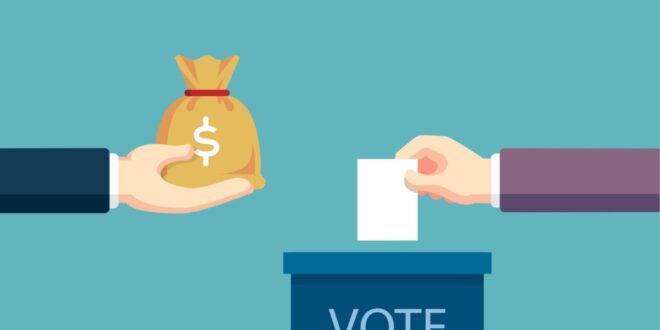
As it became clear in the first part of the series, the buying and selling of votes can occur in at least two ways. The first is by directly giving cash (the notorious 50 leva per vote) to mark a particular ballot, the second is by promising policies that financially benefit the respective voters. Let's call the first method "buying by hand" and the second "buying by promises". The difference between the two methods is that in the first method, the money-for-vote transaction is carried out at the moment, while in the second, it is with deferred execution in the form of a promise - the vote is cast now, the money will come later. Economically speaking, the politician who buys votes by promising practically assumes a debt to the voters whose votes he buys.
Promises are like the wind, money in your pocket is...
Of course, this debt may not be fulfilled. Many such cases! This risk does not change the essence of, for example, the election promise to increase pensions as an attempt to buy the votes of pensioners, but it obviously carries with it a dose of uncertainty that the promise will not be fulfilled and the voter will not receive the money. It is precisely the presence of such a risk that is the purely economic reason why this type of election promises always offer greater financial benefits than what is offered when buying votes in cash. It is obvious that a promise to permanently increase a monthly social payment such as, for example, pensions, by 50 leva represents a greater benefit to the relevant voters than a one-time payment of 50 leva.
There is a way to eliminate this risk of non-fulfillment of the promise. This can happen through the third method of vote buying. The third method of vote buying is by using the funds of the state budget to financially benefit the sought-after electorate of the moment, even before the elections. Let's call it "buying votes through state spending". It works like the first method - buying votes by hand - only using the huge financial resources of the state treasury, which is the promise of the second method. Thus, the third method of vote buying is in practice a combination of elements of the first two. The state budget for 2021 is full of examples of policies of precisely this type, which are even more striking in a period of crisis, when public funds are tight.
The state budget as an election buffet
Such policies include, for example, a sharp increase in civil servant salaries by up to 30%, the highest increase in pensions in the last few years, food vouchers for pensioners and, of course, the provision of a monthly supplement of 50 leva to pensions, specifically until the elections. Prime Minister Borisov even said that this supplement would continue to be paid if GERB forms the next government. Could pre-election “shopping” be more obvious than this?
This third approach to vote buying, defined as buying votes through government spending, has the highest potential effectiveness. The biggest weakness of buying votes by hand is that it is prohibited by law. On the other hand, the biggest weakness of buying votes through policy promises is that there is a chance that they will not be fulfilled, even if they promise a lot of money. Buying votes by immediately using the budget to benefit the relevant voters suffers from none of these weaknesses. It is completely legal, the amounts are substantial, and the payments start immediately.
However, this buffet is only served by the government.
The great conditionality of this approach is that only the ruling party (or parties), i.e. the government formed by the respective parliamentary majority, has access to it. No other political force has direct access to the state budget funds to buy votes, especially extra-parliamentary formations. This gives the government a huge advantage in each election cycle. By using the budget tools for “election shopping”, which is the most effective method of buying votes, the ruling majority can significantly improve its election result and to a significant extent compensate for any possible loss of voters to political competition. If you distribute a few billion to key groups of voters through the budget immediately before elections, this will at least give some result.
This brings us to another very strong argument in favor of legalizing the buying and selling of votes by hand. If all parties were allowed to use whatever private financial resources they were able to mobilize to buy votes, this would, to some extent, neutralize the enormous advantage that the government has in elections through direct access to the state budget.
With one hand he buys, with the other he punishes...buying
In addition, the government also controls the security structures – it controls the same police that are supposed to prosecute those who buy votes illegally, that is, “by hand”. Who do you think they are more likely to prosecute when they are monitoring such crimes – people from the government or the opposition? I think everyone would agree that this situation is extremely unfair. It is a form of tyranny. Those in power enjoy exclusive privilege and power tools through which they can not only reinforce their own vote buying, but also purposefully and selectively punish the vote buying of others.
In the “ arena of ideas” it is not fair to have such privileges. Of course, this privileged position of the government is largely structurally predetermined. Those who control the state treasury will always have a similar advantage in buying votes. But we can at least neutralize this inequality a little. To a large extent, in fact, it is the ban on buying votes (by hand) that corrupts the democratic process.
By buying votes to change the status quo!
Legalizing the buying and selling of votes by hand, as is permitted through campaign promises and state spending, would give the opposition more tools to fight the political status quo. This applies to the opposition both inside and outside parliament. Do you want to increase the chances of your favorite extra-parliamentary party doing well and maybe even winning the election? This is a very good way.
Of course, these parties and their voters are often made up of people who have particularly strong opinions on the “morality” of politics. I am sure that many of them would be morally disgusted by the proposal of this text. But the reality of buying and selling votes is all around us, if I may paraphrase Ms. Tsetska Tsacheva. As became clear in the previous article on the subject, buying and selling votes is an inevitable foundation of the democratic electoral system.
So, let's stop pretending. And let's give the opposition more opportunities to fight the status quo. If the government can buy votes by raising salaries and pensions, why can't the opposition do it, but by hand? Votes are always bought, it's always for money. This is the essence of the democratic process. The rest is poetry.