EKIP– Expert Club for Economics and Politics A Different Opinion

Often in more specialized circles there is talk of the “Overton Window” – the conditional shift of the political “center” to the left over time, as ideas once considered quite ordinary are today presented in society as “extreme”. Here we will go back 100 years, to the time of the Bulgarian National Union of Farmers and Alexander Stamboliyski. The management of farmers in our country between 1920 and 1923 is undoubtedly considered to be left-wing.
In some respects, however, their ideas today sound downright unacceptably "right-wing" - as in this case we will encounter the idea of creating a private National Opera, through a concession. A "deal" of a private investor with the state, the result of which will be the construction of a building in the center of Sofia with two concert halls with 2,500 seats each. The state, for its part, supports culture not with subsidies and grants, but by "exempting the costs of the construction from all taxes, fees and levies".
An idea supported and introduced into Parliament by farmers and promoted in the public sphere by the most left-wing newspapers and magazines of the period, whose realization did not come about just by chance.
The idea
The concept came to mind by Dimitar Karadjov (1885-1923). His name is little known to the general public. A musician, a modernist, he appeared in public in 1919, having returned with considerable funds and ideas from Vienna, and presented to the public with a concert of his own compositions under the baton of maestro Georgi Atanasov. His appearance was supported by the most modernist – and politically left – magazine “Vezni” by Geo Milev. Karadjov himself later participated in the magazine, wrote texts and presented his own positions on various topics, incl. on the future opera.
In 1920 in Bulgaria – and specifically in Sofia – the opera shared the stage with the National Theater. In addition to theatrical productions, there were sometimes various musical performances there. Opera in our country was still taking its first steps as an art form. However, Dimitar Karadjov wanted this to change and believed that it could be done by separating it into a separate building and as an independent institution, since at the moment “the opera interferes with the theater, and the theater with the opera.”
Instead of waiting for the state to build, organize, manage, and finance an Opera House, he took matters into his own hands. He decided that this mission could be accomplished as a private initiative.
He defended this idea on the pages of "Vezni", it also entered the Parliament. The concept in today's terms can be called a "concession" - the only role of the state is to provide land. On this land, the entrepreneur, without a single state leva investment, will build the opera building, will organize the institution, it will exist as an independent organization, and along with its activities there will also be a cafe to support its maintenance. 30 years after the start of the opera's operation, the entire enterprise will again become state-owned - the land, the building, the opera, etc.
Dimitar Karadjov proposes the construction of two concert halls for “2000-2500 people” – impressive premises even by today’s standards (today only Hall 1 of the National Palace of Culture is slightly larger). Interesting – and not so popular these days – is his idea of the entire philosophy of the undertaking. Karadjov himself writes that the most important thing is that “the people will receive a modernly organized cultural institute”. For the communists in the National Assembly, as we will see, the most important thing is not what the people will receive, but that it will be “private”, not “state”.
The opposition – from the left and from the right
The debate enters the parliament. The transcripts of the sessions of the National Assembly preserve the different positions. The farmers, as the submitters, support the idea. The opposition is the narrow socialists – i.e. the communists, as well as some of the “bourgeois parties”, or more generally, the right-wing.
The opposition from the communists is actually what we will hear today from the "center" or from the mass viewer, listener, person of culture. Their thesis is that culture is the work of the state and cannot be left to a private entrepreneur to develop an opera.
Their thesis did not stand the test of time. As a “state work”, the opera continued to be part of the theater, and a separate building did not appear for the next 30 years (even today it is in a hall adapted for the purpose with inadequate acoustics and under 1000 seats). Innovative tendencies too – an innovator like Geo Milev had a hard time finding a place in the National Theater, and although with a few productions he managed to introduce a contemporary element there, this became extremely difficult. Ultimately, the National Theater achieved serious successes and had high-quality productions during the interwar period, but some innovative ideas had a hard time getting in and it was often under fire from critics – although after Geo Milev’s death, rarely at such a high level.
The opposition from the right is more interesting. Although at times it is clearly “exaggerated”, just being an opposition, it also has its logical elements. According to them, such an undertaking should not be given directly to a specific entrepreneur. If the idea is really good, then it should be put on the “market” and decided on a competitive basis. There is no problem for the state to provide this terrain to a private entrepreneur, as long as it is a temporary concession and a good idea – but the specific concessionaire cannot be elected by parliament, but must be elected on a competitive basis.
Another curious and far more obviously oppositional thesis is the attack on concessions. "Concessions are given for forests, and for mineral waters and so on, and now they are given for opera houses," criticizes the decision of democrat Pascal Paskalev. According to him, this will be a "purely capitalist enterprise" and the private individual has no interest in building an opera. Whether there is or not is debatable, but in his concept Dimitar Karadjov explicitly writes that he intends to invite names that history has proven to be among the most significant for the music of the 20th century, such as Richard Strauss, Arthur Nikisch and other world-famous conductors and composers.
Ultimately, the opposition from the right is more at the party level, just to be "anti" the Bulgarian National Assembly. In fact, one of the more worthy Bulgarian politicians and later Prime Minister, Andrey Lyapchev, essentially expressed support for the initiative and it was ultimately voted on.
The specifics of the future opera
The concession bill went a long way – it was discussed as early as September 1921, and was not finalized until the end of 1922 and the beginning of 1923. According to it, the building of the new People's Opera would have an opera hall, a separate concert hall, a third stage – a small theater, a room for a music conservatory, as well as a cafe-restaurant and other profitable premises. The impressive program would be performed by the composer Dimitar Karadjov for 4 years, after which the 30 years of concession would run, and after their completion the entire enterprise would become state property.
Besides the very idea of how the Bulgarian people could acquire an opera – through private initiative and without a single leva of people’s taxes, there are other impressive moments. Art. 2 of the bill provides that all “materials, machines, etc.” that will be used to build the building will be exempt from customs duties. Without the parallel being exact, I can recall that attempts to eliminate VAT on books are still just a dream, and for other cultural products this is not even discussed. Although he is in opposition, Andrey Lyapchev from the “Democratic Party” agrees with the idea in his statement.
The same applies to the "invested capital..., profits and revenues" of the enterprise, which are exempt from "any state, county, municipal and other taxes, fees and levies."
The state, however, retains some control over the opera's "cultural concession" - it will have its own representative in the management and will approve the repertoire and prices.
After some debate, the specific location for the opera was specified - approximately the location of today's Bulgarian National Bank building.
After the first vote on the law in 1921, the National Assembly “burdened” the concessionaire with additional obligations: to build the building of the future National Museum and Library. For this purpose, Karadjov had to completely demolish the building of the Buyuk Mosque – i.e. the building that houses the Archaeological Museum to this day, but the opera would have been there. For the museum and library itself, the concessionaire had to build a separate new building – next to the Military Club, between “Tsar-Osvoboditel, Rakovski, Aksakov and 6-i Septemvri Streets”, i.e. today’s Crystal Garden.
From a cultural and historical point of view, it is probably good that this was not fulfilled and the building of the Buyuk Mosque was still preserved. At that time, the point of view on cultural values was not yet unified and there were opponents of this decision, but the proposal of Minister Stoyan Omarchevski prevailed.
It is curious that between the readings and debates about the Opera, in November 1922, at the suggestion of Minister Omarchevski, the decision to celebrate November 1 as a national holiday and the Day of the People's Awakeners was voted on.
What's happening in the "province"?
In fact, there is nothing surprising in the fact that the idea is accepted and discussed so normally in public and in the National Assembly. Similar examples already exist, although on a smaller scale – and not all of them successful. In Plovdiv there are several similar attempts, the most popular of which is the private “South Bulgarian Folk Opera” by the Italian Emilia Favretto – Sabeva, which also toured in the early 1930s. Other smaller similar enterprises have also had some success.
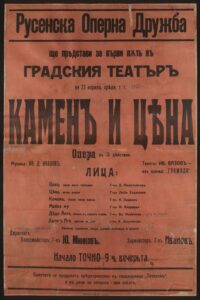
The same thing happened in another cultural center – Ruse. Today’s Ruse Opera was born as a private association “Opera Friendship”, which had a better fate than the Plovdiv experience and existed perfectly until its nationalization after September 9th. With money from investors and a business plan, it was created at the beginning of the 20th century. Shortly after September 9th, this opera was nationalized, and after November 10th, there was still neither political nor public will to return to the ideals before communism. In this aspect, we still live in the spirit of the years that began in 1944.
The end result
Unfortunately, none of Dimitar Karadjov's ideas were realized. However, the reason was not economic or political. Karadjov died in early 1923, just days after his idea was finally voted on in the National Assembly. "...he suddenly leaves, and with him the dream of his life," writes art historian Ruza Marinska in a text about the musician.
A hundred years later, the idea of a private investor building an opera house also sounds like a dream. However, its public discussion would be absurd, because a hundred years later, not left-wing parties, such as the Bulgarian National Union of Artists, but even right-wing parties and people would find this concept impossible. And it probably is impossible – but not because of specifics of society and the market situation, but for purely political reasons and the displacement of the “Overton Window”. Today, private initiative in the sphere of culture is a bad thing.