EKIP– Expert Club for Economics and Politics A Different Opinion
"The material that appears in elections or from which we can choose as personnel is not great at all," said Boyko Borisov at a meeting with Bulgarians in Chicago in 2009. Although the media then attributed to him the words "the material is bad," which he never actually said, what he said then is even more true now - not for Bulgaria, but specifically for his party GERB. After twelve years of rule, there are almost no authentic personnel left in the party, and the original representatives of GERB were replaced not by fresh blood, but by people from other parties, most of whom made their names through insults, accusations and threats directed specifically at GERB and Borisov.
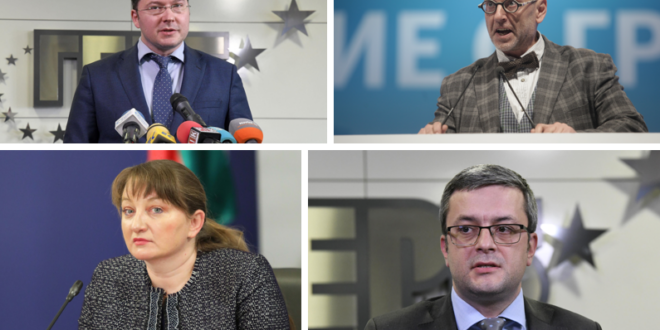
Imagine the following scenario: you go back in time and explain to a protester in 2013 that GERB will win the parliamentary elections in 2021, and the only one who says anything to the media the night after election day is Lyuben Dilov-sin, elected as an MP from the party’s civil quota. Weeks later, Daniel Mitov, the party’s candidate for prime minister, along with Toma Bikov, a second-term GERB MP, give a press conference regarding the proposed draft cabinet, which, among other things, also includes the name of Denitsa Sacheva, a candidate for a second term as Minister of Social Affairs. The protester will probably find time travel to be the least fantastical element in the whole story.
Mitov, Bikov and Sacheva, former DSB and DBG cadres, are just the tip of the iceberg. The number of people who have at one point or another turned the tables on Borisov is constantly growing. To them can be added the names of Dilov-son, Anton Todorov and Spas Garnevski (also a former DSB cadre). Dani Kanazireva is a special case – while the rest of the list turned 180 degrees, she made a full circle back to GERB after almost a decade on the other side of the barricade.
Together they could issue a whole compilation of insults and accusations against GERB in the past. Toma Bykov will probably be haunted for the rest of his life by his 2012 article about Borisov, when he called him a “caricature of a dictator.” Five years earlier, Daniel Mitov called Borisov “a product of a militia environment” and said that the main difference between him and Borisov was that he “never massaged Todor Zhivkov’s ears.” In 2013, Denitsa Sacheva said that “support for GERB is based on fear and repression,” and that the party mainly deals with “extortion and patronage.” That same year, after the Gergyovden-SDF coalition failed to enter parliament, Lyuben Dilov-son said that GERB was “another wing of the Bulgarian Communist Party. Simply put, if we divide them into Zhivkovists and Lukanovists, Lukanovists are the Bulgarian Communist Party, and GERB are the Bulgarian Communist Party – Zhivkovists.”
As for the former GERB MP Anton Todorov, who nowadays attacks GERB and Boyko Borisov's opponents every day on TV "Europe" and beyond, there it would be more difficult to choose a quote: in 2013 he published an entire book called "The Gang: Boyko, Rosen, Tsetso and the Others" (which, by the way, was published by the publishing house of PIK "Millennium"). But it is worth mentioning part of the book's announcement: "Racket, denunciations, smuggling, transfers of billions, draining the state reserve, showy arrests, merging the executive and judicial branches... The "GERB Gang" is the darkest part of the great fraud known as the Bulgarian transition."
None of the new blades ever gave a logical explanation for when and where in time and space their transformation from mildly critical of GERB and Borisov to people who seem ready to do anything for him and the party took place.
The problem is that the ones listed are actually the most active representatives of the party at this point. With few exceptions like Tomislav Donchev, Ekaterina Zaharieva and Desislava Atanasova, there are almost no authentic GERB supporters left – little by little, most of the key figures from the early years of GERB, such as Simeon Dyankov, Iskra Fidosova, Lilyana Pavlova and, of course, Tsvetan Tsvetanov, have left the stage. And while Dyankov, for example, was never a true party member, the rest waved the flag until the last possible moment. After that, some of them preferred silence and some quiet fast, and Tsvetanov simply crossed over to the other side of the barricade.
This problem also gives rise to others: it is hardly easy for the older dogs in the party, the hard-line voters and the local structures to swallow that this is the cheerful replacement who will replace Borisov. The unsuccessful candidate for prime minister, Daniel Mitov, is not only a former sharp critic of the party and its leader, but also his complete antithesis – an academic bureaucrat intellectual who in 2007, not by chance, was Ivan Kostov’s deputy in DSB, and not Borisov’s in GERB. Equally no coincidence is the anger of people like Georgi Markov and Nedyalko Nedyalkov, both outspoken supporters of Borisov, towards Mitov and his passive behavior since he was pushed to the forefront.
There is another demotivating element. GERB members, according to 2018 data, are about 94 thousand people. Instead of looking for the future of his party among them, Boyko Borisov seems to have entrusted it to former members of DSB and DBG. There are still hundreds of thousands of people in Bulgaria who vote conscientiously for GERB for the same reasons they probably did in 2009: the image of Borisov, garnished with his simple and direct speech. The new representatives of the party possess none of these qualities. The remnants of the old guard, in the person of Donchev, Zaharieva and Atanasova, are also far from Borisov's behavioral profile, and are also worn out by the years.
The conclusion from all this is that the end of Borisov could also be the end of GERB. Such a prediction is not at all bold or surprising: GERB has always been “Borisov’s party,” and even when there was a clear second man and potential successor in the person of Tsvetan Tsvetanov, he was not seen as a real replacement. The surprising thing is that GERB, it seems, would not simply disappear. Before that, it could finally turn into an attempt to move the yellow cobblestones to Bankya.
Ultimately, perhaps Borisov was right from the very beginning - the material that stands in elections or from which he can choose is indeed not large at all, and over the years it has become even smaller. So much so that one can calmly ask oneself the logical question: are there any Gerbadjis left at all? Or perhaps, to see the future of the party, one simply needs to look at the list of former DSB members.