EKIP– Expert Club for Economics and Politics A Different Opinion

The imposition of green certificates requiring vaccination for admission to certain public places has caused a severe division in Bulgarian society. For better or worse, the entire conversation “for” or “against” restrictive measures against the unvaccinated revolves precisely around the question in the title, which is unfortunately not put into a sufficiently detailed context by the authorities.
The information campaign of the health authorities regarding the effectiveness of vaccines is extremely poor, and it is this information deficit that I will try to (partially) correct. To this end, I will present slightly more detailed data on the effectiveness of vaccines in their practical application in the fight against the raging pandemic.
The data I focus on in this article comes mainly from the official weekly reports from health authorities on the progress of the Covid-19 vaccination campaign in the United Kingdom. I chose to look at this country because it is one of the few that collects and publicly presents very detailed data on the progress of the vaccination campaign. When I started writing this text, the most recent report was “ Covid-19 vaccine surveillance report: Week 41”. In the meantime, “ Covid-19 vaccine surveillance report: Week 42” has been published, but I had already written most of the text, so please forgive me if my data is a week old.
Effectiveness against Covid-19 infection
Official data from the United Kingdom shows that over the past 4 weeks (for which data is available), Covid-19 infection rates have been higher among the vaccinated in all age groups except the youngest: the 18-29 age group and the under-18 age group. This refers to people vaccinated with two doses. In some age groups, the infection rate among the vaccinated is twice as high as among the unvaccinated. Among the unvaccinated aged 40-49, the infection rate is 696.2 per 100,000 people, while among the vaccinated it is 1,455.8 per 100,000 people. Lower but similar differences in favor of the unvaccinated are found in the age groups 50-59, 60-69 and 70-79. These are worrying figures.
Graph: Infection rates per 100,000 people by vaccination status between weeks 37 and 40 of the UK vaccination campaign

The report presents the data as infection rates per 100,000 vaccinated/unvaccinated population, which is why I conclude that the negative effectiveness cannot simply be due to the fact that the vaccinated outnumber the unvaccinated. A potential explanation for the observed negative effectiveness of vaccines against infection is that it is due to an error in the presentation of the data and in fact these are not infection rates per head of the vaccinated/unvaccinated population, but per head of the population as a whole. Therefore, I also looked at older weekly reports and they show the same trend. There is no note anywhere about a potential difference and/or error in the statistical methodology.
Effectiveness against severe disease (hospitalization)
Let us now turn to the data on the effectiveness of vaccines against severe COVID-19 (hospitalization) and death. We start with hospitalization. Returning to the UK report, the table below shows a breakdown of COVID-19 cases requiring hospitalization by vaccination status. The data shows that across all age groups, vaccination reduces the chance of hospitalization due to COVID-19.
Table 1: Covid-19 emergencies per 100,000 people by vaccination status between weeks 37 and 40 of the UK vaccination campaign
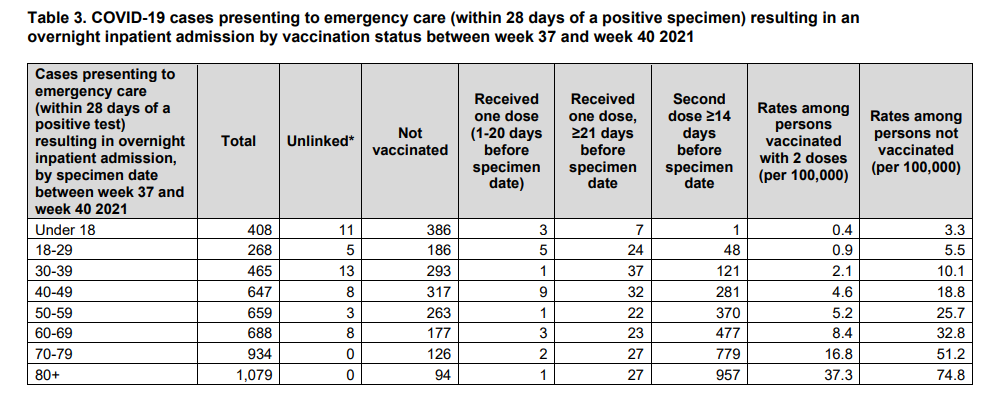
However, this reduction in the risk of severe illness is not nearly as significant as is being touted by politicians and most journalists. Data from the UK show that vaccination does not completely eliminate the risk of hospitalisation, but simply reduces it to levels seen in some younger age groups for each age group. Among unvaccinated people over 80 (who are at the highest risk of complications from Covid-19 because of their age, all other things being equal), 74.8 out of every 100,000 people require hospitalisation. Among vaccinated people in the same age group, the rate is 37.3, which is exactly half that.
This rate is also relatively close (but still higher) than the rate for unvaccinated individuals aged 60-69, in which 32.8 out of every 100,000 people are hospitalized. For vaccinated individuals aged 60-69, 8.4 out of every 100,000 people are hospitalized, which is 4 times lower than for unvaccinated individuals in the same age group and close to the rate of hospitalization for unvaccinated individuals aged 30-39. We see that for each age group, the practical effect of vaccines is to reduce the risk of hospitalization to the natural level of risk for unvaccinated individuals who are 20-30 years younger.
Effectiveness against death from Covid-19
The mortality figures 28 days after infection are not much different – let’s look at them in the next table below. In the oldest and most vulnerable age group (80+ years), 128.1 unvaccinated people die per 100,000 within 28 days of infection with Covid-19. For vaccinated people of the same age, this rate is 45.9, which is only slightly lower than the mortality rate for unvaccinated people in the lowest age group – between 70 and 79 years.
Table 2: Covid-19 deaths per 100,000 people by vaccination status between weeks 37 and 40 of the UK vaccination campaign
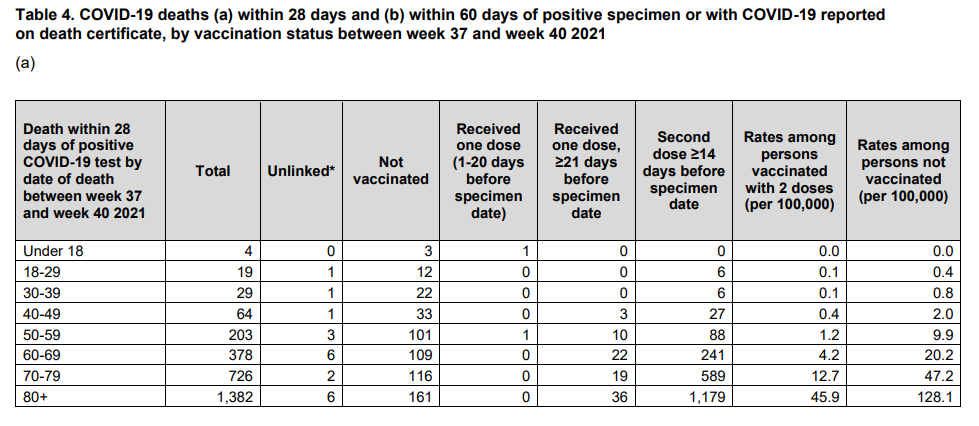
This trend is also seen among other age groups. For example, the death rate among fully vaccinated people in the 40-49 age group is the same as the death rate among unvaccinated people between the ages of 18 and 29. In both cases, it is extremely low – 0.4 people per 100,000 (equivalent to 0.0004%). For unvaccinated people aged 40-49, the death rate is 2.0 per 100,000, which is 0.002%.
In short, the mortality data suggest that vaccines probably reduce the risk of death by a factor of 3 to 5 in most age groups. Vaccines are least effective against mortality in the oldest age groups, which is both natural and problematic, because severe cases and the vast majority of deaths are concentrated among people over 70 anyway. In general, the practical effect of vaccines for a given person is to reduce the risk of death from Covid-19 to that of unvaccinated people who are 10-30 years younger than them.
What could be the reason for the negative effectiveness against infection?
Towards the end of this article, I want to return to the data on infection rates in the UK. If what they show is true and the vaccinated are getting infected more than the unvaccinated (per capita), it is very important to understand why. A possible explanation is that the vaccinated feel more protected and therefore comply with fewer anti-epidemic measures (related to social distancing, masks and hygiene) than the unvaccinated. This, combined with the relatively low effectiveness of vaccines against infection, increases the number of Covid-19 cases in the vaccinated compared to the unvaccinated. That is, the increase in risk due to non-compliance with precautions is relatively greater than the corresponding decrease in risk that vaccination brings. Another possible factor is that the authorities impose fewer restrictions on the vaccinated.
These data may also indicate something that is being hinted at in the context of the push for "booster" 3rd doses. And that is that vaccines have a kind of effectiveness period, which expires after about 6 months. But even so, we would expect infection rates among the vaccinated to be the same as among the unvaccinated, not higher. In any case, more data and targeted research in this direction is needed before we can draw any firm conclusions. The most pessimistic theory could be that the vaccines themselves actually somehow increase the risk of infection. Some virologists say that this is theoretically possible, especially with vaccines against Covid-19, specifically with regard to new mutated variants of the virus. But at the moment we have no clear information in this direction.
Conclusion
What conclusions can we draw based on the data presented in this text? Vaccines work to reduce the risk of severe development of the virus – every vaccinated person has the same risk of being hospitalized or dying from Covid-19 as an unvaccinated person who is 20-30 years younger than them. In terms of protection from infection, however, the data show the strange phenomenon of negative effectiveness, which could also be due to side factors – such as greater carelessness and failure to comply with other anti-epidemic measures by the vaccinated. In any case, it is clear that with such low effectiveness against infection, vaccines cannot “destroy” the virus, even with almost complete coverage of the population, as were the initial expectations and promises.