EKIP– Expert Club for Economics and Politics A Different Opinion

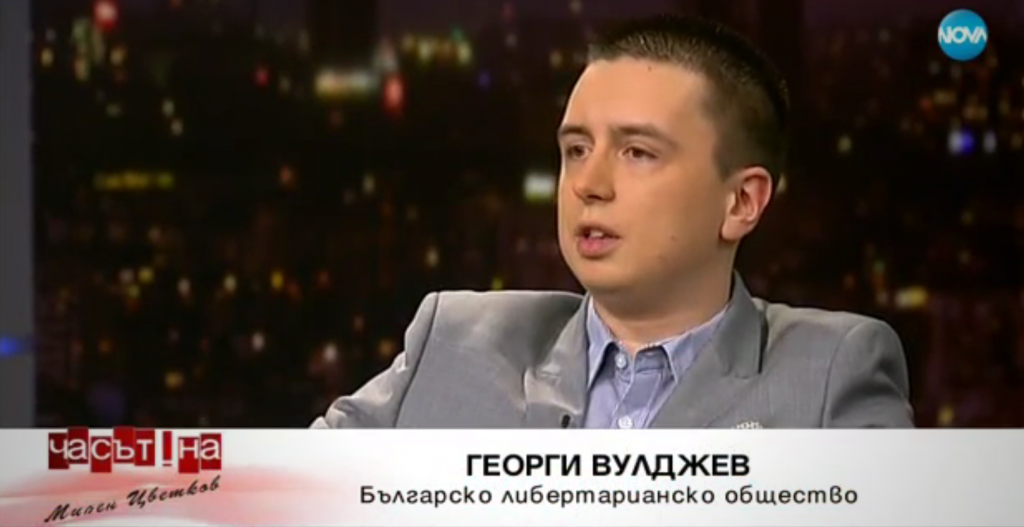
Earlier this week I had the (un)pleasure of participating together with the most famous vegan in Bulgaria – Nikola Donev – in "The Hour of Milen Tsvetkov" on Nova TV. The specific topic of the participation was the destruction of the barbecues in "Lauta" park in Plovdiv, most likely by vegans, judging by the inscriptions "Meat is murder" and "Meat is suffering" written at the crime scene. If you have not watched the show, you can do so by clicking here. In the framework of this article I would like to share my impressions of my participation in this "debate" and to supplement what I was talking about in the studio, because due to the excessive tension and frequent interruptions I was able to say very little of what I actually wanted to.
Having a civilized debate with a vegan is a very difficult task.
I wish I could start by saying that we managed to have a civilized and interesting debate in the Nova studio, but in reality the situation was more like the opposite. From the very beginning, Donev interrupted the host Milen Tsvetkov to introduce himself and start presenting his thesis. This set the tone for the entire conversation after that. When Tsvetkov gave the floor to me, Donev interrupted me several times and tried to take the floor without waiting for me to finish. This happened every time he disagreed with something I was saying - that is, every second word.
Of course, everyone is free to disagree, but basic etiquette requires that we allow our interlocutor to fully present his or her point before we begin to criticize it. For Donev, such etiquette clearly does not exist. This is, of course, a completely legitimate strategy for blocking your opponent's point in a debate. It doesn't make a good impression, but if it works and doesn't make you look like an ass in front of the audience, it was worth it.
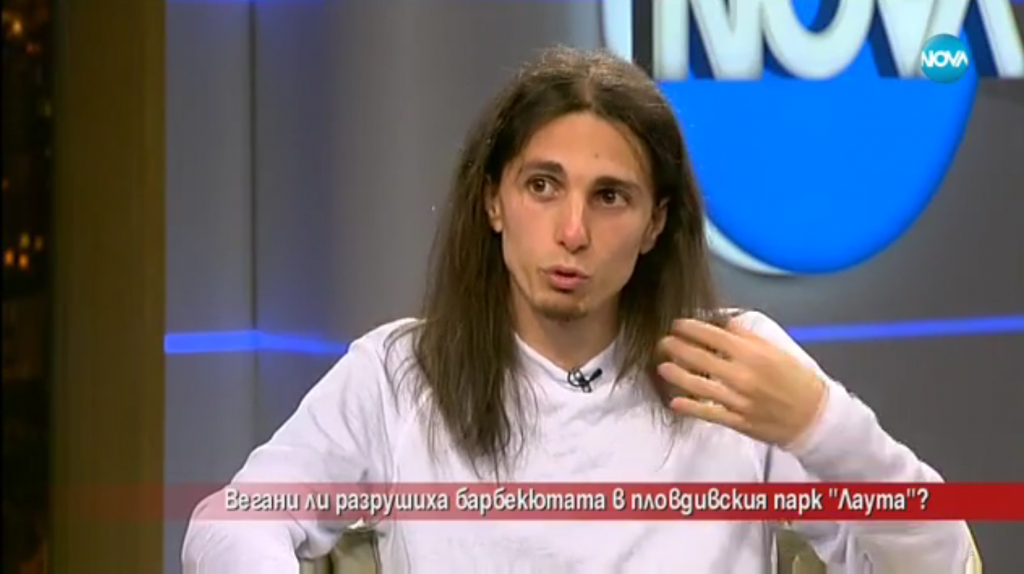
It is interesting that before we entered the studio, I spent about 20 minutes with Donev, during which time he behaved surprisingly politely. This behavior, of course, later changed. These details aside, in the framework of the subsequent very emotional argument in the studio, some specific theses were nevertheless presented. It should be noted that my opponent clearly did not want us to delve too deeply into the specific case of the destroyed barbecues, but since this was the main topic, it is logical to start from it in the framework of this article.
Vandalism can be "heroic" only for an infantile consciousness
It is worth repeating (and even thrice if necessary) that it is unacceptable to praise the destruction of someone else's property as a heroic act. No matter whether it is private or municipal/state. In this particular case, it is not just about putting up some spray-painted inscription, but about directly destroying facilities that were used daily by the residents of the city of Plovdiv. The same residents who financed the barbecues in question with their taxes will now have to finance the reinstallation of such.
I completely don't understand how anyone could even think that through vandalism or violence they can convince someone to accept their point of view? Or, perhaps it is more correct to say that I don't understand how a civilized and balanced person would think something like that. This thinking is inherent in terrorists, not activists, for a, in their words, "better" society. A better society cannot be achieved through destruction and violence. Everyone has the right to protest, but only if, by expressing this right, they do not violate the rights of others. And in this case, this is exactly what is at stake.
What has been said so far, I think, should be perfectly clear to everyone, even the vegans themselves. From the conversation with Donev, it became clear that he clearly thinks of himself as some kind of revolutionary. "In a revolution, such actions (like vandalism) are allowed" - in practice, this was the meaning of his words. The whole idea is comical, of course. Revolutionaries whose revolutionary actions in practice are expressed in petty hooliganism. The discrepancy between the scale of the proclamations (we are starting a revolution!) and the scale of the actions (petty hooliganism) cannot help but make you laugh. Such acts of infantile rebellion make the vegan cause seem even more insane than people think it is anyway.
Even if we assume that vegan ethics are not complete madness...
Later in the "discussion" (perhaps "cacaphony" is a more accurate term from now on) the question arose about the very moral ideology of vegans. Donev was purposefully trying to shift the conversation in this direction, away from the specific case of the vandalism in Plovdiv (a smart move). I had prepared myself for something like this, but apparently not enough.
What I tried to say in the studio is that even if we accept the insane moral theory of veganism as valid, it is still not enough to accept the vegan lifestyle. Because, in reality, the data shows that if we really want to minimize the killing of animals, then giving up meat and eating more plant-based foods is actually not a good idea. This is exactly the argument I tried to make in the Nova studio, but I was interrupted (rather rudely) by Donev several times. My mistake was that I had not memorized the specific sources of the data that I cited in the studio, but this is easily fixed. Let's get to the specifics.
The data suggests that switching to a completely vegan diet could actually lead to the death of many more living beings than now. Why? First, because it would require expanding agricultural land, which means appropriating the natural habitat of certain animal species for our purposes. This could even destroy entire ecosystems in certain regions. Not to mention how many people in the third world who cannot afford expensive vegan products will die of hunger if veganism really takes hold worldwide, as Donev wants. But that's not even the strongest argument.
...veganism is not a good way to protect animals
The stronger argument is that to replace meat in our diet entirely with plant-based foods, we would have to kill many more animals to get the same amount of key proteins. We all know that meat and animal products in general are much richer in certain key nutrients for our bodies – vitamin B12, for example, calcium and, of course, protein. These nutrients are much more difficult to obtain from plant foods. And growing plants also requires the killing of certain animals. These animals are all those rodents and other parasites that, if not poisoned with pesticides, can completely destroy the corresponding crops.
It was about the slaughter of these animals that I was talking about in the studio. For example, data from Australia shows that to obtain the same amount of protein through wheat, 25 times more animals must die than if it were obtained from beef. This is due to the fact that to obtain 100 kg of protein through wheat, you must kill about 55 rodents during the maintenance and deworming of the fields. And if you obtain the same amount of protein through beef, you must slaughter 2-3 animals. Here is a link to the article where these data are presented.
So, if we follow the logic of vegan ethics, that the goal is to kill as few animals as possible, then we should eat more meat, not less. There are other studies that confirm this thesis. You can find links to the sources of the data in the articles themselves, if you don't believe me.
Donev may be a herbivore, but we humans are not
Last but not least, Donev said something that is a complete and absurd lie – that humans are naturally herbivorous animals– those that consume plant foods like vegetables and fruits, but not meat . This is completely untrue, and in fact, a vegan should know it best. Why? Because following a strict vegan diet has a high risk of leading to vitamin B12 deficiency. A deficiency of this vitamin, which is found almost exclusively in animal foods, can lead to serious and permanent damage to the human body, including heart problems. This would not be the case if we had evolved to be herbivores. And vegans would not have to swallow vitamin B12 pills every day to avoid developing heart disease.
So the claim that humans are herbivores is an obvious lie. Ask any doctor, biologist, zoologist, any person educated in biology – humans are omnivores, like pigs, for example. Even Wikipedia says so. But in Nova Donev's studio, he claimed in a brazenly self-confident tone that Charles Darwin himself, the father of evolutionary theory, had said that we are herbivores. Even if he had really said it, it doesn't matter, because all the data points to the exact opposite – a strict vegan diet is not tolerable for the human body without additional supplementation.
So much for what was (not) said in the studio. Of course, there is much more to be said on the subject. And I plan to do just that at a later stage, especially when it comes to vegan ethics. Many people don't bother to think about it in depth and seriously try to refute it. Their instinctive reaction is to say "but that's absurd!", because it is. But this reaction is emotional and they are very rarely able to explain exactly WHY vegan morality is absurd. However, I will leave that task for a future article on the subject.