EKIP– Expert Club for Economics and Politics A Different Opinion
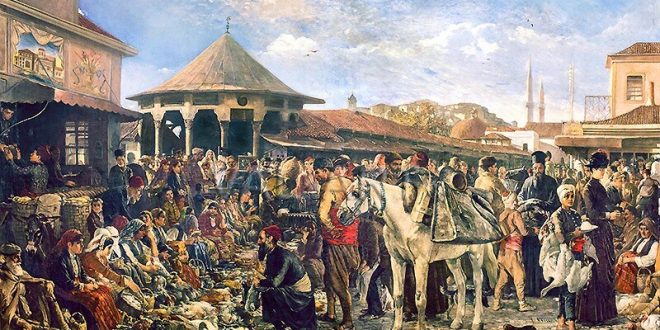
Capitalism in Bulgaria emerged during the Ottoman rule and as a natural effect of the widespread losses of the Ottoman Empire in the various wars and uprisings against it during this period. After several key losses such as the Serbian Uprising and the Greek Revolution, the empire had to undergo reforms concerning the army and administrative structure. Initially, the Janissary corps was abolished, and it was replaced by a regular army.
The Ottoman Empire was forced to reform its economic policy.
Since the regular army required a significant investment in clothing and other equipment, this provided an opportunity for the development of guild organizations, to which many of the orders for the army began to be delegated at that time. Information about such contracts between the Ottoman administration and guild organizations can be found in the state archives of Turkey, where contracts with craftsmen from Tarnovo, Sliven, Plovdiv, Pazardzhik and other small towns and villages are also preserved. This incentive for production allowed many of the manufacturers and suppliers – beglikchi, jelepi, etc. to accumulate wealth.
One of the important drivers of economic development in the Bulgarian lands was the Anglo-Turkish treaty, signed in 1838, which was essentially anti-monopoly in nature and practically abolished the state monopoly on grain and food products. The desire for reform of the empire was expressed in concluding several more similar treaties with other European countries. As a result of the created conditions for free trade, the development of cattle breeding and agriculture intensified, and from there agriculture acquired the character of a commodity economy.
Bulgarian economic development is due to free trade
By the middle of the 19th century, the Bulgarian lands were already in strong market interaction with European countries. As a result of the agrarian reform carried out by the Ottoman Empire, the farmsteads grew more and more and covered a significant share of the sectors of the Ottoman economy. Another strong sector that was growing was the number of sovats, which produced and traded animal products. Some of the farms in the Bulgarian lands began to consolidate and grow into large farms.
In addition to small farms and villages, the reform also affected urban development. As a result of the new contracts and developing farms, urban life underwent intensive development in about 70 larger settlements. Crafts were the basis of trade in the cities, and as industries, tobacco production and the leather industry were growing increasingly.
During the agrarian reform, the farmsteads in the Bulgarian villages expanded and began to encompass more and more branches of the Turkish economy. They were the fruit of the slow changes and transformations typical of the Orient, and intricately intertwined bourgeois, East Asian, patriarchal and coercive relations. Here it can be said that these were neither American capitalist farms, nor French fiefs, nor Russian landowner farms.
Capitalism begins to transform the Bulgarian economy
Along with the farmsteads in agriculture, the number of sovats, which produced and traded in animal products, also increased. Large rural farms were created, the number of which in Bulgarian agriculture has not yet been established. For the Bulgarian villages of that time, it can be said that large landownership, combined with rural industry, usury and small trade, became the basis for the development of capitalism there.
The situation in Bulgarian cities also changed. After the process of Bulgarization, carried out in the second half of the 18th century and the beginning of the 19th century and as a result of the reforms of the 1930s and 1940s, urban life in Bulgarian lands began to develop very intensively in about 60-70 larger settlements. The economic basis of the cities became crafts and trade. The leather and tobacco industries progressed.
By the mid-19th century, the Danube ports in Bulgarian lands were increasingly visited by Austrian steamships. Over time, these steamships began to serve both Bulgarian and Romanian settlements along the river, transporting people, mail and cargo. In 1867, the first private steamship company was established in Svishtov, it was named "Danube Steamship". The founder of the company, as well as its main shareholder, was Nikolaki Stanchov from Svishtov. Two more investors and shareholders participated in the company - Halil Aga from Oryahovo and a Greek merchant from Constantinople, named Zarifi. The company was mainly engaged in the transportation of grain.
Stay tuned for a sequel!