EKIP– Expert Club for Economics and Politics A Different Opinion
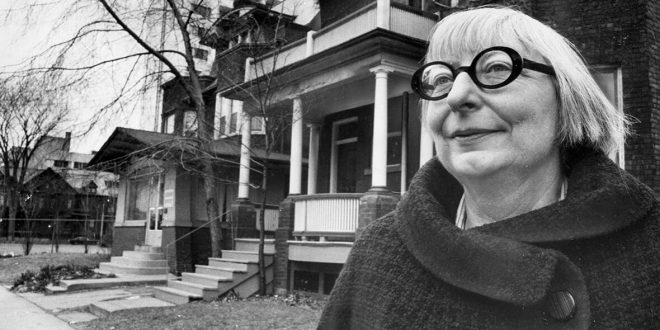
Jane Jacobs is a curious figure – one of the legendary civic activists in the United States, without a college degree, she sees herself as an economist, but with the greatest influence on urban planning. She was born in 1916 and became famous for her book “The Life and Death of Great American Cities”, which was published in 1961. She participated in numerous protests to preserve the historic parts of cities and became a legend in activism against large urban plans – for new neighborhoods, large apartment blocks, city highways, etc.
A common theme in Jacobs's publications is concern for the poor, for equality between men and women, for the harsh living conditions in urban ghettos - topics that are somehow adopted by the political "left" as their own. The irony, however, is that for all these problems, Jacobs finds a solution in the free market and spontaneous order.
Jacobs against central urban planning
"The Life and Death of Great American Cities" criticizes urban planning. Reading it selectively, without insight into the essence and without reading Jacobs' subsequent positions, today's urbanists see in this book a war against the automobile and against the still popular planning of American cities as the so-called urban sprawl - the "American dream" that we have seen in countless movies. Small houses, distant from " downtown" - the economic center of the city, with long highways and streets that make life without a car impossible.
What Jacobs claims and later explicitly reiterates in interviews is that she is against central city planning. The modern idea of city planning today has changed on the surface, but not on the inside – the emphasis on planning for cars is now an emphasis on planning for large city squares and pedestrian areas. Jacobs' thesis, however, is extremely decentralizing– knowledge is dispersed among individuals and they know best what the needs are at the local level. Therefore, any idea of central (city) planning is doomed to failure. "Local knowledge" is a term that she herself tries to impose. This may sound very familiar to economists, because it is, in general, Hayek's economic theory of "spontaneous order" applied to urbanism.
Jacobs' Unconscious Libertarianism
For Jacobs, the city is a living place, constantly changing. There is no way that some top-down knowledge can fit the life of the city – “planners go to great lengths to show how cities should work, and what should be good for people and businesses in cities”. On the contrary, her idea of life is that cities develop from the bottom up, from the inside out, from the family to the communities. In fact, throughout her life she has praised spontaneous order.
Although throughout her life she praised the supremacy of private property (a leading theme in her work is the fight against eminent domain – in Bulgarian “nationalization”) and fought exclusively against governments – local and national, she was not an anarchist in today’s libertarian sense. Jacobs is a rather paradoxical figure, who is difficult to place on the political compass if we use limited philosophical frameworks. A main incentive for her is the preservation of the historic districts of cities– traditionally built structures are much more valuable to her than any ideal central plan, because they have proven themselves over time. The preservation of historic districts is perhaps the most unlibertarian thing that Jacobs advocates.
How her approach transformed entire neighborhoods
A former industrial district in Toronto, which was abandoned and planned for demolition, was saved - Jacobs lobbied for the removal of absolutely all possible regulations related to urban planning. According to her analysis, the area is declining, since according to the regulations, only industrial activity can develop there. After her work with the municipal government, she achieved success - all regulations related to the district were removed (in her words: except for those for fire safety and those for the buildings themselves, which must be preserved in their authentic form, as cultural values). The area is now one of the most expensive and attractive.
A positive development, associated with a complete lack of central planning, also occurs in her favorite neighborhood in "Life and Death...", the North End in Boston. From a run-down neighborhood, a ghetto with Irish immigrants, in just 10 years in the 1950s it became an attractive, lively and peaceful place, with record low crime rates, great trust between neighbors and record health indicators for Boston. Today, the North End is an attractive tourist destination, and the buildings have yet to be included as landmarks - the American version of "cultural value". The curious thing is that to this day they are very well preserved by their original inhabitants.
Jacobs's approach of activism, protest, and struggle against the "powers of the day" is indeed attractive to the political left. In reality, however, she reaches the same conclusions that Ludwig von Mises and Friedrich Hayek reached. It is no coincidence that one of her subsequent books in the 1980s received one of its first positive reviews from Murray Rothbart. It is always difficult, and almost always wrong, to give assessments and classifications of different figures on the political spectrum.
Whether Jane Jacobs was a “libertarian” is debatable. But her approach, with its strong emphasis on defending the supremacy of private property, spontaneous order, bottom-up problem-solving, and the notion that knowledge is always dispersed among individuals rather than concentrated in an all-seeing central planner, can certainly be useful to today’s urban planners around the world.