EKIP– Expert Club for Economics and Politics A Different Opinion

By Steve Hanke, Forbes.com
After Bulgaria escaped communism in 1990, Bulgarians experienced several hardships. The economy collapsed, there were bankruptcies, and this Balkan paradise experienced hyperinflation, reaching an incredible 242% in February 1997. Yes, on a monthly basis.
Anticipating many of the problems that would follow currency devaluation, I co-authored a book by Kurt Schuller called Teeth for the Bulgarian Lev: The Currency Board Solution (1991). This, in short, was a plan to transform the Bulgarian currency – the leva – into a stable clone of another pegged currency, such as the US dollar or the German mark at the time.
Mrs. Hanke and I visited Sofia, the capital of Bulgaria, several times after the book was published. Although our ideas aroused genuine interest in certain circles, the official response was negative. The oft-repeated response of the former governor of the Bulgarian National Bank, Todor Valchev, was typical: Thank you for your interest in Bulgaria and your proposal, but we know the realities of the local situation and everything is under control.
How did the establishment of a currency board come about?
After hyperinflation spiraled out of control in 1996, this refrain began to ring hollow and things began to change dramatically. In December 1996, the Bulgarian ambassador to the United States asked me to present my idea for a currency board in Washington. That same month, a pirated version of Hanke-Schuller's 1991 book, translated into Bulgarian, reached the top of the bestseller lists in Sofia.
In late February, Mrs. Hanke and I traveled to Sofia again, and President Petar Stoyanov invited me to be his advisor. My initial task was to draft an alpha version of a currency board law and to explain to Bulgarian politicians and Bulgarian society how such a system would stop hyperinflation. Events were moving at a very fast pace. Nothing speeds up life as much as an economic crisis .
The currency board came into effect on July 1, 1997. Inflation and interest rates collapsed instantly. I remember the sincere pleasure (and probably relief) that President Stoyanov expressed when he congratulated me on the incredible results that had been achieved in the first few weeks of the board’s introduction. Right then, he admitted that he had hoped the currency board would kill inflation, but he had reservations and was amazed that the board had worked even faster than I had predicted. Much later, President Stoyanov confided in me that without the stability of the currency board, it would have been much more difficult for Bulgaria to be admitted to NATO in 2004 and the EU in 2007.
Today, Bulgarian society strongly supports the currency board and opposes the replacement of the lev with the euro. And why not? After all, the currency board is the most valued post-communist institution in Bulgaria. It has achieved stability. And, although stability is not everything, Bulgarians know from experience that everything else is nothing without stability.
Why shouldn't Bulgaria abandon the currency board?
Now, Prime Minister Borisov has floated the idea that the currency board and the lev should be wrapped in mothballs and put in a museum, as relics of the past. This would be a very bad decision. Here's why:
The currency board in Bulgaria allows the country to issue its own money, which is exchanged at a fixed rate with the euro, fully backed by European reserves, and fully convertible into euros. These specifics mean that the leva is a clone of the euro and that Bulgaria is now de facto part of the eurozone, without formally being part of it. Bulgaria is already informally a member of it. The Bulgarian currency board has been very successful:
- He stopped hyperinflation in 1997, which peaked at 242% in February of that year.
- It allowed Bulgaria to withstand all external currency crises, including the collapse of the Russian ruble in 1998 and the Great Recession in 2009.
- Because of him, Bulgaria managed to contain the collapse of CorpBank, which occurred in 2014 (and which was not caused by or had any connection with the currency board, but was related to the work of the Banking and Supervision Department of the Bulgarian National Bank (BNB), which failed in its task of regulating CorpBank).
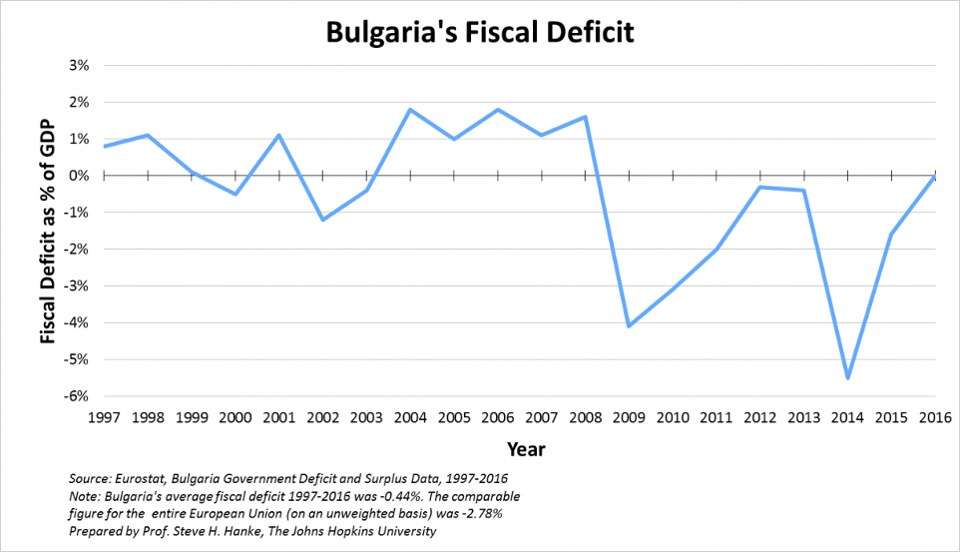
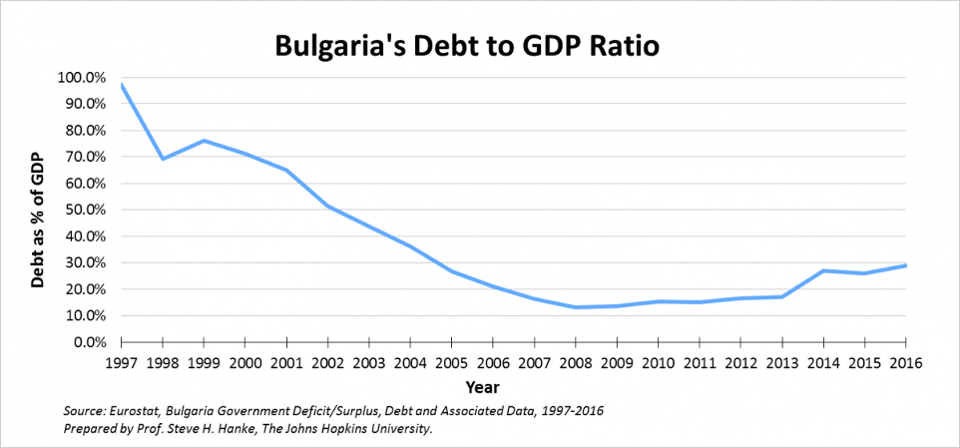
- Най-важното е, че понеже правителството НЕ може да взима заеми от валутният борд (БНБ), фискална дисциплина бива наложена на българските политици. От въвеждането на валутният борд през 1997-ма насам фискалните дефицити са държани под строг контрол и нивото на държавен дълг сериозно е спаднало (вижте графиките отдолу). Всъщност, нивото на фискална дисциплина и съкращаване на държавния дълг са направили България „отличник“ сред 28-те страни на ЕС.
Графика 1: Бюджетен дефицит на България (1997-2016 г.)
- Why would anyone try to change something that works? No intelligent person would do it. Given the overall data that Bulgarians would not support the idea of giving up their beloved lev and replacing it with the euro, it is more than clear that the Bulgarian people are much smarter than their political class.
- The Bulgarian people know that if they formally join the eurozone they would be surrendering sovereignty over their monetary system. This sovereignty is valuable, especially if the euro ever finds itself in trouble (again). If that happens, Bulgaria can instantly switch the board to a better and more stable currency without asking anyone for permission.
- Why would any sane person want to join and be locked into a club whose future is uncertain? Formal entry into the eurozone is like entering the Eagles’ hit “Hotel California.” As the song goes, “you can check out any time, but you can’t leave.” At this point, the only country that can enter and exit the eurozone is Denmark. It has gained a valuable option for entry and exit, something Bulgaria does not have and will never have.
- Защо някой би се отказал от познатите правила, които видимо работят и фискалната дисциплина, в замяна на моралния риск на Еврозоната, който окуражава опасно фискално поведение като това на Гърция? Може би именно за това си мечатят, тези български политици, които адвокатстват за влизане в еврозоната. Може би те са уморени от стриктната усмирителната риза, която валутният борд им налага.
Графика 2: Държавен дълг към БВП в България (1997-2016 г.)
- Bulgaria would make a huge mistake if it surrendered yet another piece of its sovereignty by formally joining the eurozone. If Bulgaria joined the eurozone, it would be removing one of its few institutions that works well, is supported by the public, and is controlled by Bulgarians. This would be exchanged for an unclear and potentially unstable agreement that Bulgaria cannot control and cannot exit.
Mr. Borisov, stop listening to Brussels and start paying attention to the Bulgarians.
Translated from English: Ivan Milanov Petrov