EKIP– Expert Club for Economics and Politics A Different Opinion
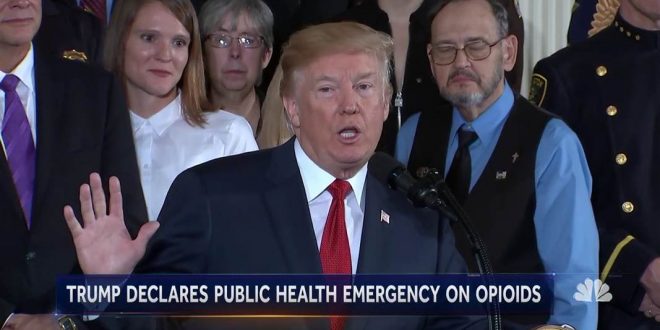
Trump and his administration have been the subject of many and varied articles in our media, mainly because of his economic and foreign policy. This article will examine his administration's actions on a topic that was not expected to become a cornerstone of his term, but here it is. Here we will examine the drug policy of the Republican administration and more specifically - how Trump intends to respond to the growing opioid epidemic in the United States, because the news coming from across the ocean is more than disturbing.
How big is the problem really?
America’s opioid problem is reaching catastrophic proportions. In 2016, 43,000 of the 62,000 overdose deaths in the United States were due to opioids (legally prescribed and illegal). This means that in just one year, more Americans died from overdoses than in their entire military campaign in Vietnam. In comparison, in the same year, gun battles, widely discussed in the media and society, killed four times fewer people, or exactly 11,000 people.
This makes overdose the leading cause of death among Americans under the age of 50. Most experts say it will be at least a few more years before the death rate peaks, which means the frightening numbers are only going to increase. The forecast is for at least 650,000 deaths in the next ten years. That would mean an entire city the size of Baltimore would disappear in just a decade.
The opioid problem is present among all age, ethnic, and social groups in the country. It is interesting to note that unlike previous social problems caused by drugs, this one affects white Americans more than minorities. In 2016, 8,000 people from minority ethnic groups died from opioids, while among the white majority, this number exceeded 33,000.
The crisis also has economic dimensions. It is hard to imagine an economy that functions sustainably with over 1% of the working population abusing opiates every day. It is hard to imagine a normal labor market in which a worker dies of an overdose every 20 minutes.
Causes and working solutions
The opiate epidemics that swept through the West in the 1970s-1990s taught us that heroin was the drug of the poor, the marginalized, the minorities, the ghetto. Back then, the cause was social stratification combined with a large dose of ignorance.
Today's crisis in the world's richest economy has a completely different genesis.
Back in the early 1990s, after several major scientific discoveries about the causes of pain and ways to treat them, the United States began, led by the pharmaceutical industry, to prescribe opium-based painkillers such as Hydrocodone, Oxycodone, Peditine, etc. for all kinds of everyday pain, such as sports injuries and minor trauma. Before that, the practice was to prescribe such substances only to people in the terminal phase or those with very severe chronic pain, but intensified marketing even led to phenomena such as the distribution of free 30-day samples of opium derivatives. Naturally, this launched the United States to the top of the world in the use of pharmaceutical opiates.
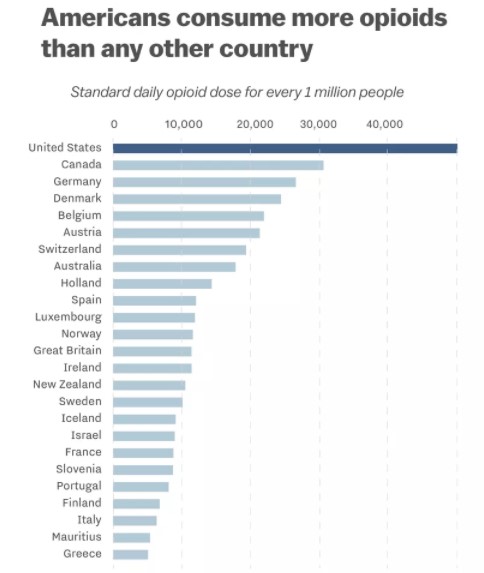
Source: Vox.com
It stands to reason that if 1/3 of your population has a prescription for opiates and 15 million doses are consumed every day in the United States, this will lead to problems in at least 10% of users. Usually, when your doctor notices that you come to him every month asking for an increase in your painkiller dose, he realizes that you are developing an addiction and stops your prescription. Faced with the risk of your pain returning, combined with the terrible symptoms of stopping opiates, you start getting your fix on the street. At some point, you do the math and realize that instead of spending $200 a week on street OxyContin, you can get the same amount of Heroin for $50, and so you make the market decision to start injecting street-produced opiate intravenously instead of pharmaceutical-grade. From there, the risk of overdose increases tenfold, due to the difference in purity of each street dose. Even 10 years ago, it became clear that 4 out of every 5 Americans addicted to opioids started with pharmaceutical products, but the response of the authorities at that time was extremely inadequate.
Of course, it is also appropriate to consider what can be done to improve the situation and what successfully implemented models can be borrowed from other countries.
- Injection rooms– Opiate addicts in Switzerland have been receiving free medically pure heroin since the 1980s, which they can only consume in special injection rooms under mandatory medical supervision, which practically reduces overdose cases to zero. There are also such rooms, but without legally prescribed heroin in them, in Frankfurt, Vancouver and other places around the world. We have examined in detail good examples such as these in this article.
- Decriminalization of drugs– examples such as Portugal, where 2% of the population was addicted to heroin the year before decriminalization, and 10 years later topped the charts in Europe for reduced health risks from use, have been discussed several times in our media, such as here, here and here
- Legalization of weed - providing patients with an alternative, non-toxic painkiller that poses ten times less health risk than the opiate family and leads to a significantly milder degree of addiction - has proven to be a working model. Good examples come from the USA. States with legal access to medical and recreational weed have significantly lower numbers of addicts and overdose deaths. Another study shows that medical weed reduces opioid use by 64%.
What will Trump do about it?
Having described the frightening scale of the problem and the solutions that work, you would surely expect that Trump and his administration would have looked into these very issues and that we would start to see them implemented as federal policy to address the crisis? Yes…but no.
Any glimmer of hope for bold and workable solutions during his tenure evaporated after people like Jeff Sessions took over the administration’s federal drug policy. From a man who, contrary to the facts, declares marijuana to be the cause of the opioid crisis (instead of, um… pharmaceutical companies, in partnership with the medical profession and the state), bold and workable solutions cannot be expected. Just two months ago, Mr. Sessions announced that he would even tighten controls in states with legal weed, reversing a policy from the Obama administration.
And if you think that this is just smoke and mirrors and that when things get tough, adequacy will prevail, you are deeply mistaken. Traditionally, Republicans are famous for their overdose of incompetence in this very social sphere. Just a few days ago it became clear that the Donald Trump administration, instead of taking a walk to neighboring Canada, where they have been successfully fighting opiate addiction for over 20 years, or flying across the ocean and seeing how Western Europe practically does not have such a problem, is actually drawing experience from... Singapore and the Philippines.
Yes, the US government is considering introducing a federal death penalty for dealers who sell fentanyl, an extremely potent synthetic opiate. As the article quoted shows, President Trump was impressed by the effects of this measure, implemented by Philippine dictator Rodrigo Duterte and resulting in the arbitrary deaths of over 20,000 people in less than 2 years in power. This shows a startling lack of understanding of the problem and its solutions. Fentanyl is not the cause of the opioid epidemic, it is a direct consequence of the War on Drugs that has been waged for the past 100 years.
The prohibition of opium poppy in 1912 deprived people of the opportunity to treat their minor aches and pains with poppy tea – dozens of times weaker than a dose of OxyContin, for example. From then on, in the next 100 years, we observe a constant increase in the potency of a unit gram of the street substance and an almost constant trend of decreasing its price – a phenomenon described excellently in the book “ The Economics of Prohibition” by Mark Thornton. The demand has always been there and will always be there, but what the supply will be depends on the laws and their enforcement.
So, instead of opium tea, people start using heroin and eventually fentanyl. If the US steps up the pressure on fentanyl traffickers, street opiates will not disappear, but will simply be replaced by even more dangerous ones. Instead of fentanyl, which is 100 times stronger than heroin, dealers will switch to carfentanil, which is 100 times stronger than fentanyl. If they catch up with it, the Chinese will invent an even more potent and easier-to-traffick synthetic opiate. The game of cat and mouse may be endless, but human lives are not. It already happens in the States that dealers are caught with quantities of fentanyl sufficient to wipe out the population of several large states at once.
Trump probably never imagined that this would be his biggest problem to solve in his first term. But it looks like it will be. Before creating new jobs, building anti-immigrant walls, imposing tariffs, disarming North Korea, and so on, his administration must think about how to keep 2 to 4 percent of American citizens alive for the next 10 years.
At least that is what is expected from the people who believed Trump when he promised “ America first”. If ignoring was an option in Obama’s last term, it is no longer. Every second American has a relative or close friend with opiate problems and these people expect the Republican administration, for the first time in its history, to offer them an adequate drug policy. If it does not happen, it will simply cost both Trump and the Republicans all the winning they have been boasting about in recent years.