EKIP– Expert Club for Economics and Politics A Different Opinion

What are the critical points that the healthcare system will face by the end of 2018?
Over the past few months, we have witnessed a number of scandals in the healthcare sector and an unceasing whirlpool of ideas, proposals and policies that, after an attempt to be put into practice, are rejected in every way by the system and its users. It is no coincidence that healthcare is the sector burdened with the most stakeholders, which is why it is so difficult to implement a consistent and coherent policy there. Another issue is the lack of continuity in the institutions, as well as the fear of the rulers to impose unpopular measures in order to carry out the promised reform in this area. Below are three problems facing the domestic healthcare system, which are expected to deepen in the coming months.
1. Hospital care
The introduction of a Unified Financial Standard (UFS) for state and municipal hospitals is one of the possible stumbling blocks for implementing a policy of reforms in the field. On the one hand, such a standard is necessary, although every self-respecting manager or hospital administrator should know the conditions set out in the standard. The reason is as follows - the EFS summarizes in itself conditions from a number of other normative and sub-normative acts that concern the management of a company. If such conditions have not been observed so far, then what kind of financial management of an organization can we talk about?
On the other hand, the EFS introduces restrictive measures against hospital overspending, by not allowing, in the presence of such, additional material incentives (DMI) to be paid to employees. This would stimulate the hospital director to monitor resource spending carefully, and would also create the possibility of internal organizational reprimand by employees.
It should not be overlooked what such a negative incentive for fiscal discipline can lead to in terms of human resources in the system. Many staff may decide to "vote with their feet" and change employers if they have not received their VHI for several months. This may lead to a shortage of staff in key hospitals in the regions. But like any reform, this one should "mature" for several years so that the effects of its imposition can be monitored.
2. Medications
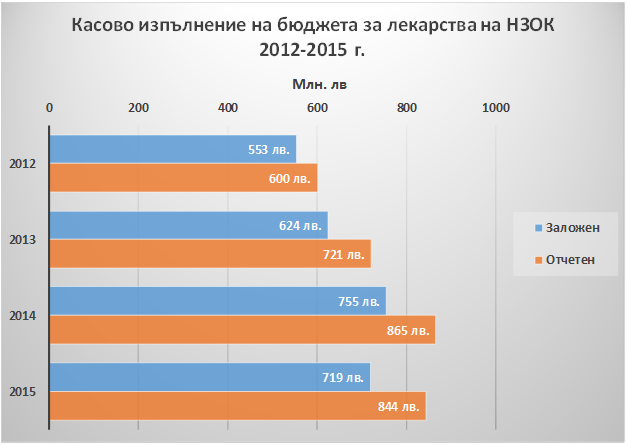
The annual increase in the budget for medicines became sharply visible last year (2017), accompanied by many political scandals for the inclusion of innovative medicines in the Positive Medicines List in order to be partially or fully reimbursed by the NHIF. Looking at the costs of medicines for the period 2012-2015, we see that they increased annually by an average of 14%, and in total, the costs of medicines between 2012 and 2015 increased by 53%. In 2018, the costs of medicines accounted for about 29% of the annual budget of the NHIF, which puts us in first place in the EU in terms of expenditure on medicines relative to the healthcare budget. Another thing that is noticeable is the difference between the budgeted and reported funds. Cumulatively, in the period 2012-2015, the planned costs for medicines were worth 2.65 billion leva, while the reported costs reached 3 billion. BGN – 350 million more.
The promised policy for optimizing funds in the sector is missing so far. This policy is well known to domestic politicians and representatives of the Health Committee in the National Assembly. It is called pro-generic and has been a tool in the hands of European institutions for years to deal with the sharp growth in the cost of medicines in Europe. One of the first steps that the government can take is to divide the budget into generic and non-generic medicines, so that the costs of the two groups can be more easily tracked. This will allow a real comparison to be made of the extent to which the policy of the Ministry of Health helps to increase access to medicines for socially significant diseases, and also whether the funds from health contributions are spent rationally.
This would also increase intra-group competition in the relevant budget items, reducing the price as an economic effect. A similar step was taken when the costs of oncology drugs were allocated to a separate budget item and there is already partial traceability there. The second important step is the introduction of electronic prescription, which allows control authorities to monitor what is being prescribed, since by law your doctor is required to warn you about the alternatives to your treatment.
3. E-health
E-health, as part of E-government, is practically non-existent. In 2013, the so-called electronic patient record was introduced. The statistics on its use are not clear to this day, due to the lack of impact analysis, as well as the lack of integration with other systems.
A project is currently underway to build a National Health Information System (NHIS), which will last 22 months and should be completed by the end of 2018. After a parliamentary inquiry to the Minister of Health a month ago, it became clear that we will not have e-health until the end of 2019. The question is - how will such a project be completed if the set performance indicators are not met?
E-health in the country has collapsed several times in recent years, after an otherwise solid start. A year ago, the National Audit Office published an audit indicating that in the period 2010-2016, several unsuccessful attempts were made to implement projects to create a National Health Information System (NHIS), with public procurements being terminated for various reasons, and in the current project, their start has not even been given. Over the years, due to the termination of public procurements, 9.7 million leva of financial assistance were not utilized once in 2012 and a second time 12 million leva from a European program in 2014. These unsuccessful attempts show, according to the auditors, that "the overall organization of the process of planning and implementing e-health projects and public procurements is ineffective and needs significant improvement."