EKIP– Expert Club for Economics and Politics A Different Opinion
(EXAMPLE FROM THE EIGHTEENTH CENTURY BULGARIAN)
Author: Assoc. Prof. Dr. Hristian Atanasov
A few words in advance
Bulgarian historical science has long proven that the beginning of the Bulgarian Renaissance should be dated to the period between the end of the 17th and the first decade of the 18th century. This is the moment of the initial awakening of already new processes, which could, over the course of more than a century, become a powerful engine for the new beginning of the Bulgarians and other Balkan peoples. Usually, historiography emphasizes that after 1683 and the unsuccessful siege of Vienna for the Ottomans, the end of Ottoman military superiority on land came and the contraction of the borders of the Padishah's state began. This means in the long term a weaker Ottoman state in internal political terms. What do I mean? First of all, I will clarify that in order for the Bulgarians to achieve positive results in obtaining an independent church, which would become official only in the early 1870s, to build a system of modern schools (more widely after the mid-19th century), to start publishing their own newspapers and magazines, and to lead an active political life, there was a long process of economic prosperity, which probably began in the early 18th century. In my opinion, this process of material prosperity is directly related to the weakness of the state, especially in the economic sphere.
Eighteenth century, regulations and lack of regulations
I will specify that during the “classical” Ottoman years (15th-16th centuries), when the state was strong and there was no one to oppose it, the Ottomans managed to impose some fairly strict economic frameworks on their subjects. In practice, at that time, if we trust the laws issued, everything was standardized. Starting from market prices, plus the fact that the state had a monopoly and the right to purchase a large number of essential goods at state prices, we move on to norms in the production of craftsmen, determining the quantity to be sold and even regulating profits. In addition, all craftsmen were members of guilds and thus no external competition was allowed, no intensification, no possibility of some more qualified master producing more and offering it on the market cheaper. The guild itself would not allow such a thing – all its activities were carried out within the previously set norms.
This model works well for the state, at least as long as there is a way to replenish the state treasury – i.e. military campaigns are positive, the loot is large and in practice this static nature in the economy does not have such a negative impact on the budget. However, these frameworks turn out to be extremely negative in terms of initiative. Production is regulated and the subjects do not have that much interest in producing more. They cannot, since, at least from the point of view of the urban economy, this would be contrary to the idea of the “common good” and “justice”.
At the beginning of the eighteenth century, however, the system began to crack. The state was already losing wars, and large parts of it began to practically separate from the center. This became especially evident during the so-called Kardzhali unrest, when entire regions were no longer under the sultan's rule. For example, in Vidin, Osman Pazvantoglu seceded, in Ruse, Ismail Trusteniklioglu and Mustafa Alemdar Pasha, etc. In vast regions of the empire, there was already a different economic order, which, in my opinion, would prove positive for economic initiative. The state could not collect taxes there, instead, persons engaged in production paid smaller amounts to the local Ottoman princes in order to receive their protection.
Osman Pazvantoglu from Vidin (1758 – 1807).
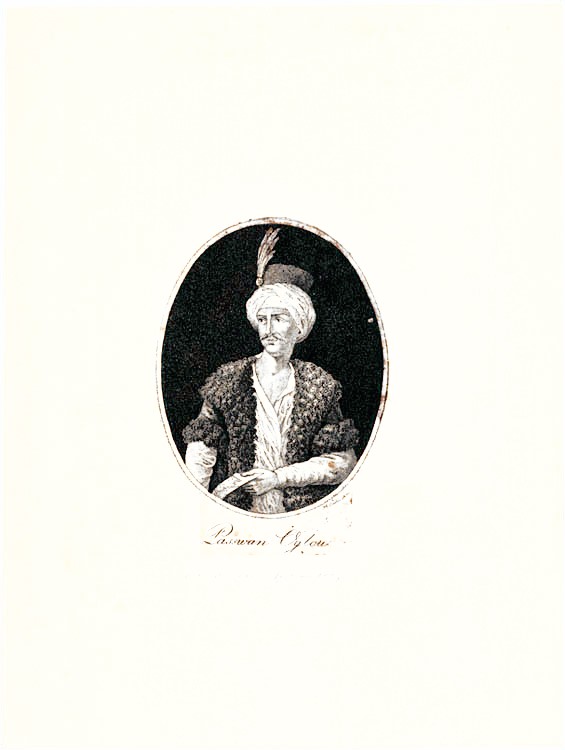
Source: Croatian State Archives.
http://arhinet.arhiv.hr/_DigitalniArhiv/Portreti/Portreti-P-0641.htm
The regulations imposed by the center are gradually starting to fail and accordingly, proactive people are appearing who will try to produce more, with a market orientation, and accordingly improve their material situation. A few years ago, we had similar conversations with fellow historians and we all wondered why it was precisely with the collapse of the Ottoman economic model and the emergence of the Kardzhali, that the more tangible economic prosperity of the Bulgarian lands under Ottoman rule began. I think the answer lies in the weakness of the state to interfere in any economic activity, something that was characteristic of the previous centuries, when, in the opinion of some Turkish historians, the Ottoman state was “a well-ordered farmstead, led by the center – i.e. from Constantinople”.
Information about the property status of the urban population in the 18th century
We have data on how in the 18th century the urban population of the Bulgarian lands became richer, while the state weakened. The graph is made based on the hereditary inventories of residents of Ruse, Vidin and Sofia, with their property assessed at a certain amount, which was converted into silver (there was a silver standard at that time) in order to avoid the devaluation of the Ottoman coins for the period. The data are distributed into six periods: until 1720, until 1740, until 1760, until 1780, until 1800, and until 1820 (in the graph the periods are given according to the Ottoman calendar, as they are in the archival sources used).
Chart 1. Property status of the urban population in Vidin, Sofia and Ruse for the period from the beginning of the 18th to the beginning of the 19th century, in grams of coined silver.
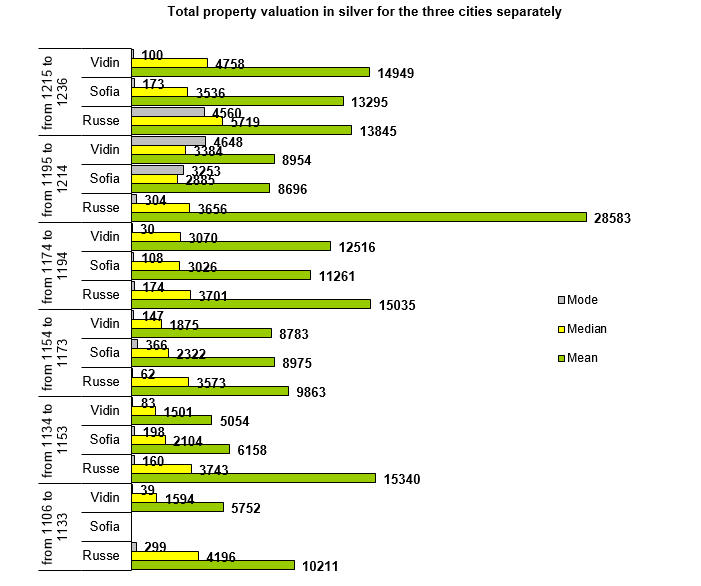
Източник: Atanasov, Hr. Property trends among the urban population of Rumelia in the 18th century as indicated by inheritance inventories from Russe, Sofia and Vidin – a first glance. Bulgarian Historical Review, Vol. 41, Issue 3/4, 201 3, 33-59, 27 p.
Obviously, the population gradually became richer, and this was especially evident at the end of the 18th and beginning of the 19th centuries. This completely coincided with the time when Ruse and Vidin were outside the power of the Ottoman Sultan, and in Sofia his positions were somewhat shaken. So, around the stronger Ottoman princes, groups of rich people were formed, including Bulgarians, who no longer paid taxes to the central government and, accordingly, managed to gradually accumulate more significant capital. Later, probably among the heirs of these people, we will be able to look for donors for the construction of modern Bulgarian schools, community centers, churches, and so on.
The weak effect of regulations on craftsmen can also be judged from a table of the property status of citizens from Vidin engaged in some craft. Their property is again assessed in coined silver, it can also be seen in nominal value, and their inheritances are distributed in 5 periods (until 1720, until 1740, 1760, 1780, until 1800).
Table 1. The hereditary inventories of the craftsmen from Vidin in the 18th century, grouped according to their estimates, in grams of coined silver.
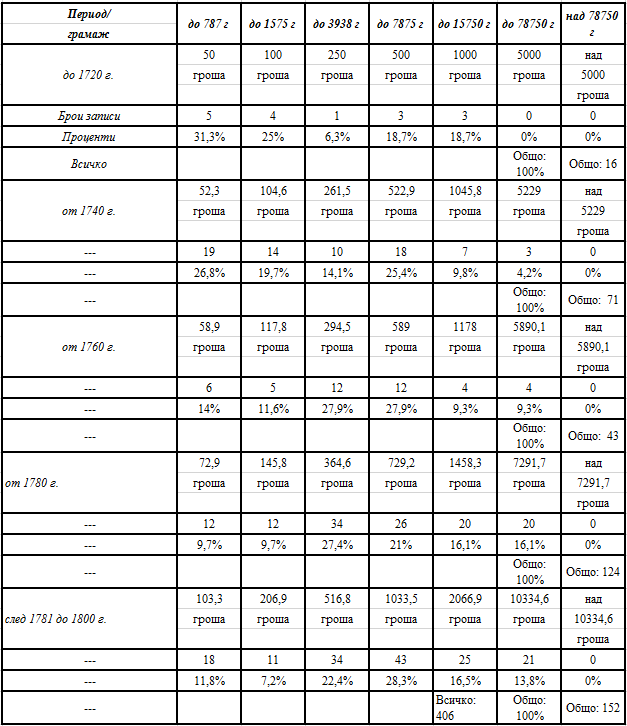
Source: Atanasov, Hr. In the Ottoman Periphery: Society and Economy in Vidin and the Surroundings in the 18th Century. Sofia , 2008, 360 pp.
If we assume that at the beginning of the presented period there were stronger regulations of the state power and, accordingly, the craftsmen received equal raw materials, produced equal goods, sold equal quantities, at equal prices, then obviously they remained almost equally “poor”. Already in the following periods and especially towards the end of the century, richer craftsmen began to appear, and the poor became a minority. This was a consequence of the drive towards intensification in the urban economy, which led some more resourceful producers to work contrary to the norms of state regulations. I will remind you that at the end of the century the Sultan’s power over Vidin practically did not exist and this accordingly allowed for the accumulation of larger assets. Interestingly, in 1773 Sultan Mustafa II promulgated an order (ferman) with which he tried to strengthen the regulatory mechanisms of the guild organizations, and thus reaffirm the “customs” left over “from old times”, but in practice he did not succeed. I will add that similar disproportions regarding the craftsmen in Vidin (I do not have data from other Bulgarian cities yet) are also observed regarding their houses and shops, which means that those who are more alert and proactive manage to benefit from the created environment of weak state intervention on a market basis.
Conclusion
History gives us examples when the time of a weak state turned out to be more than useful, especially in the economy. Obviously, the 18th century was exactly such a period. In practice, the role of the state was taken over by stronger local Ottoman princes and they reduced it to its minimum functions – to ensure order, guarantee the peace of the population and resolve disputes that arose (i.e. to have judicial prerogatives). This, combined with low taxes (probably a kind of one-time fee that the population paid to guarantee its safety) and the release of economic initiative led to positive results and the urban population in the Bulgarian lands gradually became visibly richer.