EKIP– Expert Club for Economics and Politics A Different Opinion
"We occupied you Czechs because we love you."
Explanation of what happened by a Russian officer,
given on August 24, 1968 to Milan Kundera
During this week in 1968, another desire for freedom and humanity in the socialist camp was trampled. It did not begin with the economy, but with culture, music, everyday life, religiosity and the desire for elementary decency in public relations and state governance. This desire, in fact an unwillingness, as Georgi Markov (in the 1960s) and Alexander Solzhenitsyn, Vaclav Havel (in the 1970s) defined it, to live a lie, encompassed individuals from all social strata – from the greengrocer to some functionaries of the Communist Party.
On August 20, 1968, about 250,000 soldiers from the Warsaw Pact (WP) armies—those of Bulgaria, East Germany (providing only logistical support, due to the fresh memories of Hitler’s 1938 invasion), Hungary, Poland, and the Soviet Union—were massed in full readiness around the Czech and Slovak borders, ready to invade the country. The troops were organized into 27 divisions, and had 6,300 tanks, 2,000 guns, and 800 aircraft at their disposal. By the end of the occupation, a total of 500,000 troops would be stationed there.
Their task was to “take over all important state institutions” in order to support “the organs of people’s power fighting counter-revolutionary forces”. This was the largest military operation since World War II (WWII). An important detail is that in the mid-1960s, the Czechoslovak army had (approximately) 130,000 men in uniform (including reservists) who were under the command of the VD and who were ordered not to defend the country. In fact, as even the soldiers understood the strategy of the Treaty, the task was “we die and the Russians fight on our territory”. Even the deployment of nuclear warheads in Central Eastern Europe took place without the knowledge of their military commanders, let alone the official authorities.
On top of that, in reality, the individual armies were not at all a significant player in the aggressive enterprise, the military power was overwhelmingly Soviet (85-90% of the deployed forces, 100% of the planning, logistics, communication and, of course, command were also Soviet). The fraternal armies were there to legitimize the military intervention and to reinforce the propaganda effect of the aggression, performing minor logistical and security tasks. In fact, it was not even the Soviet army generals, but the top leadership of the KGB and the leaders of the CPSU (Communist Party of the Soviet Union) who had the final say on decisions affecting Czechoslovakia before, during, and after the invasion.
Today, even the reading public around the world, including especially those in the former member states of the VC ( young Czechs and Slovaks are no different from the rest), has lost the memory of this scandalous aggression, as if it did not exist outside the memories of contemporaries and the narrow circle of studies of a handful of historians. Not so long ago, in 2015, the Prosecutor General of Bulgaria initiated a constitutional case, according to the decision of which it turns out that the invasion of Czechoslovakia was not a “crime against peace” within the meaning of Art. 31, para. 7 of the Constitution. Only one judge disagreed – Filip Dimitrov.
Before the Prague Spring, there was an autumn
On the surface, the formal reason for the invasion was the “Prague Spring,” the familiar allegorical name for a “new beginning” in the governance of Czechoslovakia. It was invented by a few good-natured naives in the leadership of the Czechoslovak Communist Party around December-January 1967-1968. They were forced by events to seek something that the poet-journalist turned party boss, Alexander Dubček, called “Socialism with a human face.” Today, no one knows that the program so titled was not supposed to be adopted at a congress until September 1968, after public discussion, as planned.
The metaphor of the “human face” is a sincere reaction to the events of October 11, 1967. Then, students, irritated by power outages during the preparation of term papers in one of the districts of Prague, went out to express their dissatisfaction in front of the presidential palace in Hradcany. Their rally was crushed with violence and water cannons, but the students’ reaction was to continue protesting (in general, student and youth protests everywhere in Eastern Europe, from 1945 to 1989, were always to defend individual freedom and human dignity, and not to spread communist and Maoist ideas, as in 1967-1968 in France).
In an attempt to calm the situation, the leaders of the Soviet Union and its party looked for someone to replace the Communist Party Secretary (in fact, the real ruler), Antonin Novotny, with someone loyal and unknown. And they found Alexander Dubcek, who had lived and been educated in the USSR. Honest, well-intentioned and naively believing in the philanthropic intentions of others, in January 1968 it was Dubcek who proposed the plan with a “human face” as a counterpoint to the way of governance demonstrated by Novotny. This plan was never implemented, but even the promise of such socialism created a strong, self-organized movement in support of freedom, resembling both previous similar public actions and the discontent that toppled the regime in 1989.
Then, in January 1968, even the very name of the program shocked communist leaders. According to some recollections, Leonid Brezhnev's comment to Dubcek was: "If your socialism has a human face, what does ours have?"
Dubcek's program, by today's standards, is between modest and cosmetic. It promises: separation of the Communist Party and the executive branch of government, political equality of all parties in the Fatherland Front, which has been in power since 1948, but under the leadership of the Communists; equality between Czechs and Slovaks, federation; decriminalization of small private business and meritocracy in the gigantic state sector; abolition of censorship and easing of freedom of association. The latter two were already a fact in January 1968. This is already a crime in communist countries, and especially in the eyes of sociopath leaders, who unmistakably see a threat to the regime.
The occupation
The criminal, according to international law, planning for the aggression against Czechoslovakia began on April 8, 1968. The above-mentioned goal "to seize all important state institutions" came from an order of the Minister of Defense and Chief of the General Staff of the Soviet Army. The plan was ready by mid-April. Just when nothing more was happening in Prague and Bratislava than breathing somewhat more freely. I remember this breath was still there from a student (pioneer) visit to Liberec, Decin and Prague.
The attack plan was based on "accurate information" (provided by the KGB) that "Zionist, revisionist and counter-revolutionary elements" had undertaken "attacks against socialism on a significant scale"; the task was to "liquidate Zionist and enemy forces" and it was recommended, as a parallel course of action, to purge Zionist elements in the Czechoslovak Communist Party. The most frequently cited "Zionist" organization was Simon Wiesenthal's Jewish Documentation Center in Vienna; some of the targeted Czech and Slovak communists were not even of Jewish origin... [2] Between April and 20 August 1968, the Warsaw Pact armies conducted five military exercises on the border and the last one inside Czechoslovakia. In July 1968, the largest division of the Red Army simply forgot to return to the USSR.
Between January and the end of July, the communist leaders met eight times to discuss their pressure on Dubček and his associates. At the same time, the KGB organized (through bribes and threats) opposition against them and drafted a letter on their behalf calling on the USSR and the VD to "take measures to combat counter-revolution and imperialism."
In parallel with these significant measures, the necessary actions are being taken to brainwash the army soldiers and officers. The key role in providing false information and manipulating decision-makers belongs to the head of the KGB, Yuri Andropov, who, among his other merits, is recognized as the main organizer of the Red Army's invasion of Hungary in October 1956.
From a military perspective, the aggression is a failure of strategy, tactics, and execution. Even the time of the invasion seems to be wrong, due to a lack of clarity as to whether it should begin in Moscow or Central European time.
The operation was an undisputed success because it met no military resistance. And because, as the Czechoslovak Chief of the Army General Staff explained, it was "an operation to kill a fly with a steam hammer."
„Masters of Invasions“
The capture of the airports (the most important task of the BNA - the Bulgarian People's Army - is the security of the Prague Ružine Airport) proceeds smoothly, in the absence of resistance and the presence of an experienced commander, General Markelov.
He led the operation with skill in interacting with the KGB, accumulated over the years and experience during the Second World War, participation in the aggression against Poland together with Germany (1939), Finland and the Baltic countries (1939-1940, where he defeated unarmed women's and volunteer battalions) and Hungary in 1956. His biography is one of the modern army myths in Russia, monuments to him are being built all over Russia (the last one in April 2018), but by all objective assessments this man is simply a rapist and war criminal. For his merits in the "victory" in 1968, he became a "Hero of the Soviet Union", and between 1969 and 1985 he was awarded about 20 highest awards from the Warsaw Pact countries (four of them from Czechoslovakia, five from Bulgaria). In 1979 Markelov was the chief inspector of the Soviet airborne troops that invaded Afghanistan.
In addition to being tasked with the most important task in the offensive, Markelov appears to have been, according to the memoirs of his fellow general, the main advisor to the aggression: "Fuck the Czechs, don't ask their names!"
Logistics and casualties
The indoctrinated soldiers do not encounter armed imperialists, in fact not a single shot is fired against the VD troops, neither by the army nor by the police. In some large cities, locals use a homemade amalgam of incendiary materials to light fires or block trams and buses in the streets – simply because they disagree with what is happening. Some soldiers are surprised that Czech and Slovak ladies are not prostitutes (as they have been “informed”), that the Czech and Slovak way of life is significantly richer, and above all cleaner, than what they know as the “superior Soviet way of life”.
Logistically, the invasion was almost a nightmare. KGB units and an airborne infantry division took over the airfields and post offices because no one was guarding them. But the remaining troops on the ground were confused: they had old maps, towns and villages often had new names, and locals were changing or painting street and train station signs white. Poor logistics, initial misinformation, and culture shock seriously contributed to the decline in the already low morale of the soldiers and officers. Often, the occupiers were embarrassed to appear before the locals in dirty clothes, and they didn’t even think of talking to them – simply because of an inferiority complex.
This situation led to numerous irrational shootings, suspicions, and paranoia among the occupiers: there were many cases of tanks smashing up shops, attacks on barefoot protesters or trams, or simply shooting at walls and militarily unimportant buildings such as museums, schools, etc.
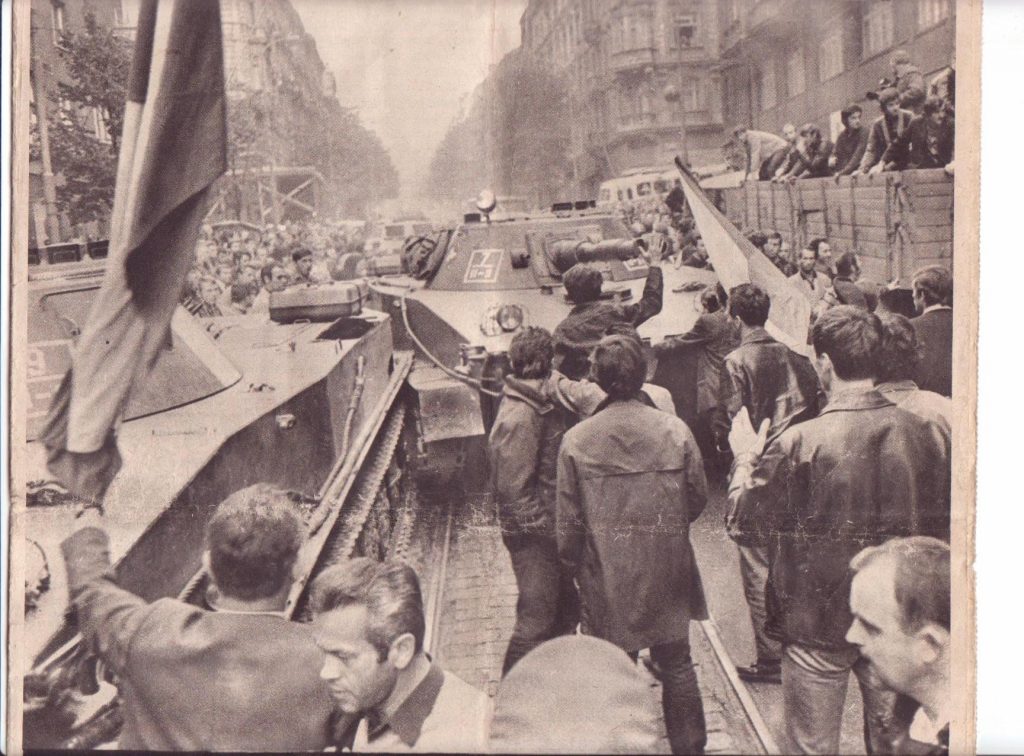
Source: unknown, allegedly from an illegal newspaper
It is impossible to count the casualties, especially on the part of the occupiers – it is assumed that they were significantly fewer than among the Czechs and Slovaks, but this is still a top state and military secret in the Russian Federation.
Czech sources speak of 137 Czechs and Slovaks who died as a result of the Soviet-led invasion of Czechoslovakia in 1968 and early 1969. In the years leading up to 1989, the number grew to 400.
People took to the streets on August 21, building makeshift barricades, stopping tanks with human chains, and refusing to cooperate with the occupiers. The latter, apart from random shots in the air, is most often the reason for the incomprehensible and completely senseless killing of innocent, unarmed, teenagers and young women.
The most organized resistance was around the National Radio building in Prague, which continued to broadcast news in real time for about a week (the occupiers did not have the technical knowledge to stop the broadcast). After that, the radio went underground and unsanctioned newspapers took over the media niche.
On the side of the occupiers there were 98 casualties, mostly from accidents and incidents with equipment, inept use of weapons, five suicides in the first month of the offensive, etc. It is assumed that 11 Soviet soldiers were killed by the locals. There was also one Bulgarian victim: after deserting, the soldier got drunk and after a quarrel or (according to another version of what happened) while trying to escape to West Germany, he was shot by border guards or helpers. (The soldier's family recently erected a monument in his honor, assuming that he was a hero.)
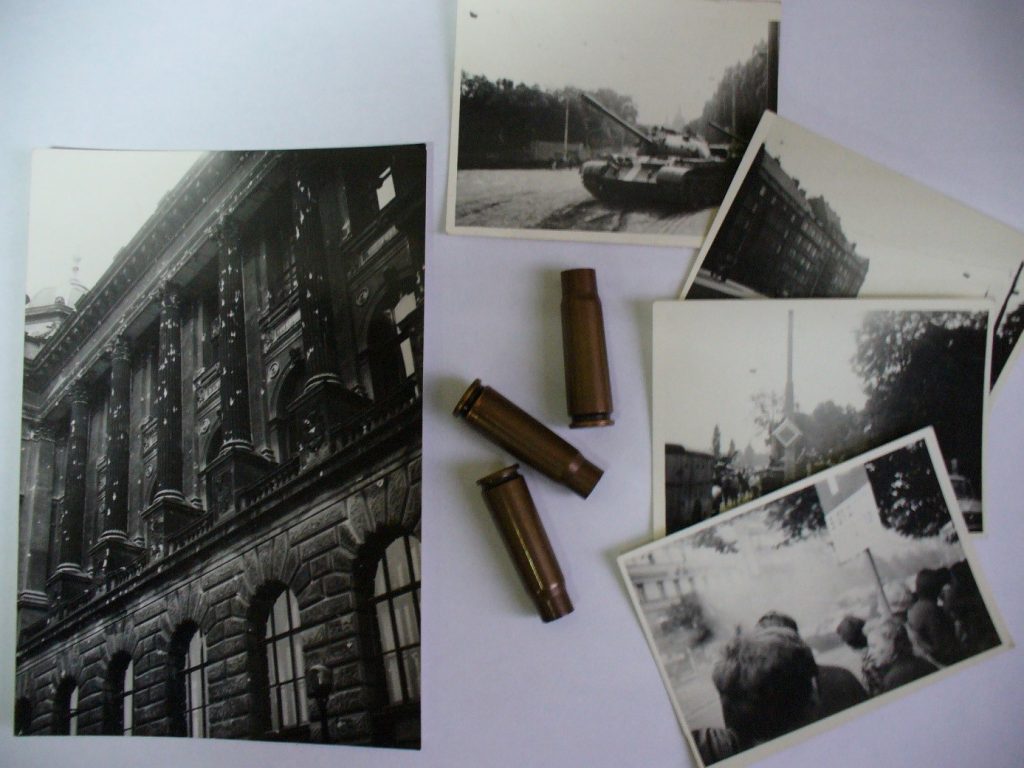
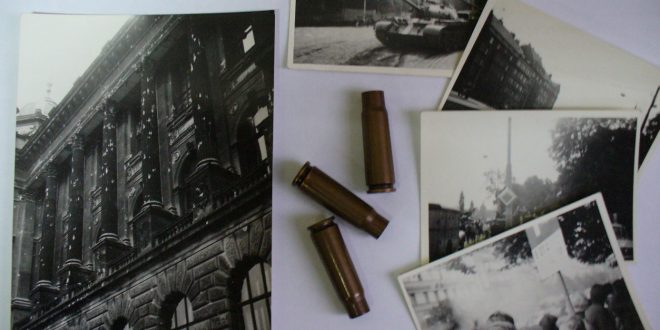
Photos courtesy of Angel Nikolov from his personal archive: the bullet-riddled walls of the National Gallery in Prague, shell casings collected around the building in August 1968. Students call the walls “El Grechko Frescoes” (named after the de facto commander of the occupation, Marshal Andrei Grechko, Minister of Defense of the USSR, former commander-in-chief of the Soviet ground forces in East Germany and until 1967 commander-in-chief of the Warsaw Pact armies).
The role of the Church and pop music
These things are rarely talked about.
76% of Czechs and Slovaks still identify themselves as Catholics, 10-11% are Hussites (Czech Protestants). After 1948, the authorities, as everywhere else, tried to impose atheism, accusing the church of clerico-fascism during WWII, persecuting and trying to corrupt the clergy, dividing the church between the two peoples and between those who were "new Catholics" (young priests who pretended to support communism) and bishops who opposed it and became guardians of religious freedoms and human rights.
From the early 1960s, the New Catholics were losing public authority even among the Communists. Dubček had no choice but to liberalize religious life, ending the persecution of Catholics and lifting the tacit ban on other Christian faiths. (Until 1968, Orthodoxy was de facto banned in Czechoslovakia.) Cardinal František Tomašek was one of the main defenders of freedom and human rights both before and after 1968. He remained a major inspirer of freedom, along with Václav Havel and other intellectuals, until 1989.
My favorite Czech band of the late 1960s and early 1970s was Plastic People of the Universe (PPU), who were initially heavily influenced by Frank Zappa – another favorite musician of mine.
After the invasion of the VD, they went underground. Their music outraged the authorities because it was above all free, a little surreal and somewhat psychedelic, very figurative, for people who understood Czech, but they soon began to write and sing in English. The group was arrested and an attempt was made to hold a show trial in 1976. Without result: they continued to record and perform music illegally, sometimes abroad, until the final collapse of the regime.
"The Oak is Out, the KGB Remains", hockey and live torches
On August 21, 1969, the anniversary of the invasion was planned to be "celebrated" with street demonstrations in Prague, Bratislava and other cities. The police deployed an unusual number of uniformed personnel, used tanks to patrol the cities, and 130,000 Soviet soldiers were put on standby for intervention. Czechs and Slovaks called this day the "Day of Shame." Despite threats of violence from the authorities, over 100,000 protested in Prague's main square that day.
By this date, the Prague Spring had been suppressed with tanks, shooting, and persecution of its initiators and participants.
By the fall of 1968, the unarmed resistance had already died down. To provoke the conscience of the people, on January 16, 1969, Jan Palach set himself on fire, leaving the following message: "I am burning myself to awaken the people of this land." This caused anger in Moscow. The Kremlin telegraphed Dubček to "stop politicization," but he was unable to "calm down" the situation. Self-immolations began to occur one after another - six young men and one young woman, in the period up to March 1969 alone, died in this way. 26 other human torches were saved after medical intervention. Three young people demonstratively set themselves on fire abroad, one each in Poland, Hungary, and Latvia. The messages they left were essentially identical: I am burning myself not for glory, but in protest against the invasion.
What really offended the leaders of the CPSU, however, was that the Czechoslovak ice hockey team defeated the USSR team at the World Championship in Sweden in March 1969 (twice - in the team elimination and in the final). At the same time, the Czechoslovaks behaved "indecently" - they did not shake hands with their opponents, the national flag of their teams was a mourning ribbon, etc.)
Soviet hostility to the Czechoslovakian hockey team has a long history. After World War II, the team was the best in the world—outrageous behavior for a team from a vassal country. In 1950, the KGB and its Czech collaborators orchestrated a brawl between some of the champions and unidentified hooligans in a pub in central Prague. As a result, the entire team was arrested and charged with disloyalty, treason, and espionage, and eventually sentenced to a total of 77 years in prison and hard labor and sent to the uranium mines (the most famous of the champions, goalie Bohumil Modry, who was not even present at the beating, received 15 years in prison and hard labor, dying shortly after serving his sentence).
Hitler and the GESTAPO's intervention in the 1936 Olympics seems like a humanitarian act compared to what the KGB did to make the USSR a world champion in hockey. But by the mid-1960s, the Czechoslovak team was once again one of the best in the world. Its victory in 1969 was celebrated all over Eastern Europe. I was 14 at the time, but I clearly remember the excitement of that victory, even in Sofia.
The USSR cannot eliminate this team this time like in 1950-1951.
But the championship title was beyond Leonid Brezhnev's patience. He decided to get rid of Alexander Dubcek. The order to Grechko was "The oak - out, the KGB stays!" ("Dubcek" comes from "oak".) It was as a result of the hockey demonstrations that Dubcek was removed in April 1969. Then he was ambassador to Ankara for two years and until his retirement he worked as an official in the Ministry of Forestry. His successor was installed as the loyal (to the KGB, the USSR) Slovak Gustaf Husak ("Husak" comes from "goose"). He remained in power until 1987, his rule called by the Czechs and Slovaks "Socialism in Goosebumps".
Why is all this happening?
Apart from some theoretical reconstructions of the events preceding the offensive, the reasons for the discontent are not directly economic. Power outages are a common phenomenon in former communist countries, as are indeed all deficits, as predicted by Ludwig von Mises in 1922 and subsequently proven by the economic history of these countries.
Despite the reparations paid by Soviet Russia after WWII (despite the fact that Czechoslovakia and Poland were victims of the German attack, the Red Army confiscated key industries in both countries), Czechoslovakia's economy was the most competitive of all the communist ones, their cars were significantly better than those produced in the USSR or the GDR, their stores had better food and other goods, and by the end of the 1980s the country was "trading" only 55-56% of its production with the Soviet Union (in the case of Poland and Bulgaria it was 80%).
The main reasons for the occupation are historical and symbolic.
The "Evil Empire" had been exporting communism since the creation of the Comintern in 1919-1920. In 1920, this strategy successfully led to a split between the left parties in Germany, thus ultimately aiding Hitler's rise to power and leading to the takeover of Ukraine. In 1922, the Comintern exported the Bolshevik system to the Caucasus and financed the "September Uprising" in Bulgaria in 1923. In 1939-1940, the USSR took over Western Ukraine, Bessarabia and the Baltics, and in 1944-1948 extended the Soviet system to Berlin, in 1945-1950 to China and North Korea, and in 1979 to Afghanistan.
Then the defense of the Empire was put into practice by force of arms, in East Germany in 1953 and 1960, in Hungary in 1956, Poland and Czechoslovakia in 1968, if we do not count the martial law in Poland in 1981-1983.
The invasion of Czechoslovakia was commonplace, deadly, unpleasant, and fundamentally unjust, but typical.
Because the system cannot work on its own economically, without private property and free exchange, nations and people must be kept in it by force. For individuals there is an Iron Curtain, for nations – the Warsaw Pact under the command of the Soviets and the KGB.
For the US, NATO, the Vatican and the West, the invasion of Czechoslovakia and elsewhere was an internal Soviet matter - no one wanted to risk another war, this time with nuclear confrontation in the 1960s, and for a distant country about which "the British know nothing" (as British Prime Minister Chamberlain justified the seizure of Czechoslovakia by Germany in 1938). This issue has been analyzed in detail in the literature. The Soviet Union did not risk a deterioration in relations with the West. In this spirit, the USSR tried to retain and expand its influence over the Warsaw Pact countries and other friendly regimes until 1989. The Russian military base in Syria is a legacy of those years.
Today, the Russian Federation keeps the tradition of KGB tactics alive – mostly in the former USSR countries, to a lesser extent in New Europe and elsewhere. This is also the main motivation for the post-facto glorification of the Red Army and the embellishment of its history through legends of various “masters of invasions”.
[1] I borrow the title and many of the historical facts from the book by my friend, Angel Nikolov, “The Hot Summer of ’68. The Prague Spring, Fraternal Aid and the People’s Republic of Bulgaria,” published in Bulgaria in 2013. The book is unique with its panoramic view of the events, written by a witness, a participant in the resistance against the aggressors, a historian and at the same time an outsider and an objective observer. The book is being translated into Czech, and a second, expanded edition is awaited in Bulgaria, by the CIELA publishing house. [2] One of the excuses for these anti-Semitic sentiments is probably the fact that in 1967 the sponsored and equipped Arab invasion of Israel ended in complete failure. The rhetoric of the plan aims to motivate the decision to operate in Czechoslovakia by the authorities in the USSR and the VD.