EKIP– Expert Club for Economics and Politics A Different Opinion

For a long time, including in Bulgaria, there has been a lot of talk about the effect of social networks on our society. This modern Gutenberg revolution is fundamentally changing every aspect of our existence, opening up new horizons and creating new problems. Cases such as the sudden and coordinated deletion of Infowars (a media outlet with millions of users) from almost all of cyberspace raise new moral questions whose answers are not yet obvious. The debate about the influence of the Internet on politics will occupy a central place in the public discourse of Western societies for a long time to come.
This article aims to briefly examine and compare conventional and new media, as well as to outline some features of the political dynamics on the Internet. The comparison is particularly apt for the Bulgarian media landscape, as currently the conventional media are sitting comfortably on their throne, while the new ones are still fighting for their small piece of the common pie.
What is media?
For the purposes of this article, we define “media” as a collective term for all organizations and individuals who professionally produce and disseminate information and/or facilitate communication in society.
The classification of media, both contemporary and historical, is based on their technological characteristics, especially with regard to the method of information distribution. For example, media that are distributed through paper media are distinguished from those that are distributed through electromagnetic waves or electrical cables. The reason for this is not accidental. Innovations in communication technologies have their own qualities and lead to the birth of new genres of content, as well as to very profound cultural, social and political changes. The transition from manual copying of text to printing is a kind of revolution that has extremely profound consequences for Europe and subsequently for the world. Equally revolutionary is the invention of radio waves, as well as the emergence of the Internet.
In the contemporary context, "conventional" media are considered to be print media (newspapers, magazines), radio and television, while "new" media are those using digital technologies, especially the Internet. The reason for this division is that historically the first three types of media dominated political discourse in the 20th century, while digital technologies gained mainstream popularity in the early 21st century.
Digital media vs. conventional media
Let’s compare conventional and new media based on a few key factors. First, production costs are an important aspect of the media market. The low capital investment required to enter the sector is crucial for its competitiveness and dynamism. Second, the cost of content distribution is directly related to the influence it exerts on public discourse. Finally, the upper limit of potential audiences is key to the long-term prospects of media technology and its position relative to alternatives.
Visualized through a table, a brief analysis of conventional and digital media on the three key factors listed above looks like this:
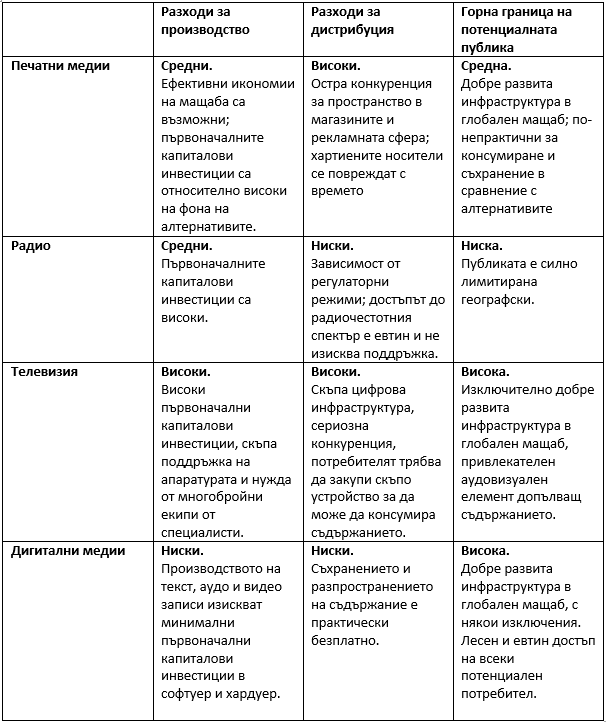
The comparison between conventional and new media explains the current trend of the latter growing extremely rapidly while the former are experiencing stagnation and decline. Market factors indicate that digital media are not only a key factor in the public environment at present, but will also be the main dominant factor in the long term. This phenomenon is already observed in some developed countries such as the United States, where political commentators and public intellectuals on social networks and YouTube enjoy many times greater viewership than conventional media and exert a key influence on both election results and public discourse (1).
Just like with conventional media, political communication on the Internet has its own peculiarities. Let's look at some of them and analyze how they shape and change political discourse.
The specifics of digital media
First and foremost is the anonymity that communicators on the Internet enjoy. Although an increasingly rare element of online communication, widespread anonymity practically guarantees the freedom of speech of participants and communicators. Because of this factor, the Internet is a space where even the most radical political theses exist and are disseminated without censorship, and the scope of what is perceived as acceptable and unacceptable political speech is expanding. The anonymity of communicators further strengthens ideological arguments, as it eliminates their identity and the prejudices associated with it from the equation and leaves only the purity and quality of their political theses and arguments.
In second place is two-way communication. In conventional media, the communication process is most often one-way - content producers deliver it to consumers. Technological limitations do not allow for reliable reporting of audience reactions. Contrasting with this are the possibilities for instant and numerous reactions of consumers to a given content, which we observe in digital media. These most often take the form of text comments and/or buttons expressing positive or negative emotions.
From the perspective of political communication, this phenomenon is key. For the political communicator, not only the message of his content becomes important, but also the reaction of the audience. This is because audience members actively communicate about the content and influence each other. This situation drives most political communicators to invest resources in attempts to shape the reactions of the online public, cultivating positive reactions to their own content and negative ones to the content of their ideological opponents. Examples of such activities are “troll factories” – organizations composed of political activists whose main activity is to shape public opinion through their reactions and presenting themselves as average citizens.
Third, the speed of generation and dissemination. The constant connectivity of digital media allows the generation and dissemination of basic factual information to happen extremely quickly. This has a very strong impact on the journalistic profession, especially on professional reporters. Their role as transmitters of factual information and content generated by political communicators to society is rapidly decreasing. Political communicators, in turn, can easily bypass reporters and journalists and communicate with their desired audience directly.
This phenomenon has radically transformed political discourse, as political communicators are less dependent on the goodwill of journalists and editors to shape their image. The overall effect has been to increase the weight of populist political communication strategies, the best example of its effective implementation being the administration of US President Donald Trump. The Trump team and the president himself have skillfully used digital technologies to bypass and delegitimize hostile conventional media and to spread their messages to society with the help of their activists (and sympathizers) on social networks such as Twitter and 4chan.
Conclusion
In conclusion, economic factors weigh heavily in favor of new media and predetermine their key position in contemporary political discourse and their dominant position in the long term. This, as well as the listed features of Internet communication, lead to the decline of old and established media institutions and the emergence of new influential centers of public opinion. The expanded capabilities of political communicators are transforming the landscape of political communication in new and unpredictable ways, with reactions and emotions taking center stage instead of the generation and dissemination of facts.
It is difficult to say how long this process of transformation will continue, but one thing is certain – the end result will be a political communication totally different from that which characterized the 20th century. This communication may take the form of an unprecedented flourishing of free speech and knowledge, or of mass censorship in the name of some totalitarian ideology.
Which of the two will happen in Bulgaria? It depends on the individual actions and morality of each of us.
Източници:
1. Battaglio , Stephen; "YouTube now bigger than TV among advertisers' target audience"; Los Angeles Times,