EKIP– Expert Club for Economics and Politics A Different Opinion
The direction of his argument may be wrong, but not its substance.
Italy has been really pissing off Europe lately. The populist government, led by comedian-turned-politician Luigi Di Maio’s out-of-the-box Five Star Party and Matteo Salvini’s Northern League, has announced that it will publish a 2019 budget with a deficit of 2.4% of GDP, against the EC’s 2% limit. The EC’s limit is normally 3%, but Italy has been specifically limited to 2% to help contain its massive public debt of 130% of GDP.
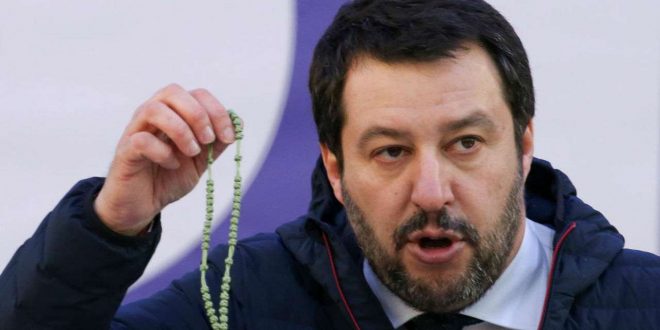
The Italian government has therefore attacked the EC, with Deputy Prime Minister Salvini taking the liberty of calling the commission the “Brussels bunker” – supposedly because of its blindly pushing through laws, regulations and rules, without any contact with the ordinary people they affect. It’s like being in a bunker during a war. According to him, all of Italy’s problems are due to “the EU’s policy of pushing through austerity (savings) and bringing in migrants”. As the authors and readers of EKIP well know, he is right about the latter, but not about the former.
Europe still can't happen to populists. The libertarian in this part of the world must always wonder whether to support some anti-system player, because he is bent on breaking the ever-hungry for power and eternally centralizing globalist, supranational political status quo, or to oppose him, because he is often a steroid version of the indigenous local political culture - authoritarian, statist, collectivist, socialist and anti-individualist. On the one hand, he must like them because they are nationalists instead of internationalists. On the other hand, however, he must be suspicious of any of their messages, because they are nationalists instead of individualists. Big socialism is simply replaced by a smaller one.
Libertarian populism
But let's turn our attention to the European establishment. This clash is one of the rare cases in which it defends the correct, sustainable, conservative position. Why does the EC bow to a deficit of 2%, but no more? Because this is the level at which the debt burden as a percentage of GDP (not to be confused with absolute government debt) will not increase with 2% economic growth, which is an acceptable, achievable level, averaged over the last few decades. In this way, governments could make the necessary investments in infrastructure so that their economies can grow, without directly burdening their taxpayers. Matteo Salvini hopes to use this money to buy votes.
But the problem is not Salvini. The problem is the dogmatism of the eternal centrist and the fervor with which he pursues it. In this case, the EC's far-sighted but unpopular balanced budget policy is left without support from other far-sighted policies such as tax breaks and regulatory retreats that would give the population a breath of air. As libertarians, we should be aware that no matter how much we dislike spending governments, they ease social friction, keep unemployment low, even if the employment is not particularly high-quality. The people are happy. If you remove fiscal stimulus without offering an adequate substitute such as tax cuts, people will hate you so much that you will not survive long enough to get to the point where you have healed the economy and they will love you for it.
Juncker is trying to get the best of both worlds, but instead he gets the worst
So this establishment got Greece wrong, too, by insisting on textbook tax increases to deal with the debt burden. That killed the goose that lays the golden eggs, the economy. Greece should have focused on qualitative changes like reducing hiring regulations and then laying off a huge number of civil servants so it could tax them as private workers, expanding the tax base. Not all incentives are created equal.
Similarly, the EC should have silenced Salvini on his deficit: “No, communist! Reform your communist country and eliminate the lifetime jobs that so many of your civil servants enjoy, and that other Italians pay for. All of Eastern Europe beats you on capitalism, and all you know is how to spend. Not allowing deficits is not an attack on Italy, but only on some Italians who have been used to feeding them all their lives on the backs of taxpayers.” Divide and rule. Libertarianism can also be promoted with populism.
But the EC will never stand up for true capitalism, because that would mean giving up a large part of its power and becoming insignificant itself (compared to the moment). That is why it will measure the angle of the cucumbers. The EU wants to sharpen at the same time and pretend to be an important pillar of civilization, holding on to the balanced budget so that people don't understand its schemes. But in doing so, it achieves the opposite - there is no dynamic economy that people are happy with. At the same time, however, it gives populists like Salvini the ammunition they need to wipe it out. If you drop a drop of tar in a jar of honey, you get a jar of tar. The mixed economy is not a golden mean, but the exact opposite - the low place among the hills that floods first.