 EKIP– Expert Club for Economics and Politics A Different Opinion
Excerpt from the book "The Machiavellians: Defenders of Freedom" by James Burnham, part 4 - chapter 3 (Burnham, “The Machiavellians, defenders of freedom” pp. 189-202; Published June 1st 1988 by Gateway Editions (first published January 1st 1943).
Translation: Stefan Radev
Editor's Foreword: James Burnham's The Machiavellians is the most important book on politics you can and should read. Presented primarily as a collection summarizing the ideas of some of the most interesting political thinkers of the modern era, it will help you understand politics as it is, not as we wish it to be. If you read only one book on politics in your entire life, let it be The Machiavellians: Defenders of Liberty.
In the 18th and 19th centuries, and increasingly so today, many theorists have raised the question of whether politics can be scientific. It is usually assumed that an affirmative answer would be grounds for optimism: that is, if politics could be, or were, scientific, it is assumed that this would contribute to the well-being of humanity. The leading American philosopher John Dewey and his followers continue to debate this problem, to give an affirmative answer to the question, and to maintain a stance of social optimism.
It is natural that this question should be raised. Since the 16th century, the application of the scientific method to all human spheres except the social has led to human triumph in them. In each field, science has solved the relevant problems; science is de facto simply a systematic method for solving relevant problems. And if this is the case in fields such as mathematics, astronomy, physics, chemistry, geology, why should it not be so in the social fields? Why could we not solve the most important problems of all, those of social and political life, by applying the scientific method?
These hopes in science reflected a broader optimism, both about what science could do and about the possibilities of social progress, which, from the perspective of the social achievements of the 18th and 19th centuries, seemed limitless. In our own time, an anti-scientific attitude is developing, at least in the question of the application of science to social problems. This in turn seems to reflect a pessimism both about what science could do and about all utopian social ideals. The idea of progress passes along the usual path from self-evident belief in it to empty illusion.
Let us try to answer this question by referring to the facts, without trying to justify an attitude of optimism or pessimism. Ultimately, optimism and pessimism are a matter of temperament. The big question, "Can politics be scientific?" is an unclear one. It can be answered by dividing it into several other questions. Three of these questions I am now addressing, and they are the following:
(1) Can there be a science of politics (and of society, since politics is a phase of social life)?
(2) Can the masses act scientifically in political affairs?
(3) Can the elite, or at least some part of the elite, act scientifically in political affairs?
The first of these more specific questions can be answered easily and confidently: Yes, there can be a science of politics and society. There is no insurmountable obstacle to such a science. There are undoubtedly observable events in the field of political and social affairs. These events can be observed and systematically described. On the basis of the observations we can formulate generalizations and hypotheses. These can then be tested, either by predictions of future events or by the results of further research. Nothing more is required to make science possible in any field.
Of course, it is easy to assume that there are serious practical difficulties in the way of the social and political sciences. It is often claimed that the subject matter - the actions of groups of people - is extremely complex; and this is so, although the subject matter of a number of other sciences is also quite complex. A more direct and specific difficulty lies in the reluctance of people to adopt a scientific attitude to the study of political and social events or to apply the canons of scientific procedure. "Intentions," as Pareto would call them, have an effect. A physicist would think it ridiculous if every treatise in his field were to include a plan for the cure of social pathologies, with selected facts - and fictions - by which he could prove how desirable his plan was. Yet in 99 percent of the articles and books that pretend to tell us how society works, just such a method is uncritically accepted as normal. More specifically and deliberately, the application of the scientific method to politics is the work of those in power. They do not want there to be true political knowledge and block freedom of inquiry when it threatens, and it often does, to undermine their power. From the time of the Greek sophists to the present day, anyone who, through objective inquiry, reveals some of the truth about power has been denounced by official opinion as a traitor.
Because of these obstacles, which do not seem merely momentary, we should not expect too much in the results of political and social science. Nevertheless, such a science is not a mere theoretical possibility. We already have a science of society - incomplete and undeveloped, no doubt, but existing. The truths discovered so far by this science are of two kinds.
Quite accurate results have been obtained for problems of limited scope. When care is taken not to project conclusions too far beyond the temporal and spatial limits within which the data were collected, statistical conclusions about mortality, disease, some economic facts, suicides, crime, literacy, trade movements, illustrate these results. They are the main and most fruitful achievement of academic social research.
At the other extreme, rough patterns have been discovered for large-scale and long-term social and political movements. These are the achievements, for example and exclusively, of the Machiavellians (political scientists - realists); many cases are given in this book. However, most of them can also be found (often in somewhat different ways, but similar in content) in the works of other social scientists from the time of Karl Marx [1] to the present day.
We do indeed have much more knowledge about society than is usually acknowledged - and much more than is ever used. There is a widespread misunderstanding of the nature of scientific knowledge, a misunderstanding partly encouraged by academic scientists themselves, who prefer their profession to remain an esoteric cult. Statements, for example, that bodies, when held back by nothing, fall towards the surface of the earth, or that water flows downward, are very far from the mathematically formulated law of gravity. Interpreted literally, these statements are actually wrong, as the behavior of a feather, the movement of airplanes, or siphons and pumps show. Nevertheless, these statements about reality are genuinely scientific and, with a little rough experimentation, can rightly be considered true. They are what Pareto calls "first approximations" and they summarize a huge number of observable facts quite correctly. They are also very useful knowledge as guidelines for conscious action. On the basis of these we may be advised to move out of the way of a stone if we see it falling on us from the roof of a building, for example; or to build a house or village under rather than over a spring if we want water to flow. It seems rather pedantic for an expert in physics to tell us, first, that our rough generalization about falling bodies is absolutely false, because there are facts (as there are indeed) to refute this statement; and second, that we therefore have no right, on the basis of such falsehood, to move out of the way of a falling stone. But this is precisely the way in which some academic experts reason and advise on social issues.
We have a considerable body of knowledge of this kind of "first approximation." An example would be the rough laws of social revolution which we have considered in their application to the present period; or the summary list of Machiavelli's principles given at the beginning of this part of the book (Part 4), and the innumerable assumptions which can be made from these principles. There is sufficient knowledge to have enabled us to realize that the Kellogg-Briand Pact is powerless to prevent the outbreak of wars, and that the "Stimson Doctrine" of non-recognition of territorial changes effected by force has never stopped, and never will stop, territorial changes effected by force. It is interesting to note that professional gamblers in New York have never been wrong about the outcome of a presidential election since the Civil War. [2] We know enough now to say that there will almost certainly be a widespread economic crisis shortly after the end of the present war - although this expectation will be carefully concealed from the parties concerned. We can predict with reasonable confidence that the national debt of this and almost all other countries will be either outright rejected or indirectly reduced, by lowering interest rates, by inflation from money printing, or by several other similar mechanisms. Reflecting on the analogy of comparable historical periods, we can also conclude that the trend away from private capitalism is irreversible.
True, our scientific statements on social matters must often be put in conditional form: if other things remain the same, if such and such things do not happen, then so-and-so will probably happen. (There is, however, an implied condition in most, if not all, statements within all sciences.) Thus we can now know with considerable probability that: if the state absorbs under centralized control all the essential public powers, then political freedom will disappear; if after this war Europe is again divided into a considerable number of independently armed sovereign states, then we can expect a new war to break out in Europe very soon; if the present plan of military strategy (i.e., submarine warfare and "island hopping") continues unchanged in the East, then Japan will not be definitely crushed for many, many years, and perhaps never; if the present administration plans to remain in office indefinitely, then it will have to restrict political freedom further; and so on. Such knowledge and much more is available: available, but not, of course, used.
Let us turn to the second question on which we have analyzed the general problem of science and politics: can the masses act scientifically in political affairs? To act scientifically would mean to act "logically" in the Pareto sense; that is, to consciously and deliberately select real ends (ends that are not supernatural, fantastic, and impossible) and then to take practical steps that are appropriate to the attainment of those ends. The ends may be peace or a higher level of material prosperity or economic equality - although it is possible that the ends may be quite different: starting a war or conquering; we should not make the mistake of assuming that everyone really wants the things that moralists say they should want. In any case, the ends would be clear, consciously chosen; and the actions would really achieve them, or at least bring us closer to the ends.
This question, as Professor Dewey has often shown, is very similar to the question of whether it is possible for the masses to act scientifically by themselves. For a group to act scientifically presupposes that its decisions are made on a democratic basis, because otherwise the decisions are not considered from the point of view of the group itself. In conclusion, that self-government of the masses is impossible, it therefore also follows that it is impossible for the masses to act scientifically in political affairs.
Machiavellian analysis confirms and reaffirms, using historical evidence, that the masses simply do not think scientifically for political and social purposes; and that even if they did think scientifically, the technical and administrative means for the application of their scientific thought would necessarily be lacking. Beliefs, ideals sometimes influence the political actions of the masses; however, these are not scientific beliefs and ideals, but myths or derivations.
Moreover, there is no reason to expect a change in this respect in the foreseeable future. In the 19th century, many thought that universal education would enable the masses to be scientific about politics and thus to arrive at a perfect democracy. This expectation has not been fulfilled. Illiteracy has been almost abolished in most great countries. Nevertheless, the masses act no more scientifically today than they did a century or a millennium ago. In political matters, the scientific possibilities of a wider literacy have been surpassed by the new possibilities which the mass school creates for unscientific propaganda. At the same time, the ever-increasing size and complexity of modern social structures constantly pose new technical obstacles to the direct application of scientific procedures by the masses to their own political problems.
Many modern politicians usually tell the people that "their fate is in their hands," that they govern themselves, make the final and fundamental decisions, they - the citizens - are the judge of last resort. Statements of this kind are all conclusions expressing some variant of democratic formulas. Their real purpose is to enable politicians, while governing in their own interests, to defend their regime through the moral sanction of the myth of the popular will.
An honest statement to the masses, which by its nature a politician can never make, would be: you cannot govern yourself; doubt all leaders, and especially those who tell you that they merely express or represent your will; erect and value every possible safeguard against unchecked power. Although such statements are never made, there are many among the masses who understand their meaning without being told. The great anti-fascist novelist Ignazio Silone wrote: “The cafon [which can be roughly translated as ‘small farmer’ or ‘farmer’] is by no means primitive; in one sense he is over-civilized. The experience of generations leads him to believe that the state is simply a better-organized Camorra [i.e. farm] ... Marx often speaks of the peasants as having dull minds, but what did he know about them? I suppose he watched them in the market at Trier and noticed that they were sullen and did not talk much. He did not think that perhaps they had assumed this role deliberately.” An American version of Ignazio Silone might mention, in the same connection, groups of farmers or industrial workers who one day passively listen to patriotic rhetoric about “honesty and justice”; and the next - demand higher prices or wages. By adopting attitudes of this kind, the masses come closest to being scientific about politics.
It is absurd that the authors of books like this—that is, serious books about society—pretend to speak to “the people.” The vast majority of people in this country do not buy or read books at all—and thus avoid a great deal of nonsense. As statistics show, the potential audience for this kind of book is limited to a relatively small portion of the elite. [3] The absurdity does not at all prevent the authors from covering page after page with rhetorical advice to the masses about what they can and should do to govern society for their own welfare and interest.
But the words of politicians reach the masses; and when politicians say these things, it is not absurd but sinister. When it is assumed that those in power govern only as agents of the will of the masses, then their rule becomes irresponsible. The rulers are no longer personally responsible for their actions: they can go to war, persecute, steal, violate liberties, fail to prepare for social or military crises, and yet never be held accountable for any crime or failure - they will say - they simply carried out the will of the people; if the masses are stupid or selfish or frivolous or short-sighted, who are their humble rulers to blame? [4] No wonder the rulers do not encourage the development of a science of politics!
The question remains whether at least some parts of the elite can act scientifically in relation to political affairs. It is necessary to raise the question in this modified form, and not for the elite as a whole, since the elite is usually not a homogeneous group.
There is no doubt that a man can conduct his political affairs scientifically or logically. For example, a man, endowed with certain abilities and a little luck, may decide to rise in society and may take appropriate steps that will have a fair chance of achieving that goal. In some cases, people can, through deliberate scientific means, rise to the highest ranks of social and political power.
In the cases mentioned, it should be noted that the individual does not usually work as an isolated unit. Associated with him are various other individuals, who together form a group of more or less size. The most prominent person may become a prime minister or a king or a dictator; but power is really acquired by the group, not by any individual. Nowadays, these groups will usually include certain experts in propaganda, public relations and people with organizational skills, as well as one or more "theoreticians."
This kind of group constitutes part of the elite, and in general there seems to be no reason why parts of the elite cannot function scientifically, at least within some limits.
The inability of the masses to function scientifically in politics is based primarily on the following factors: the enormous size of the mass group, which makes it too clumsy to use scientific techniques; the ignorance of the masses of the methods of administration and government; the necessity for the people of the masses to spend most of their time and energy in the workplace, which leaves them little energy or time for acquiring more knowledge of politics or performing practical political tasks; the lack in most people of a sufficient degree of those psychological qualities - ambition, ruthlessness, etc., which are prerequisites for active political life.
All these shortcomings can be overcome by sections of the elite. These sections are relatively small in size. Their members can and do acquire a good deal of knowledge about administration and government. Since their members either inherit money or find ways to earn their living from others without much effort on their part, they have both the time and energy in which to cultivate political skills. They are careful not to crowd their ranks with pretentious idealists. Thus there seems to be no theoretical reason why sections of the elite should not be scientific in political affairs. If our reference is to the ruling section of the elite, we ask whether rulers can govern scientifically; and the answer seems to be that up to a certain point they can. We may add that at certain periods in certain societies they have done so, or at least have come close to governing scientifically.
What exactly would it mean for rulers or other elites to be knowledgeable about political affairs? And if they were, would it benefit society as a whole?
This would mean, as always when behavior is scientific, that the department in question would pursue consciously understood and deliberately chosen goals. The goals must be real and possible. It follows from these conditions that the choice of alternative goals would be limited to very narrow limits. All utopias would be excluded, all those mirages of permanent and universal peace, abundance, and joy for all. Moreover, since the general pattern of social development is determined by technological change and by other factors that are probably beyond human control, a scientific elite would have to accept this general pattern. In 1800 it was an illusion to think that society could revive the social structure appropriate to the pre-steam engine era; so it is an illusion today to dream that the 19th-century structure could be preserved on the technological basis of the assembly line, the airplane, electricity, and radio. From this perspective, we can say that the scientific elite should be "opportunistic" - not in the narrower sense, in which opportunism means taking the easiest course today without a clear thought for tomorrow, but in the broader perspective of both not stopping the main course of progress and not wasting time fighting for causes that are lost before the battle has even begun.
In short, a scientific ruling group would not guide its political action by myths. We must repeat, however, that our concern is with political action only. Just as a man who is otherwise perfectly learned in the field of physics, but who is otherwise able to accept the most naive myths in the field of politics, so another whose political action is consistently scientific may believe all sorts of myths in other fields. We find a striking demonstration of this in the history of the Catholic Church. The upper hierarchy of the Church has defended and probably believed many unscientific theories. However, ever since St. Augustine made the wonderfully useful distinction between the "City of God" and the "City of Man," this has not prevented the hierarchy, on frequent occasions, and sometimes for centuries together, from acting scientifically in the field of organization and politics.
We have seen that the main real aim of any ruling group is the maintenance of its own power and privilege. Scientific behavior on the part of the group will not destroy this social fact, but, on the contrary, will force the group to admit it frankly and to take appropriate steps to secure power and privilege. Would it not then seem that scientific rulers would be the worst of all, that a scientific ruling class would in practice mean perpetual tyranny? Should the ruled rather rejoice in every mistake, every illusion, every absurdity of the rulers?
In some circumstances this would undoubtedly be the reasonable attitude on the part of the governed. Nevertheless, there is often some connection between the interests of the ruler and the governed, despite the fact that the rulers' primary aim is to serve their own interests. Examples are not at all difficult to find. All will undoubtedly admit that James S. Petrillo ran the Musicians' Union primarily for his own benefit; and if the published accounts of his salary and other privileges are correct, he did very well for himself. It is clear enough, however, that his regime greatly improved the economic position of the members of the Musicians' Union. In the fifth century in Athens or in the Roman Empire, the ruled and the rulers prospered together and faced disasters together, and so it often happened. The fate of the whole society is often - whether one likes it or not, and however unjust it may seem - linked with the fate of its ruling class. The collapse of the French ruling class a few years ago meant a severe tragedy for the entire French people, although we cannot blame the French masses for it from a moral point of view. Certainly the French would have been better off if they had been governed by an elite which knew its business, knew, among other things, how to keep itself in social power, and which was firm enough to take the necessary steps. If the generals are not good, the army will be defeated; but the soldiers too - in fact, mostly - the soldiers will be slaughtered. Society - a city or a nation or an empire - may become so rotten as a whole that it is better for it to be destroyed as a social organism; and this is rarely a happy event for the individual members of society, both governed and rulers.
The lessons of history show us that a ruling class can rarely continue in power unless it is prepared to open its ranks to capable and ambitious newcomers from below. A scientific ruling class will therefore keep its ranks open; and this will also be to the advantage of the governed, by providing an outlet for dynamic individuals, and even more so by permitting a greater expansion of creative social energies. Political freedom also in the long run usually helps both the rulers and the ruled. We have already seen that this is so from the point of view of the ruled; from the point of view of the rulers, freedom is a safeguard against bureaucratic degeneration, a safety valve against errors, and a safeguard against revolution.
If a significant portion of the elite continued to act more or less scientifically, catastrophic revolutions would be much less likely. It is perhaps not so clear that the abolition of revolutions would promote the welfare of society as a whole. It seems that the net result of at least some revolutions is to the advantage of the masses, at least when measured against the old regimes. The point is, however, that a scientific ruling class could avoid catastrophic revolution not by stopping revolutionary change in society, but simply by guiding the change, controlling it, and thus making it happen more orderly. Catastrophic revolutions occur when the conditions are in place that require a drastic change in the social structure, but the changes themselves are blocked; then, sooner or later, they erupt in full force. There is rarely anything inevitable about this process. Broad changes will occur in all cases. If they can be carried out without the immeasurable blood and terror, the cruelty and chaos which are the sure companions of modern mass revolutions, few would lose. But revolutions will surely come unless their causes are removed; and only a responsible leadership, understanding the laws of society and acting on that understanding, ready to sacrifice, when necessary, many of its immediate interests, and blessed with no small amount of luck, will have a chance of removing the causes of revolution.
We should not imagine that even the most thorough scientific procedures on the part of the ruling class can "solve" all the problems of society. We have already noted that the broad patterns of social change are established by factors beyond conscious human control. Scientific action can therefore only make a difference within these general patterns. Many important social problems - such as lasting peace or lasting economic prosperity - are probably insoluble. Moreover, a scientifically ruling class can never hope to do more than make the best possible use of what is at its disposal: if it leads a nation poor in resources and people, it and its society may still be crushed, no matter how brilliant its scientific leadership.
However much an elite guided by the scientific method may accomplish - both for itself and for the society it governs - there are obstacles to an elite acting scientifically. These obstacles, if not completely insurmountable - as in the case of the masses - are quite great. In general, as we have seen many times, it is extremely difficult for people to be scientific or logical in relation to social and political problems. If the elite have on the one hand an advantage over the masses - possessing more knowledge, more leisure time (since they are freed from the burden of having to earn their living and shelter), and undoubtedly possessing certain talents - on the other hand, members of the elite are subject to the inevitable corrupting influence of power and privilege. Those who have privilege almost always develop false or distorted ideas about themselves. Elites are forced to deceive themselves and others with some irrational theory that justifies why they hold a monopoly on these privileges, instead of having to explain the annoying and unpleasant truths about how these privileges are actually acquired and retained.
This dilemma confronts every section of the elite that tries to act scientifically. While the political life of the masses and the cohesion of society require the acceptance of myths, the scientific attitude towards society does not allow for belief in the truth of myths. But leaders must profess, indeed encourage, belief in myths, or the fabric of society will crack and they will be overthrown. In short, even if leaders themselves act scientifically, they must lie. It is difficult all the time when one is in the spotlight to lie, and meanwhile behind closed doors to have an objective attitude towards the truth. Not only is it difficult; it is often ineffective, because lies are often not convincing if they are told with a divided heart. The tendency is for liars to deceive themselves, to begin to believe their own myths. When this happens, they cease to be scientific. Candor is bought at the price of truth.
In light of these obstacles and this tragic dilemma, it seems that the possibility of scientific-political action, even on the part of a section of the elite, which is itself only a small section of society, depends on favorable and temporary circumstances. From my own knowledge of history, I must say that such were almost realized during certain periods in the history of Rome, the history of the Catholic Church, the Republic of Venice, and the history of England. Such favorable circumstances have clearly not existed so far in the present 20th century. Our leaders - not only the ruling elites, but also other sections of the elites, such as those who have grown out of the labor movement and who are increasing their own power - are for the most part unscientific and even anti-scientific in their actions related to basic social problems, while at the same time they have adopted scientific techniques to deal with narrower problems of mass manipulation. The programs they profess, as well as those they act upon, are devoid of reality, since they fail to recognize the general pattern of our age. They are content not simply with myths, but with the remains of vanished myths. They acknowledge no responsibility except for the fiction of the masses, which is only a projection of their own lax will to power. In so doing, with the material resources invented by the physical sciences, they have brought civilization to the most destructive crisis in history.
Civilized society will probably survive somehow. But it will not survive if the course of the ruling class continues in the direction of the present and of the last forty years. This course leads to the destruction of both the rulers and the ruled. But in the monstrous wars and revolutions of our time a great purge of the ranks of the ruling class has already begun. This purge, and the recruitment of new leaders that accompanies it, may be expected to continue until it brings about a change in the present course. While the change will never bring about the ideal society of our dreams, we may hope that it will allow human beings at least that minimum of moral dignity which alone may justify the strange accident of human existence.
[1] Pareto had little use for Marx's economic theories, which he considered to be largely absurd metaphysics. However, in Les systèmes socialistes, he wrote: "The sociological part of Marx's work is, from a scientific point of view, far superior to the economic part." (Volume II, p. 386.) In particular, he notes that the concept of class struggle is "profoundly true" (Volume II, p. 393). [2] I base this statement on my personal knowledge since the election of Harding (1920); and for the elections before 1920, on the memory and research of Jack Doyle, who until his death in December 1942 was the preeminent authority on the subject. He was, however, unable to trace the betting records before the Civil War. For most of the 1916 campaign, the professional odds favored Hughes; but they were changed in Wilson's favor 48 hours before the election. [3] The average sale was under 2,000 copies, and on rare occasions as high as 40,000 to 50,000 copies. [4] This was the main thesis of the State Department's "White Paper" on Peace and War, issued in January 1943. As Life magazine rightly noted: "It vindicates what [the State Department claims] the people wanted by proving that the Department knew all along that what the people wanted was wrong."
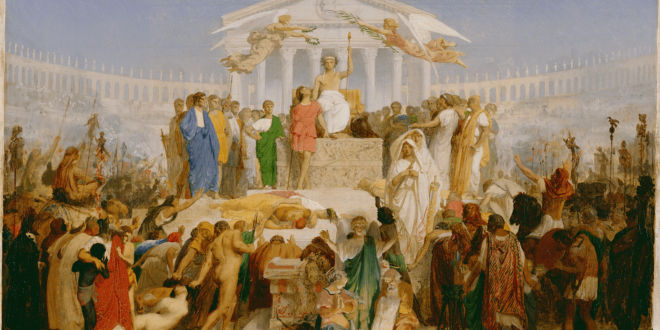
The painting is by Jean-Léon Gérôme - The Age of Augustus, the Birth of Christ (1852–1854)
Link to the working file of the translation - https://prevodi.chitanka.info/book/75/298
Link to the audio chapter in English:
https://drive.google.com/file/d/10R83HadvPe0d20HTy8oymOMj1g-PvsSk/view?usp=sharing






This is like something out of a textbook on scientific Marxism.