EKIP– Expert Club for Economics and Politics A Different Opinion
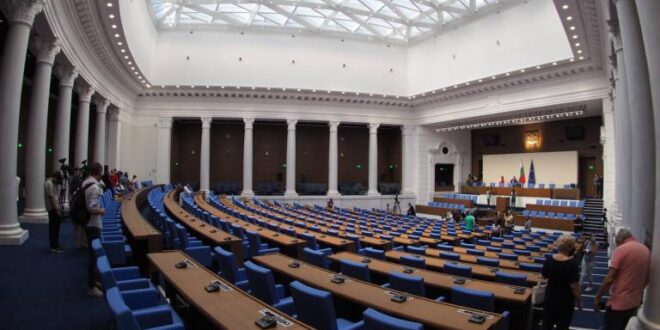
The Saturday immediately before election Sunday is usually marked as a “day of reflection.” But the Monday immediately after it is perhaps an even more important day of reflection. It is the day when, reviewing the election results, we can outline the ideological color of the new parliament in view of the political formations that managed to cross the barrier, and assess what we can expect from it as politicians.
Looking at the (almost) final results of the CEC, we see that the greatest success in these elections was achieved by new and opposition-minded formations such as "There is such a people", "Democratic Bulgaria" and "Stand up! Get out!", which overtake or equalize the old and established formations BSP, MRF and VMRO. What is particularly interesting is that the economic programs of these new formations include a number of policies and reforms that we at EKIP have proposed and actively promoted over the past 3 years.
Over the past three years, in the field of tax policy, the EKIP has most actively promoted two very specific proposals. The first of these is the abolition of the tax on retained earnings of enterprises (the so-called "corporate tax"), which, through a very in-depth report by our colleague Stefan Stoyanov, we presented for the first time in the fall of 2018. The second proposal is to raise the threshold for VAT registration from the current level of BGN 50,000 to the maximum possible BGN 250,000, which we first published in the article " Three Fiscal Ideas for Budget 2020 " in October 2019. In one form or another, these ideas of ours find an equivalent in the programs of all three new players in parliament.
First of all, "There Are Such People" envisages the introduction of both a higher threshold for VAT registration and a corporate tax credit for reinvesting profits. As an added bonus, the party promises to reduce public spending to 38% of GDP and reduce the budget deficit to a maximum of 1.5% within one mandate.
Then we see a similar proposal in the program of the other big winner of the elections – Democratic Bulgaria. The formation proposes raising the threshold for VAT registration to 200,000 leva. As a pleasant surprise, the formation “Stand up! You bastards out!” also stands out, which also proposes raising the threshold for VAT registration to 200,000 leva and introducing a zero tax rate for corporate tax on the share of this profit that is reinvested in Bulgaria.
What is clearly distinct is that these are three new political formations that are entering parliament for the first time in these elections, riding the wave of mass dissatisfaction against the GERB government, which has been riddled with constant scandals and suspicions of corruption. Given the fact that the next government, regardless of whether it will need re-election for this, will most likely be of a similar “reformist” nature, it seems very likely that these tax policies will become a reality. And this would be a very big success and a positive development in the field of tax policy in the country.
Of course, in this aspect, the left-wing competition of the EKIP also deserves a certain salute. The idea of a non-taxable minimum for income tax, which was strongly promoted through the campaign "Stop the inequality machine", also finds a presence not only in the programs of each of the above-listed opposition formations, but also in that of the BSP. This was a campaign led by a number of left-wing journalists, activists and non-governmental organizations - very similar in profile to the EKIP, but from the other side of the political spectrum. The position of the EKIP regarding the non-taxable minimum has always been rather neutral - in principle we are not against it, as long as it does not lead to progressive tax rates for higher incomes.
In the programs of the aforementioned new parties, other reform signals are also noticeable, which could potentially have very positive effects. For example, in most of them (DB and ITN) there are proposals for reform of the pension system and reduction of the insurance burden specifically along the lines of the first (state) pillar of the pension system. In this direction, we at EKIP have also made proposals and campaigned for pension reform. However, the past has shown that requests for real pension reform before elections very often remain just that – requests. Therefore, for the time being, it is rather early to place any special hopes in this regard.
The results of yesterday's elections will still be weighed, analyzed and assessed in depth. But based on the first impressions expressed in this text, one thing is clear - a serious realignment is taking place on the Bulgarian political scene, both in terms of political formations and political priorities. The realignment by formations is clearly evident from the fact that ITN is ahead of the BSP in terms of election results, and DB is ahead of MRF in general and GERB specifically in Sofia. The realignment by political priorities is clearly evident from the aforementioned ideas for reforms of a number of aspects of the tax and pension systems. But this is just the beginning. The realignment of the Bulgarian political scene is yet to deepen - especially in terms of ideology.