EKIP– Expert Club for Economics and Politics A Different Opinion
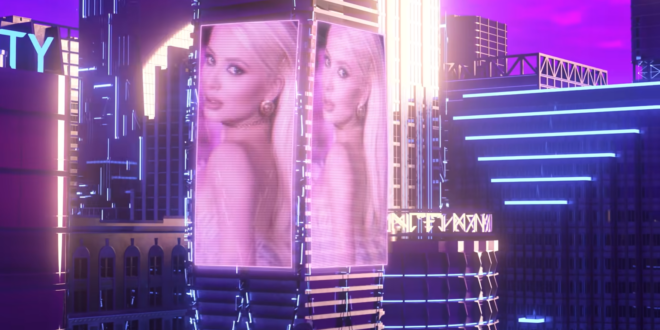
Let's talk about culture on Good Friday. Specifically, about Tsvetelina Yaneva, the retrowave aesthetic, and the lost futurism of contemporary mass culture. Keep reading if you want to find out what Tsvetelina Yaneva and Elon Musk have in common.
Do you listen to Tsvetelina Yaneva, ladies and gentlemen? And do you watch her music videos? I want to pay attention specifically to two of them - "The Angel" from 2019 and "Fight, Fight" from 2021. Because through these two videos, Tsvetelina Yaneva becomes the icon of retrowave aesthetics in Bulgaria. Before we continue, I recommend that you watch them:
"The Angel" (2019):
"Fight, Fight" (2021):
What is retrowave? Retrowave, or more fully known as retro synthwave, is a musical movement that originated about 10 years ago in the United States. The music is characterized by heavy use of synthesizers and electronics, but the sound is very different from that of electronic dance music such as dubstep, trap, and drum and bass, which were very popular at the time.
"Retrowave" as an aesthetic
The retrowave sound is far more subdued, elegant and above all both futuristic and nostalgic. It is also far less danceable. It is retro because it completely purposefully copies elements of the sound of 80s music, especially the soundtracks of science fiction films and games. Of course, elements and sounds from more modern electronic styles are also added (like some of the aforementioned), but the overall impression it leaves on the listener is definitely RETRO. When something sounds "retro" you know it right away.
Retrowave music made its biggest impact with the film Drive (2011). Kavinsky's song Nightcall (a classic synthwave track) is heard in one of the film's opening scenes, as a backdrop to the nighttime Los Angeles that the main character The Driver (Ryan Gosling) is driving around in his car. The entire sequence is imbued with a retrowave aesthetic. The film purposefully recreates a retrowave aesthetic in many ways, and is therefore considered emblematic of the musical genre.
And what is the retrowave aesthetic? This is something that must first be heard, but perhaps it is even more important to see. As for the sound of retrowave music - it is most often both minor, futuristic, and nostalgic. It evokes in the listener a strange mixture of feelings of futuristic optimism and nostalgia for lost value. This particular combination of feelings is the key characteristic of the retrowave sound.
The visual aesthetics of the genre can be seen most eloquently depicted in the covers of various albums and singles by retrowave artists. And in Bulgaria - in the music videos of Tsvetelina Yaneva. Mostly 2 of them. "The Angel" from 2019 and "Fight Fight" from 2021, with the latter definitely being more aggressively expressed.
The visual style is extremely specific and once you see it you can't mistake it. The color scheme is dominated by different shades of bright blue and bright purple/pink. Bright and neon lights. Red is much less prevalent, if at all. In the aforementioned two videos by Tsvetelina Yaneva, this color scheme is recreated almost to perfection. The later video ("Boy Boy") is even more aggressive in copying the retrowave aesthetic, recreating one of the genre's favorite tropes - the aesthetics of 80s arcade games (note the design of the car).
"Retrowave" as a philosophy
The (un)hidden message of retrowave is that the futurism of mass culture of the 80s is better than today's mass futurism (or at least more vital, i.e. "alive"), if there is one at all. Retrowave is a remarkable achievement of critical post-modernist culture, which reflects on the loss of vitality in contemporary society. Retrowave reflects on the loss of the ability not only to build, but even to DREAM about the future in a beautiful way. In the sphere of mass culture, the 80s are the last decade in which there is an aggressive and extremely ambitious futuristic techno-optimism.
From the 90s onwards, it fell into an era of techno-pessimism and present-ism (I know that's not a word). We no longer expect the future to be as BRIGHT and EXCITING as people thought in the 80s. Even the feeling beneath the surface is that it will most likely be worse than the present, so we concentrate almost entirely on the here and now. This is a paradoxical development, considering that in the 80s the Cold War reached a critical level of tension and the fear of nuclear catastrophe was very tangible among society (this aspect of the then mass culture in the West is perfectly captured in Alan Moore's great graphic novel "Watchmen").
In the 1990s, such a threat no longer existed. The USSR collapsed, and the late 1990s and early 2000s were arguably the peak of US geopolitical dominance on a global scale. Yet it was during this period that techno-pessimism and futurism in Western popular culture grew and continue to escalate to this day. You would think that a society living in fear of nuclear war would be more pessimistic about the future, but it turns out the opposite is true. Why? I’m not sure.
The greatest philosophical value of the retrowave aesthetic is that it asks this very question. In short, the fact that retrowave evokes feelings of nostalgia in listeners, recreating the "sounds and colors of the future" as imagined by the people of the 80s, means that we feel that their futuristic aesthetic is more beautiful than ours. Do we actually have one at all? This is precisely the fear of us futurists.
Nostalgia for the years immediately before (and around) the fall of the Berlin Wall and the Iron Curtain is not limited to music and films. This nostalgia is a far more comprehensive phenomenon, born of a sense of some lost hope. The hope for a progressive, colorful, beautiful future. The decade before the collapse of the USSR ironically seems to be the last decade in which the population of its mortal geopolitical enemy allows itself to look with ambition and hope to the future.
Why are we afraid of the future?
In the 1980s, computers went from being a niche technology for specialists in universities and government institutions to a mass product that reached every household. This is what gave a significant boost to the wave of techno-optimism during this period. People in the 1980s wondered how far the technologies of "thinking" machines like computers would go. And while they looked at these technologies with hope, nowadays we seem to look at them with fear. Computer technologies have consumed the life of a person in 2021 far more than the life of a person in 1986, but the former does not seem to be particularly fascinated by this fact.
Computer technologies are an inevitable part of our daily lives, but despite this, mass culture constantly inundates us with not how useful they are, but how harmful they are. Giga-corporations that collect unimaginable amounts of data about our daily lives, the perverse effects that digital social networks have on our socio-psychology, fake news that spreads at the speed of light – these things scare us. And they are to a significant extent the offspring of the “new” technologies that have appeared since the fall of the USSR – the Internet as a network for mass exchange of information among ordinary people all over the world (not just specialists) appeared in 1991.
Is this the reason why most people are afraid to think about the future? Is this why they no longer have hopes for it? They don't expect it to be bright, colorful, ALIVE, like the 80s aesthetics that retrowave nostalgically recreates? Or is the reason far deeper? Mass culture flows from top to bottom to a greater extent than we would like to admit. Isn't the loss of a mortal enemy for the Western elite in the face of the USSR the reason for the subsequent cultural stagnation and even decadence? Maybe the formation of China as the successor to the role of the USSR will lead to a kind of "renaissance" in this regard? And maybe not, the mentality of the West is already in a terminal phase, absolutely incapable of formulating an ambitious and beautiful vision of the future, with a mass culture completely obsessed with superficial "here and now" petty issues, whose psycho-social influence is amplified to an extreme extent by social networks?
People today are massively afraid of the acceleration, if you will, of technological progress. Retrowave aesthetics often emphasize speed and acceleration as a symbol of progress, as it was visualized in the 80s. These days we don't want to talk about speed. Especially the speed of technological progress! We live in an era of a perverse combination of conservative, even reactionary fear of the future, combined with an empty and narcissistic obsession with one's own well-being here and now. Modern mass culture combines the worst traits of the conservative and the liberal.
Renaissance of Futurism
And yet, there is some hope. The spirit of the times is dominated by fear of the future, but the fog of techno-pessimism is pierced here and there by rays of futurism. This is evident even in the “green” socio-political movement. From an initially techno-pessimistic genesis, today it is in it that we find not only a surviving, but also a thriving techno-optimism. Entrepreneurs like Elon Musk have a leading role in this. Before Musk, the political consensus was that human technologies would destroy the planet and the only salvation was to abandon them. After him, the consensus is that in fact only human technologies can save it. The historical significance of this turn cannot yet be fully appreciated today. In this regard, the EKIP recently published our vision of how RES technologies can be developed as effectively as possible.
Beyond energy, in the purely digital realm, the spirit of techno-optimism is being kept alive by innovations like blockchain. Technologies that promise to deterritorialize the internet, break up the monopolies of stagnant and totalitarian mega-corporations, and return it to ordinary users. A machine for decentralization and radical freedom is what the internet was meant to be and still can be – that’s the message of the Cypherpunk movement of the 1990s, which evolved into the modern crypto society.
The distinctive feature of these movements is that they originate as the absurd fantasies of eccentric and even marginal elements in society. They are not a product of mass culture, like the futuristic aesthetics of the 80s. In his attempts to create a private company that would one day replace NASA and colonize Mars, Elon Musk initially met only ridicule. When it appeared in 2009, Bitcoin was considered nothing more than a toy for programmers-zoos. 10 years ago, who took seriously the idea that such a thing as a “cryptocurrency” could be a mass means of payment and have a capitalization of over 1 trillion dollars? Nowadays, we are all sure that it will happen. The question is no longer “can it”, but “when”.
These technological movements are the bearers of the main dream of the retrowave movement – to dream of a beautiful and exciting future again. Does Elon Musk listen to retrowave? I wouldn’t be surprised. Now, this aesthetic is already entering Bulgaria, thanks to artists like Tsvetelina Yaneva. This may surprise some of you, but pop-folk has always been the most progressive musical genre in Bulgaria in terms of adapting elements from new, recently emerging hip aesthetics and genres. Bulgarian pop music is far more ossified in this regard.
The musical value of retrowave can be discussed in depth by musicians (I'm not one), but for me as an amateur it certainly cannot be denied. This is one of my favorite genres to listen to no matter whether I'm working, walking outside or just lying in bed. It's no coincidence that I have a 6 hour and 30 minute Retro Synthwave playlist on Spotify. Should I add these Tsvetelina Yaneva clips to it? No (maybe just for the meme). The visual aesthetic is retrowave, but the music is pop-folk. Which I now find a far more charming combination than I would have expected. The director of Yaneva's two retrowave clips is the same. Is he also a futurist-nostalgic?