EKIP– Expert Club for Economics and Politics A Different Opinion
In a previous post, we showed some of the reasons why the political system cannot be relied on to successfully solve socio-economic problems ( see here ). The theory of regulatory captivity and Bulgarian economic history revealed how the interaction between governance structures and interest groups ends in a conspiracy against society and the plunder of resources.
The review of the reasons for low expectations towards the authorities continues with two more scenarios: a) the neglect of (otherwise) good principles and laws and b) the unforeseen consequences of the actions of those in power. The first shows that the players in the political arena successfully forget or stifle the restrictions imposed on them. The second is rather an objective fact that cannot be escaped. The illustrative examples are again from Bulgarian economic history.
To forget or to drown
The Tarnovo Constitution (1879) contains provisions that should curb the urge for indiscriminate and uncontrolled spending of public finances. The budget is adopted by the National Assembly before the money is spent. The spending itself occurs only for activities foreseen in the budget and in an amount again foreseen in the budget. In the event of extraordinary expenses on the foreseen items and in the event of impossibility of convening the parliament, the monarch, upon the proposal of the Council of Ministers, authorizes the conclusion of a loan of up to 1 million gold francs. A mandatory condition is that the loan be approved by the first National Assembly convened after the conclusion of the loan (Art. 125). For extraordinary expenses not foreseen in the budget in the same manner as in Art. 125, up to 300,000 francs may be granted (Art. 126).
The budgetary practice of the Bulgarian state is rapidly moving away from constitutional requirements. The articles and paragraphs of the basic document are difficult reading for representatives of popular sovereignty. A contemporary of the events bitterly writes about “the misunderstanding of budget figures by almost our entire society, even by those who compose the budgets”. Lack of knowledge explains the waste only to some extent. The constitutional brakes on uncontrolled spending are ineffective because the deputies “forget” the inconvenient articles 125 and 126. For years, the parliament has voted for so-called over-budget credits for the executive branch. They approve amounts already spent by ministers that significantly exceed the limits of the constitution. In other words, despite the clear restrictions in the basic law, the ministers spend almost as much as they want on whatever they want.
With Art. 105, §6 of the Tarnovo Constitution, the National Assembly is granted the right to review the accounts of the Supreme Audit Office, “which is obliged to present to it detailed statements on the implementation of the budget”. The Office must assist the Parliament and exercise control over the revenues and expenditures of the budget. In 1880, the first organizational law for it was adopted. Its Report on the Implementation of the Budget of 1879/1880 contains important findings and recommendations to the deputies on the collection of revenues and the justification of expenditures. It was found that some fines were collected without issuing a document, irregularities and incompleteness were found in the documents justifying the amounts spent, etc. Obviously, the Office has the potential to become a meaningful state structure, but it is not exactly happening.
In its history, two trends stand out in the following decades, which weaken it. First, the executive branch makes efforts and puts it under its control. Managers who are too independent of the powerful of the day are dismissed. Second, it is burdened with a huge amount of bureaucratic activities that do not allow for effective verification of budget revenues and expenditures. The chairman of the Supreme Audit Office reported to the prime minister in 1935 that the advisors there are in a reduced composition and will have to "put an average of 800-1000 signatures per day". They cannot perform their more essential functions. The Chamber is drowned in clerical routine and the idea with which it was created is lost.
Unintended consequences or how instead of drawing eyebrows, you draw eyes
Purposeful actions are not the only means of distorting good intentions. Sometimes the results of the actions of those in power are simply the opposite of what was intended.
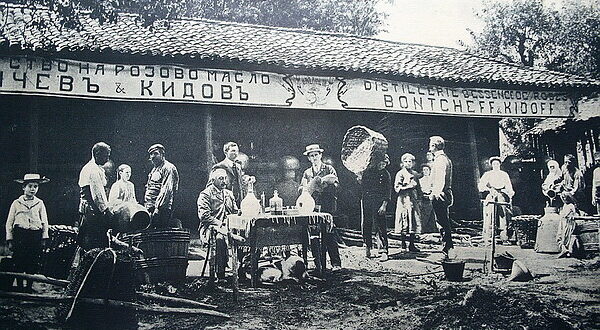
Before the Liberation, rose oil established itself as a valuable Bulgarian export product. Suitable conditions for growing oil-bearing roses were limited, and the demand for rose oil was growing. Trade was dominated by Western European companies, but in the 1870s some Bulgarian companies were also quite successful. They were well-versed in local characteristics, gained knowledge and skills to operate on international markets. The Russo-Turkish War of 1877-1878 caused temporary difficulties, but after it, Bulgarian rose traders continued to be active.
An old problem in the trade in rose oil is its counterfeiting. Pure rose oil, which is an expensive product, is mixed with a cheap one, called tereşe. It is imported from the Ottoman Empire. Even experienced traders have difficulty distinguishing counterfeit from pure rose oil. It is also impossible to establish in what proportion the two oils are mixed. This only happens when the product reaches the end consumer. The rose oil market is extremely delicate in its characteristics. It is influenced by heavy and not always loyal competition, mutual trust and the temptation of everyone along the chain from producer to consumer to mix pure oil with tereşe.
In order to enforce rules at the end of the 19th century, the import of teresh into the country was banned. The expectations were that this would improve the quality of the export product, which would increase the income of Bulgarian producers and traders. The consequences for them were unforeseen and devastating. The government's actions benefited the competitors of Bulgarian exporters, because "indirectly, undeserved suspicion was cast on the commercial honesty of our traders and our rose producers", i.e. the authorities declared to the rest of the world that in Bulgaria everyone associated with rose production were counterfeiters. Experts in the sector write that "foreign traders competing with ours use" the state act "as an official document of the bad faith of our traders". The Bulgarian state unknowingly trapped one of the few market-oriented economic sectors. A possible lifting of the ban on the import of teresh will be a signal to buyers of rose oil to legalize and massify counterfeiting, which will reduce the price of the product. If the ban remains in force, any detection of illegal imports or rumors of such will fuel claims by foreign competitors that Bulgarians adhere to bad trade practices, and the price of rose oil will decrease again.
Another example of unintended consequences is found in the social sphere. In the late 1920s and early 1930s, in the conditions of deflation during the Great Depression, pressure increased for administrative reductions in various prices (flour, yarn, coffee, bread, salt, etc.). With varying success, the state's regulatory bodies met expectations. Since the beginning of the 20th century, state attention to the situation of wage workers and the desire to help them have also increased. There are politicians of the rank of Andrey Lyapchev with sober views. He reminds us that excessive regulation threatens to destroy working factories and that the life of children who work in factories is often better than the life they led outside the factories. However, populism prevails. In April 1929, in the National Assembly, the Social Democrat Iliya Yanulov justified the need to introduce a minimum wage with arguments of a social and nationalist nature. According to him, the minimum wage is “a matter of humanity, a matter of national honor, a matter of national healing.” Another means of supporting wage earners who were affected by the economic crisis of the 1930s was the obligation to pay unemployment benefits.
The combination of administrative suppression of one group of prices (consumer goods), artificial maintenance and subsidization of others (labor) has unforeseen consequences. They are to the detriment of the hired workers, who were supposed to be taken care of. In November 1931, in parliament, the deputy of the ruling majority, Il. Kurtev, reported that when the Main Commissariat for Food Supply raised the issue of reducing the prices of cotton yarn and fabrics, the manufacturing enterprises immediately agreed to reduce the wages of the workers in order to compensate for their losses. In June 1935, the Minister of National Economy, Stoycho Moshanov, noted with disappointment that many employers were trying to reduce the wages of their workers to the amount of assistance paid to the unemployed.
Theory of hope
In the end, there remains hope - vain or not. The concept of unintended consequences has long been present in the social sciences. In the 18th century, Adam Smith anticipated it with his famous phrase about the invisible hand, which makes it so that the selfish interests of individuals unexpectedly lead to favorable results for society. Later, in the mid-19th century, Frederic Bastiat drew attention to the fact that in economic life there are forces and results that are visible, but also those that are invisible. In 1936, the American sociologist Robert Merton systematized the nature and causes of the unintended consequences of social action. His summary shows that unwanted or unexpected results do not always have negative consequences. It is not much, but it is something.