EKIP– Expert Club for Economics and Politics A Different Opinion
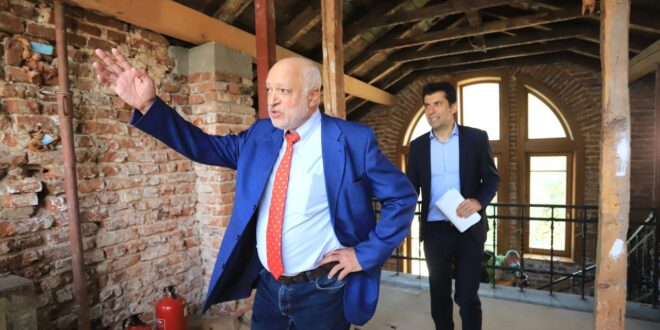
Photo: BGNES
A statement by Acting Minister of Economy Kiril Petkov at the Sofia Arsenal Gallery stirred up the spirits in the cultural sphere a few days ago. Published as shocking news in a headline by clickbait media that all money for culture will be stopped almost from tomorrow and any orchestra or museum that cannot "support itself" will go bankrupt, many people from the sector reacted with insults in other media or with posts on Facebook.
As often happens, it's not about computers, but about compotes. And it's even sadder that in this case the "audience" that confuses the concepts is not the Dinko people who chase migrants, but supposedly the highest intelligentsia in our country, the so-called "people of culture" - directors of museums, theaters, orchestras, and so on.
Acting Minister Petkov himself, at the joint press conference with the Minister of Culture Velislav Minekov, expressed his idea specifically for this gallery for contemporary art. And for it to be a model for future development in this direction. Is it possible that this will eventually happen?
The problem with the reactions against "Culture can support itself" in our country is many, but the main ones, perhaps, lie in the legacy of socialism and in the "fat" in art, i.e. who orders the music.
The legacy of socialism in our country is expressed mostly in the lack of adequate education in the field of cultural management. In Bulgaria, this specialty is indirectly addressed with varying success only in a few universities. It was shocking, for example, when a lecturer in art management at the Plovdiv Academy of Music, Dance and Visual Arts said that it was impossible for culture to support itself. In fact, he should be teaching just the opposite.
The problem with "education", however, is general. This is not about single inadequate statements by incompetent people, but about an overall perception. The mass reactions were "how can a museum support itself only from tickets". In an identical way, we can ask "How can FC Barcelona support itself only from tickets". Well - tickets alone are not enough for them, of course. Because the revenue part in a football club - and in a cultural institution, be it an orchestra, museum, theater or other, includes many different feathers. And the more diverse these feathers are, the freer you are in both the artistic and business part.
The reactions against “culture can support itself” are even more amusing in the context of “Sofia Arsenal”. The gallery itself was renovated and expanded using this method a few years ago – with a project won by the so-called Norwegian Fund. From the point of view of the Ministry of Culture and more generally – the Bulgarian state, the gallery is managing independently, without burdening the state budget. And that is all that “to support itself” means.
In some cases, this “self-support” is 100% and the respective cultural operator is completely independent of the state. On the contrary – in our country there are hundreds of art galleries that present art, support artists on the free market, sell and make happy both artists and buyers, who are not only not “self-supporting”, but on the contrary – they are donors to the state budget. When it is said that there is no orchestra in our country without state support, why is it not commented that there are thousands of wonderful artists who do not receive a single leva from the state, but live more or less well only by selling on the free market? Are artists less artists than viola players?
There are not many, but there are also a few art galleries in our country that are not even on the market – that have permanent exhibitions or hold temporary exhibitions without selling. Such private galleries are the gallery at the NBU UniArt, or the recently opened Djurkovi and Dimitar Georgiev galleries in Plovdiv with wonderful private collections of old Bulgarian art. Just like the galleries that sell art, the last two museum galleries are also donors to the budget, since the entrance tickets they sell are also charged by the state.
There are also many private cultural operators that are partially supported by the state, but do everything possible to increase their budget in various ways. Petar Dimitrov, organizer of the A to JaZZ festival in Sofia, was one of the people of culture who spoke out in support of the idea of self-sustaining culture. He himself admitted that he receives a subsidy from the state, but his goal is to make it smaller and smaller, by attracting sponsors and structuring the budget accordingly. In this way, the cultural product is “independent in the field of creative thought,” as he himself puts it. Unfortunately, this thinking is not widespread in our country – at least not in public speaking. Because whoever pays – orders the music, that is, the more independent you are in financing your creativity, the more independent you are in creativity itself.
In the current situation in our country, whether this percentage of subsidy to various cultural operators can be zero is just a hypothesis. One not-so-popular measure (since differentiated rates have many drawbacks) is reducing or eliminating VAT on culture. But it is still much better to save you 20% of the cost, instead of taking it from you and then returning it to you in the form of “supporting culture”. At least that should be the right-wing economic approach. The other main obstacle to seeing if this is possible is “self-sufficiency” at least in some areas is the lack of an adequate law on patronage. In many countries around the world – not only in the USA – donating to culture is stimulated with the corresponding tax breaks. More simply translated: If the Sevlievo Opera House needs 100,000 leva, then it would be better for the Ideal Standard Vidima factory to give it directly to the opera. Currently, the state takes these 100,000 leva from Ideal Standard in the form of taxes, they are passed on and redistributed to the offices of the Ministry of Culture, and after all the bureaucrats along the way have received their salaries, 80,000 leva are returned to the opera house in Sevlievo. Of course, the example and the figures are made up, but the principle is clear.
There are many more examples around the world, with both smaller cultural operators and entire orchestras (some of which are not permanent) of large companies, such as Lufthansa, or of private universities, private radio stations, museums such as Antonio Gaudi's Casa Vicens building in Barcelona, supported by an Andorran bank. Another example is the Museum of the Florentine Cathedral, Baptistery and Bell Tower – like other similar Italian organizations – a specific structure that is under state control, but rather independent. Every year they publish a public report on income and expenses, from which it becomes clear that even such a huge structure, which carries out extremely expensive restoration and conservation activities, manages to support itself. In 2018, the expenses were 22.6 million, and the income of the so-called Opera – 22.7 million euros, without any state subsidy. On the contrary, the organization paid about 300,000 euros in income tax to the Italian state. Literal comparisons between Bulgaria and one of the most touristic cities in the world cannot be made – but the fact of the transparency of this structure is indicative (to reveal the budget of a Bulgarian public cultural institute is a bit of a feat); it is also indicative for anyone who claims that only chalga can support itself. And this is just one of thousands of similar examples, unfortunately unknown in the Bulgarian cultural management atmosphere.

Naturally, the cultural managers, who were fed up with the idea of “who will give us money”, and who are waiting for a “fat” from the state, jumped at the opportunity to claim that nowhere in the world has culture been self-sustaining. Here I will continue not so much libertarian as classically liberal or moderately right-wing: yes, some cultural institutes need state funding. But this does not mean that fat should flow everywhere, because like everything in the world, the budget of the Ministry of Culture is a limited resource. And if the minister starts giving away money for the opera in Sofia, the operetta in Sevlievo and the symphony in Cherven Bryag, in the end it may turn out that there is no money for the restoration of the crumbling Alexander Tomb or for the Madara Horseman.
The goal of every cultural manager – whether private or public – is to fight for the “self-sufficiency” of the institute entrusted to him, i.e. for its freedom. Unfortunately, in our country, a significant part of the noisy political figures in the public space do not want freedom, but want the fat to not stop. Successful business models that lead to diversification of income are not applied. Museums that work to attract more people, for attractive marketing campaigns, for smaller things, such as a quality souvenir shop, etc. are rare (one obligatory exception to mention is the House of Humor and Satire in Gabrovo).
Ultimately, the goal of every artist who is not just a performer of state propaganda is to be free, to be themselves. Unfortunately, by thinking primarily about where the "fat" drips from, and not about freedom in art, our development will not be enviable. Fortunately, there are also many people who think in the other direction - not so noisy and without being surrounded by loud media, but they still exist, and they work.
And finally, although the above lines are a defense of a quote by the Minister of Economy Kiril Petkov, as well as his colleague in the Ministry of Culture Velislav Minekov, this is not a defense of their activities. No matter how active and ambitious they are, two service ministers should not be concerned with details, such as a specific Sofia gallery. The inadequate hint that the "Sofia Arsenal" could be almost the first self-sustaining gallery in our country should not be overlooked. This is an insult to thousands of other self-sustaining artists in our country, who survive despite the state, and not because of it.