EKIP– Expert Club for Economics and Politics A Different Opinion
Author: Vasil Kanev
The case with the Republic of North Macedonia is becoming increasingly urgent, and solutions are not being offered, despite the changed approach of the new government. Why is the Bulgarian side not understood, what are the Bulgarian interests and what can we change to protect them and resolve the case?
I define myself as a patriot who is interested in history and I decided to analyze the topic mainly, referring to publicly available sources on the Internet. The following lines do not claim to be scientific, but rather are an attempt at an objective analysis of the situation and its causes.
The conflict point.
The essence of the conflict between the two countries lies in the way in which certain historical facts are accepted and interpreted and the consequences of this. The official Bulgarian position demands compliance with all clauses and definitions of the “Treaty on Good Neighborhood” (2017), guarantees of the absence of territorial claims (without demanding a change in the name, for example, of Northwestern Macedonia), a rejection of minority claims, a revision of the curricula and the removal of signs and inscriptions instilling hatred against Bulgarians. For its part, the RSM insists that Bulgaria must recognize the presence of a Macedonian ethnic minority on its territory, to disown some Bulgarian revivalists and to begin to accept them as people with Macedonian self-awareness. Over the years, the fear that all their neighbors have territorial claims to this small country has been instilled in Macedonian society, and its representatives do not miss the slightest opportunity to present themselves as victims.
Bulgarian interest.
We are a people who currently find reasons for pride mainly in history or some sporting achievement (the same is noticeable there). As a result of national catastrophes and state bankruptcies, we are imbued with complexes and malice against all who played a role in these downfalls of ours. But we have always found a way to get out of difficult situations and hold our heads proudly high. It is right that we do it now, with honor and dignity. By the end of World War II, although internally divided, arguing, opposing, we had a national ideal that united everyone. We are proud of the Unification and dream of bringing it to an end, because for everyone at that time this was only the beginning, Macedonia and the Edirne region remained. The model that guides us is the Bulgarian Exarchate recognized by the Sultan in 1870. The Bulgarian nation was formed on its basis. After each unsuccessful attempt at this unification, waves of refugees to Bulgaria and repressions against the rest in their homelands followed. In those years, it was easy to formulate the Bulgarian interest because it was subordinated to the national ideal, but nowadays we do not have such an ideal and probably for this reason different people define this interest in different ways.
However, it is an indisputable fact that, both before and now, we have a public consensus regarding the accession of the Republic of North Macedonia to the European Union. It should be crystal clear to every Bulgarian that it is in our interest for this republic to become part of the EU as soon as possible, which will allow us to strengthen our cooperation, trade, cultural exchange and reduce anti-Bulgarian influence there.
At the same time, we imposed a veto that is supported by all political parties and there is no politician, statesman or public figure who has opposed this act, as it will be instantly anathema to society. But why is that? It is both in our interest to assist in the accession, and we oppose it, and this meets with full support in society?!
When we were on the path to the European Union, a number of conditions were set for us, including from Greece, and we fulfilled them all without complaining. When the Republic of Macedonia took this path (2005), the Greeks were the first to oppose and set conditions, which after difficult negotiations (until 2018) were accepted and the country was renamed from the Republic of Macedonia to the Republic of North Macedonia. Although painful, its citizens accepted it, and probably the years in which international organizations used FYROM (Former Yugoslav Republic of Macedonia) were enough for them to realize that if they did not do so, they would remain isolated.
Our attitude should not be like the Greek one, because these people are our brothers who have remained within the borders of another country. It should not be soft either, because if we unconditionally accept the current republic, then we are doing the European Union a very bad service. Because in North Macedonia they still miss Tito's Yugoslavia, because the power of the Serbian and Russian services is enormous, because repressions are still being carried out against people with Bulgarian self-awareness, because there is no rule of law, because the files of the former services have not been declassified and the atrocities of the communist regime have not been recognized, because propaganda is state policy.
What would be an achievable interest in this complex situation? What new and different can we offer that we haven't tried before? How can we do so that we both don't betray the struggle of our ancestors and accept a compromise with our firm positions in order to reach agreement?
This historic moment gives us the opportunity to achieve our first diplomatic victory since the declaration of Independence, and we must give everything we are capable of. But in order to cope successfully, we must first look at ourselves and our past mistakes, admit what we ourselves are guilty of, and thus find the path to compromise.
Our historical contribution.
This republic now exists because of us, the Bulgarians. We were the first to invent the Macedonian ethnicity in the times when the nation was formed as a concept in these lands (18th century) and we did it through the work of Spiridon Gabrovski - “History in Brief about the Bulgarian Slovenian People”, in which he developed the theory of our ancient origin, reaching the claim that Alexander the Great was of Bulgarian origin. This text, which is kept in St. Petersburg, he based on “History of Slavs and Bulgarians” by Paisius of Hilendar. Probably his motives at that time were connected with the modern, for those times, competition in antiquity. Every ethnicity in these lands strives to prove that it is the most ancient in the Balkans.
There is another theory that everything originated at the end of the 19th century with the publication in Belgrade of "Dictionary of Three Languages" by Georgi Pulevski, through which he tried to distinguish a Macedonian language different from Bulgarian. He later abandoned this initiative and wrote ""Dialbook. Containing the Old Bulgarian Language, and Arranged and Corrected, for the Teaching of Bulgarian and Macedonian Sons and Daughters", in which he accepted the Macedonian dialect as a Bulgarian dialect.
At the end of the 19th century, this concept was embraced by Serbian nationalists, who also had their own appetites for the region, and turned it completely against us. Subsequently, the Yugoslav communists further developed the concept and liquidated all who opposed it, even those who simply did not accept it. Thus, as a result of many years of repression, the Macedonian identity was forcibly imposed on the remaining Bulgarians after the wars.
Driven by excessive pride and self-confidence, due to military victories against the Ottoman Empire, we make a strategic mistake and start the Inter-Allied War, accusing Serbia and Greece of seizing parts of Macedonia and repressing the Bulgarian population there. We all know the disastrous consequences for Bulgaria of this war and one of them is the creation of the Vardar Banovina as part of Serbia and subsequently of the Kingdom of Yugoslavia, which was created after the First World War. Thus, we lose the battle for this region and its population.
Today, this republic is populated by people who identify themselves as Macedonians, Albanians, Turks, Gypsies, and others (under 1% each group). Bulgarians are under 0.1% and are not listed in the Constitution, although the results of the census are expected this year, which may give a slightly different picture.
We also create the revolutionary organization that fights for the freedom of the Bulgarians in the lands that remained under Ottoman rule and we name it VMORO - Internal Macedonian-Edirne Revolutionary Organization. After the First World War and the irretrievable loss of Edirne Thrace, we rename it VMRO.
Nowadays, there are political parties with this name in both countries. However, these parties do not partner with each other, do not like each other and are constantly attacking each other. The local VMRO defends Macedonianism, and ours - Bulgarian nationalism. In the 1990s, a certain split was observed in the Macedonian VMRO, caused by Macedonians with a revived Bulgarian identity, who wanted the republic to become closer to Bulgaria and insisted that this happen politically through the efforts of the VMRO. These people were punished and repressed, and this movement in the party was destroyed.
Our contribution to the creation of this nation is significant and today we are witnessing the results of our historical mistakes. We should not wonder where and why in this republic anti-Bulgarianism is a national doctrine, nor should we be angry with them. It is right that we approach it as an older and wiser brother and find the path to our reconciliation, and this can be done through compromise. But what kind of compromise should it be?
Compromise as a means of diplomatic success.
The Bulgarian position is clear to us, but not to our Western partners. The leading countries in the EU and the USA are putting pressure on our statesmen to compromise, because from a geopolitical point of view it is better for them that North Macedonia becomes a member of the EU. But why don't these partners of ours realize what a time bomb the admission of this country to the Union is, without having reformed and without having removed hate speech from its national policy? It is partly our fault, because it is difficult to convince Western diplomats that the Macedonian nation and language were created, stepping on anti-Bulgarianism. Everyone looks at us with bewilderment when we claim it. We have never managed to convince them that the Yugoslav communist regime carried out repressions against Bulgarians, just because they have the courage to claim that they are.
At the same time, through the official position of the Ministry of Foreign Affairs, we demand the rehabilitation of these victims and the adaptation of textbooks that objectively reflect our common history. We demand it from people who categorically deny that we have a common history. We have also created a historical commission that is supposed to resolve the disputes, but it never succeeds, and even generates new ones. It is also worth noting that our official position does not fully reflect the mood in society. There are many Bulgarians who refuse to accept that a Macedonian nation exists, even though the whole world has already recognized it. So we also have something to work on internally in order to achieve good neighborliness. However, what compromise do we need to set the process in motion?
First of all, we as a society must be tolerant of their desire to be recognized. Only we do not recognize them, even the Greeks recognized them. I do not see why we should not recognize the existence of such people in Bulgaria. There may be a few people, but if they want to have an organization, it is right to allow them, because if we do not do so, convictions in Strasbourg for our country will follow. Regarding the language, it is also obvious to every Bulgarian that it is quite distant from ours and close to Serbian. As of today, this language is very different from Bulgarian. I am sure that we can find a compromise on this topic, as long as the Macedonian side recognizes the historical connection between the two languages. They have worked for so many years to distance Macedonian from Bulgarian that we cannot deny the result. It would be difficult to achieve any change in the name itself, for example to rename it Macedonian-Bulgarian, despite the fact that there are many examples of countries in the EU that speak dialects but do not insist that they speak a different language, such as Austria, Switzerland, and Belgium.
Secondly, we need to tone down our tone and not sound ultimatum-like. Giving ultimatums is not a good-natured attitude. I don't think we have the right to demand a revision of their historiography. This is their internal matter, and it is not urgent. This should not be a reason to stop European integration. We will be able to work on these topics for many years after the RSM becomes a member of the EU.
By retreating, we are actually advancing.
Many Bulgarians are afraid to accept the Macedonian nation as a reality and point to various elements of their historiography, but there is nothing wrong with that, because it will subsequently open up many opportunities for us.
It is common knowledge that over 120,000 citizens of this republic have Bulgarian passports. The procedure for them is easy, because it requires proof of Bulgarian origin, which is easy for almost every Macedonian, and a notarized declaration that the applicant has Bulgarian identity is also required. The wait is long, because checks by our security services are required, which take the most time.
This topic is a major one in Macedonian society, even the resignations of Macedonian statesmen who have such a passport are being demanded, while here “patriots” were found who generated financial income along with this process. However, what does the Bulgarian state gain from this? We know that the people there have been put under an iron lid and have been instilled with a number of untruths or distorted historical facts, and the only way to clear this propaganda is by giving people the opportunity to discover the truth themselves.
There are many examples of Macedonians who, upon setting foot in Bulgaria and learning more about it, discover the truth about their origins. One such example is a beautiful girl named Diana Milicevic, whose father is a Serbian officer and her mother is originally from Shtip. After getting a Bulgarian passport, she begins to study here and discovers more and more truths about history, reaching the realization that she is actually Bulgarian. This happens after spending some time in Bulgaria and without anyone telling her what she is.
But it is not necessary for a Macedonian to live in Bulgaria to revive his self-awareness. An example of such a person is the popular YouTuber Bobby, who grew up in Germany and makes videos on the topic of healthy living and bodybuilding. He was raised as a Macedonian Slav, until at one point he converted to the Orthodox religion and became interested in history. He discovered that he was Bulgarian, even took a DNA test to confirm it, and made several videos on the topic.
Of course, not everyone will discover it on their own, there are those for whom history has no meaning, such are most young people today. I met such an example in a company where I worked. My former colleague is from Delchevo and speaks excellent Bulgarian. He came here to complete his higher education, after which he found a job and bought an apartment. He lives here as a Bulgarian citizen and no one can catch his different nationality, which he, however, holds dear.
During business trips, after a few toasts, I always had the imprudence to raise the topic of his self-awareness and subsequently suffered criticism for this initiative from other colleagues. I wondered how and why this man did not want to dig into the past, discover the truths, find out more about his family. I was annoying and intrusive, something that could not be received well, not only by him, but by almost anyone. If I were him, I would feel uncomfortable. And this man told me - "I don't care what it was like, that's how we learned in school and that's it. I'm not going to change my self-awareness, history doesn't interest me, I want to work, live my life and have fun."
It was hard for me, but I understood it. Today's young people are mostly not interested in history, they are excited by other things, and we, by constantly bringing up history, only intensify their negative emotions. I hope he will soon find a local wife, start a family, and over the years I am sure that the Macedonianism injected into his consciousness will subside. But if his environment constantly teases him about what he is and nags him about this topic, not only will it not subside, but it will also harden.
Therefore, we must be aware of the characteristics of the time in which we live and focus on adequate instruments. Such instruments are market instruments. Nowadays, economic wars are being waged all over the world. And it is no coincidence that the strongest economic state is also the strongest militarily. Strengthening trade will also strengthen cultural exchange. The moment the border falls, many more Macedonians will come here and, like many others before them, they will be surprised by the warm welcome, because they have been nurtured with hatred for Bulgaria and the love we give them surprises and changes them.
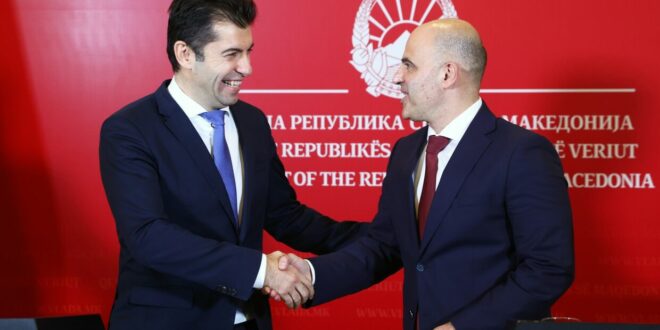
The idea of the new Prime Minister Kiril Petkov to create working groups to seek the benefits for both countries from the future accession is a great one. This approach gave a positive result in the formation of our new government and we can assume that it will also give in the negotiations with the Republic of North Macedonia.
Let's put the economic potential first and then everything else. Let there be joint commissions that come up with common positions and concrete solutions. The only commission that I doubt will come up with a common position is the historical one, and that's why it's good to propose international arbitration. Let historians and linguists from European countries who have studied the history of the Balkans in detail create it and propose a solution, because we will never succeed and we will be spinning in a vicious circle.
The citizens of the Republic of North Macedonia deserve to become part of the European Union and to free themselves from their old dependencies that hold them back on their path to building a modern and free state! Let us help them this time too!
Sources and references:
Bulgarian Exarchate – Wikipedia
Republic of Macedonia name dispute – Wikipedia
Macedonian nationalism - Wikipedia
Brief History of the Bulgarian Slovene People – Wikipedia
Population of North Macedonia - Wikipedia
Macedonians (ethnic group) - Wikipedia
AM I REALLY MACEDONIAN ? | TRUTH ABOUT NORTH MACEDONIA | GREEK , BULGARIAN ?
DNA TEST RESULTS ! My Heritage + GedMatch | North Macedonia
https://www.mfa.bg/bg/news/30248
"A Brief History of the Bulgarian Slavic People" (1792) - Fifth edition, GUTA-N, 2019. Transcription by Mincho Minchev.
"Language dictionary. Containing the Old Bulgarian language, arranged and corrected, for the learning of Bulgarian and Macedonian sons and daughters" Manuscript by Georgi Pulevski 1892.
"Dictionary of Three Languages" - Gjorgjija Pulevski - 1875
The article was originally published on Offnews.